Home » How To Open a High-Risk Merchant Account for an Online Pharmacy
How To Open a High-Risk Merchant Account for an Online Pharmacy
| September 3, 2026
Opening a high-risk merchant account for an online pharmacy starts with proving that your business can legally sell the products you offer in the locations you serve.
Once that is established, you can apply through a chosen high-risk payment provider that works with online pharmacies.
This guide covers how to do all of that — what you need to apply, how to prepare your website and documentation, what to watch out for, and the benefits of signing up with SecureGlobalPay.
QUICK TAKEAWAYS
- Online pharmacies are considered high risk because of card-not-present transactions and compliance with strict licensing, prescription, and dispensing regulations.
- Approval typically requires pharmacy licenses, a compliant website, and healthcare merchant certification or accreditation.
- Processing costs depend on your products, sales volume, average transaction size, chargeback history, and account terms.
- SecureGlobalPay provides a flexible high-risk merchant account and a robust payment gateway for online pharmacies.
What is an online pharmacy merchant account?
An online pharmacy merchant account allows a pharmacy to accept credit cards, debit cards, and other electronic payments for medications and healthcare products sold online. It connects your business to an acquiring bank that approves and processes transactions on your behalf.
Online pharmacies are considered high risk because they must comply with strict licensing, prescription, dispensing, and shipping regulations while processing payments without a physical card present. Fraud, chargebacks, restricted medications, and third-party fulfillment arrangements can create additional concerns for acquiring banks.
For these reasons, pharmacy merchant accounts typically require more extensive underwriting than a standard e-commerce account.
Payment providers will evaluate your business differently depending on what you sell, where and how you operate, and which customers you serve. For example:
- Prescription medications: Require pharmacy licensing, prescription verification, and additional underwriting.
- Over-the-counter medications: Typically easier to approve, although product restrictions and regulatory requirements still apply.
- Compounded medications: Usually receive additional scrutiny because of manufacturing, labeling, and regulatory considerations.
- Controlled substances: Require specialized authorization and compliance procedures, and many processors will not support them — a high-risk merchant account is a must.
- Telehealth and prescription fulfillment: Require review of both the prescribing model and the pharmacy fulfilling prescriptions.
- International sales: Require compliance with the laws of the merchant’s location and the customer’s location.
A processor that supports over-the-counter medications may not necessarily approve prescription drugs, controlled substances, or compounded products. That is because selling prescription weight-loss drugs or compounded medications requires additional licenses, certification, and underwriting (compared to selling less regulated products like vitamins and over-the-counter pain relievers).
Prepare these documents before applying
During application for a high-risk online pharmacy merchant account, you’ll need to prove that your business operates legally, follows applicable pharmacy regulations, and provides a secure, transparent experience for customers.
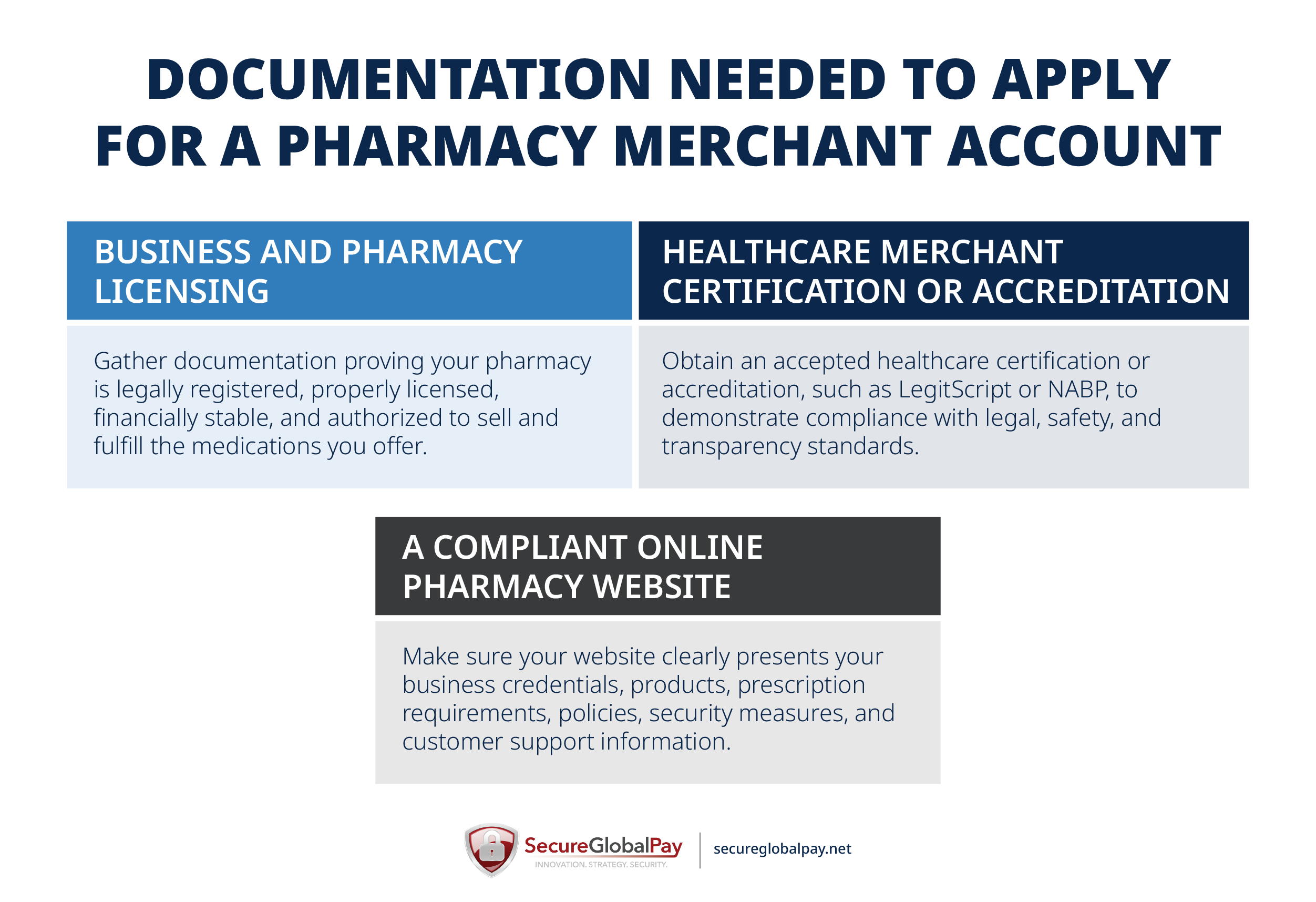
Most acquiring banks evaluate three areas: your licenses, your healthcare certifications, and your website.
1. Business and pharmacy licensing
Your business must have the appropriate licenses for the products you sell and the locations where you operate. Requirements depend on whether you dispense prescription medications, sell over-the-counter products, compound medications, or work with third-party fulfillment pharmacies.
Depending on your business model, you may need:
- Business registration: Documentation confirming your company is legally established.
- Pharmacy license: Authorization to operate a pharmacy and dispense medications.
- Pharmacist credentials: Proof that a licensed pharmacist oversees dispensing and other regulated activities.
- Business bank statements: Help assess financial stability and your ability to cover refunds or chargebacks.
- Previous processing statements (if applicable): Show your transaction volume, sales history, and chargeback rates.
- Product or medication list: Helps underwriters identify restricted products and assess your pharmacy’s risk profile.
- Processing estimates: To establish your expected monthly volume, average transaction amount, and maximum order size.
- Voided check or bank letter: Verifies the bank account where your processing funds will be deposited.
- Additional state licenses: Authorization to serve customers in states where your pharmacy is not physically located, when required.
- Controlled substance registration: Additional authorization if your pharmacy dispenses regulated medications.
- Fulfillment agreements: Documentation identifying any outside pharmacy that prepares or ships prescriptions.
If your business uses telemedicine providers or third-party pharmacies, underwriters may also review their licenses and contractual arrangements.
Don’t waste hours researching every document your pharmacy might require. Most high-risk payment providers, SecureGlobalPay included, offer streamlined online application forms. We will request any missing documentation after reviewing your application. Just be ready to respond promptly to keep your application moving.
For reference, the FDA identifies state licensing, valid prescriptions, and access to a licensed pharmacist as key characteristics of a legitimate online pharmacy.
2. Healthcare merchant certification or accreditation
Many acquiring banks require online pharmacies to obtain certification or accreditation from an independent organization before approving card payments.
Two commonly recognized options include:
- LegitScript Healthcare Merchant Certification: Verifies that healthcare businesses meet applicable legal, safety, and transparency requirements. This is what we typically require for pharmacy merchants that sign up with SecureGlobalPay.
- NABP Healthcare Merchant Accreditation: Evaluates pharmacy licensing, regulatory compliance, website practices, and other healthcare merchant standards.
Before starting an application, ask your payment provider which accreditation it accepts and whether certification must be completed before underwriting.
If you have any questions, do not hesitate to call us at +1-800-419-1772 or send an email to partners@secureglobalpay.net.
3. A compliant online pharmacy website
Your website must clearly explain who you are, what you sell, how customers receive their medications, and how to contact your business.
At a minimum, make sure your website includes:
- Business identification: Your legal business name, physical address, and contact information.
- Pharmacy credentials: Relevant license information and access to a licensed pharmacist.
- Prescription requirements: A clear explanation that prescription medications require a valid prescription.
- Accurate product information: Transparent pricing, appropriate descriptions, and no unsupported medical claims.
- Shipping policies: Expected delivery timeframes, service areas, and fulfillment details.
- Refund and cancellation policies: Clear terms explaining when customers can cancel an order or request a refund.
- Privacy and security policies: Information about how your business protects customer and payment data.
- Secure checkout: An HTTPS connection and appropriate safeguards for online transactions.
- Customer support: A working phone number, email address, or other reliable support channel.
Your website should also match the information provided in your merchant account application. If your application says you sell over-the-counter products, but your website advertises prescription medications, the discrepancy can delay approval or result in a denial.
Steps to open a high-risk merchant account for an online pharmacy
Before applying, make sure you have the basic documentation at hand and that your website covers the details we discussed above.
Once those basics are in place, follow these steps.
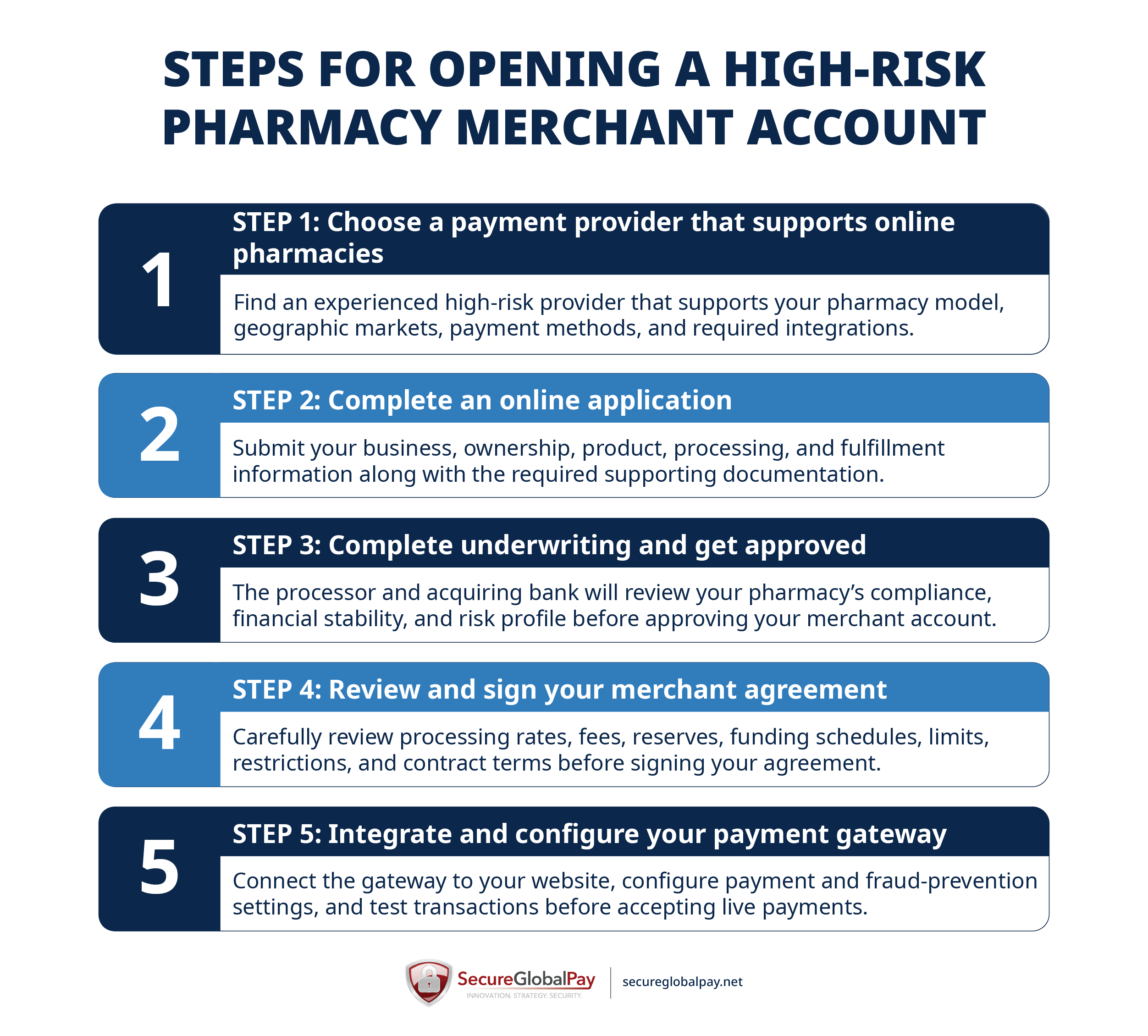
Step 1: Choose a payment provider that supports online pharmacies
Not every high-risk payment provider works with online pharmacies. Some processors accept over-the-counter products but decline prescription medications or compounded treatments.
Look for a provider that understands your pharmacy’s business model and can connect you with an acquiring bank willing to support it. If they have a dedicated page on their website for online pharmacies (like this page), it is more likely they will have a solution for you.
Your chosen merchant services provider should also offer a secure payment gateway that supports your desired payment methods and integrates with the business tools (CRM, billing software, chargeback tools…) you already use.
Lastly, you’ll want to check geographic coverage. Many domestic high-risk merchant account providers operate only in the US. For reference, SecureGlobalPay supports US, Canada, UK, and EU markets.
[lead_magnet_form_2]
Step 2: Complete an online application
Once you have chosen a provider, complete its online merchant account application.

You will typically need to provide the documents we discussed earlier: business details, ownership information, product information, processing estimates, operating locations, and fulfillment arrangements.
After reviewing your application, we will request any additional documentation needed to move your pharmacy through underwriting. Our team might also suggest minor changes to your website if we believe that will increase your approval odds or processing terms.
GET AN ONLINE PHARMACY MERCHANT ACCOUNT
SecureGlobalPay specializes in getting high-risk merchants approved and processing!
Step 3: Complete underwriting and get approved
After you submit your application and supporting documents, the processor and acquiring bank will assess whether your pharmacy meets their legal, financial, and risk requirements.
The acquiring bank may also need to register your business with the card networks. Mastercard requires acquirers to register qualifying non-face-to-face pharmaceutical merchants under specific MCCs (5122 or 5912) and verify their compliance with applicable laws.
Approval times vary based on your business model, certification status, and application completeness. In our experience, it takes between 2 and 5 business days to get approved for an online pharmacy merchant account.
Respond promptly if the underwriter asks questions or requests additional documents — delayed responses are the number one reason for a prolonged approval process.
Step 4: Review and sign your merchant agreement
Once your application is approved, your payment provider will send you a merchant agreement outlining your processing fees, account requirements, and contractual obligations.
Before signing, review the following:
- Processing rates: The percentage charged on each transaction and any additional per-transaction fees.
- Monthly fees: Charges for account maintenance, gateway access, PCI compliance, or customer support.
- Reserve requirements: Whether the processor will temporarily hold a portion of your sales to cover potential refunds or chargebacks.
- Funding schedule: How quickly processed payments will be deposited into your business bank account.
- Processing limits: Your approved monthly sales volume and maximum transaction amount.
- Contract terms: The agreement length, renewal conditions, and any early termination fees.
- Product restrictions: Which medications, services, sales channels, and customer locations your account covers.
Ask your provider to clarify anything you do not understand. A clear agreement helps you avoid unexpected costs and protects your account as your sales grow.
Step 5: Integrate and configure your payment gateway
After signing your merchant agreement, connect your payment gateway to your pharmacy website, e-commerce platform, or ordering system. Depending on your setup and requirements, gateway integration may involve installing a plugin, using a hosted checkout page/embeded forms, or building a custom checkout.
Your payment provider should also help you configure:
- Accepted payment methods: Credit cards, debit cards, ACH transfers, eChecks, or digital wallets, depending on your approval.
- Fraud prevention tools: Address verification, card security code checks, and 3-D Secure authentication.
- Billing descriptors: The business name customers see on their bank statements, which should clearly identify your pharmacy.
- Recurring payments: Automated billing for eligible refill programs or subscription services.
- Reporting and reconciliation: Transaction records, settlement reports, and refund tracking.
- Refund procedures: Clear workflows for issuing refunds and resolving payment disputes.
- Routing and balancing: If you have multiple-merchant accounts connected to the same gateway, we can set up rules for load balancing and smart routing. This helps keep all accounts healthy and under approved thresholds. We can also make sure specific payment methods or transactions (like international payments or sales of a specific product) go through a designated merchant account.
Always run a few test transactions before going live to confirm that payments, refunds, and reporting work correctly. Once everything is configured, you are ready to start accepting payments.
How much does an online pharmacy account cost?
The cost of an online pharmacy merchant account depends on your product mix, associated risks, monthly processing volume, processing history, average transaction size, business location, and customer locations — all of which impact the level of risk your acquiring bank will accept during underwriting.
This is why we can’t give you an exact number before a proper review. However, you can still use the image below to get a broad overview of all possible costs.

For a deeper dive, check out our recent guide on high-risk merchant account fees and rates.
Tips to improve approval odds and keep your pharmacy account in good standing
Maintaining a stable high-risk pharmacy merchant account requires ongoing attention to licensing, customer experience, fraud prevention, and communication with your payment provider.
Follow these best practices to avoid processing interruptions:
- Keep licenses and certifications current: Track expiration dates and renew pharmacy licenses, pharmacist credentials, and healthcare merchant certifications before they expire.
- Maintain a transparent website: Keep product descriptions, prescription requirements, contact information, shipping policies, and refund terms accurate and easy to find.
- Use a recognizable billing descriptor: Make sure customers can identify your pharmacy when reviewing their bank statements.
- Respond to customer concerns quickly: Address delivery problems, billing questions, and refund requests before they turn into chargebacks.
- Track medication shipments: Provide tracking information and delivery updates to reduce disputes caused by delayed or missing orders.
- Use fraud prevention tools: Apply address verification, card security code checks, and 3-D Secure where appropriate.
- Use chargeback management tools: Tools and services like Chargebacks911, Kount, and Chargebee integrate directly with our payment gateway and can help you keep your chargeback rates in check.
- Stay within approved processing limits: Notify your provider before major sales increases or unusually large transactions.
- Report business changes promptly: Seek approval before adding restricted medications, new sales channels, additional fulfillment partners, or international customers.
- Review payment performance regularly: Monitor chargebacks, declined transactions, refund activity, and fraud alerts to identify potential issues early.
A consistent processing history, transparent operations, and controlled chargeback rates can also put you in a stronger position to negotiate better processing terms over time.
Open a trustworthy high-risk pharmacy merchant account with SecureGlobalPay
Finding reliable payment processing should not prevent a legitimate pharmacy from serving its customers. SecureGlobalPay helps licensed online pharmacies, mail-order pharmacies, and other regulated healthcare businesses access merchant accounts designed for their specific products and operational needs.
When you work with SecureGlobalPay, you get:
- Personalized underwriting support: We review your business model and guide you through the application and documentation process.
- A secure payment gateway: Accept online payments with built-in fraud protection, reporting tools, and hundreds of integration options.
- Multiple payment methods: Process credit & debit cards, ACH transfers & eChecks, recurring payments, MOTO transactions, and more.
- Transparent pricing: Most of our clients opt for interchange-plus pricing.
- Scalable solutions: Our setup enables you to manage higher processing volumes, add more merchant accounts, implement smart routing, build custom payment integrations, and more.
- Dedicated customer support: Get assistance with gateway setup, account management, and ongoing payment processing questions. Reach out to your account manager at any time via phone or email.
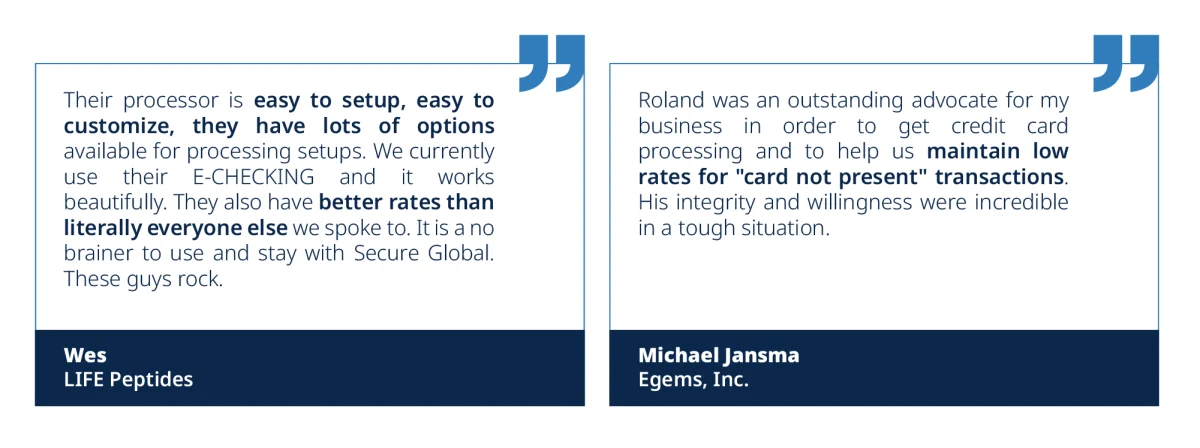
Whether you are launching an online pharmacy, expanding an existing business, or replacing a processor that no longer supports your products, our team can help you find a suitable payment solution.
Apply today or talk to a SecureGlobalPay payment expert if you have specific questions, concerns, or require a more complex processing setup.
FAQs
Not always. Some providers can support in-person and online payments under the same processing relationship. That said, online prescription sales must be specifically approved and often require a separate merchant account.
Yes, provided your payment processor supports HSA and FSA transactions and your business meets applicable eligibility requirements. Some pharmacies may need additional systems (like IIAS) that identify which products qualify as eligible medical expenses.
Yes. Your merchant account can process the patient’s copayment, while the insurance claim and reimbursement are handled separately through the insurer or pharmacy benefit manager.
Yes, if your merchant account is approved for mail-order and telephone-order transactions. Our payment gateway comes with an easy-to-use, secure virtual terminal for entering customer payment information.
Possibly, but every location, website, and business model must be disclosed and approved. You will need separate merchant accounts if different websites sell different products or operate in different jurisdictions.
Possibly, depending on your payment provider, financing partner, product category, and applicable regulations. Some financing companies restrict prescription medications or require additional approval for healthcare merchants.
SecureGlobalPay does offer offshore merchant accounts for eligible international pharmacies. However, an offshore account does not exempt your business from pharmacy licensing requirements, card-network rules, or laws governing the sale and importation of medications.
SecureGlobalPay uses PCI-compliant processing, point-to-point encryption, and tokenization to protect payment card data during and after a transaction. Our gateway also supports AVS, two-factor authentication, and comes with built-in fraud detection tools.

Posted in - High-Risk Payment Processing, Merchant Accounts
Written By
R
Roland G. Szasz
Director of Business Development at SecureGlobalPay
Roland has spent nearly three decades helping businesses navigate the complexities of payment processing. He now works closely with high-risk merchants that have been declined or restricted by conventional providers - and shares his experience and best practices on this blog.
Tailored payment solutions for high-risk merchants
- Domestic and offshore accounts
- Competitive, interchange plus pricing
- No long-term contracts or hidden fees
- Built in fraud protection
- Dedicated account manager; 24/7
Sign up in 5 minutes

A+ Rating
as of 06/17/26
Related Posts