


Home » An Overview of High-Risk Merchant Category Codes in 2026 [List Included]
![An Overview of High-Risk Merchant Category Codes in 2026 [List Included]](https://secureglobalpay.net/wp-content/uploads/High-Risk-MCC-codes-FI.jpg)
An Overview of High-Risk Merchant Category Codes in 2026 [List Included]
| August 11, 2026
A merchant category code, or MCC, is a four-digit number used by payment networks to identify the primary type of products or services a business sells. That’s why a restaurant, a travel agency, a subscription service, and an online gaming business will all receive different MCCs.
An MCC can influence how acquiring banks, payment processors, and card networks evaluate your business. If your business falls under a category commonly considered high risk, you may face higher processing fees, rolling reserves, and delayed funding.
This guide explains how high-risk MCC codes work, provides a list of common high-risk MCC codes, and discusses how this classification affects payment processing. You will also learn how to find your MCC, fix an incorrect code, and answers to other common questions we receive from high-risk merchants.
QUICK TAKEAWAYS
- There is no universal list of high-risk MCC codes that is used by every processor or acquiring bank.
- Some high-risk MCCs require additional registration, documentation, and monitoring from Visa or Mastercard.
- A high-risk MCC can affect approval, pricing, reserves, funding schedules, available payment methods, and who a merchant can sign up with.
- Businesses with high-risk MCC classification can sign up with specialized high-risk merchant services providers to minimize account approval issues.
What are high-risk MCC codes and how do they work?
A high-risk merchant category code is a standard four-digit MCC associated with a business category that a card network, acquiring bank, or payment processor considers more difficult to approve or monitor.
The MCC does not determine risk by itself — it’s just one of many factors underwriters will consider.
Who assigns an MCC?
Your acquiring bank or one of its authorized agents normally assigns your MCC when your merchant account is established. When you take payments through third-party processors like PayPal or Stripe, they evaluate your business and assign the appropriate code for your submerchant account.
Visa requires acquirers and their agents to select the MCC that most accurately describes the merchant’s primary business activity. When a merchant has multiple business lines, the acquirer may use the MCC associated with the highest sales volume or establish separate MCCs for distinct lines of business.
MCC vs MID vs SIC vs NAICS
MCCs are easy to confuse with other business codes and account identifiers. Each system serves a different purpose.
| Term | What it identifies | Who assigns or selects it | Primary purpose |
| MCC | The merchant’s primary type of goods or services | Acquiring bank, authorized agent, or payment facilitator | Card-payment classification, network compliance, transaction reporting, and risk management |
| MID | A specific merchant account or acquiring relationship | Acquiring bank or payment processor | Identifying the merchant account used to process and settle card transactions |
| SIC code | The industry in which a business operates | Government agencies, data providers, or the business, depending on the use | Legacy US industry classification used in some regulatory, reporting, and commercial databases |
| NAICS code | The primary economic activity of a business establishment | The business or a government/statistical agency, depending on the application | Classification of businesses for US, Canadian, and Mexican economic statistics |
How MCCs are used in payment processing
A Merchant Category Code follows the merchant into the payment-processing environment and helps participants understand the type of business behind a transaction. Visa describes MCC data as a tool for activity tracking, reporting, and risk management.
Payment companies can use your MCC for several purposes:
- Merchant underwriting: Acquirers and processors compare your MCC against their risk policies, prohibited-business lists, and underwriting requirements.
- Card-network compliance: Certain MCCs may trigger network registration, transaction data monitoring, or operational requirements.
- Transaction processing: The MCC identifies the merchant’s business category within authorization and clearing data.
- Risk monitoring: Acquirers and card networks can use MCC data to group and monitor transactions associated with particular industries.
- Pricing and interchange: Merchant category can be one factor used when applying interchange categories and processor pricing, although transaction type, card type, sales channel, and the merchant agreement also affect the final cost.
- Product and feature eligibility: Some payment methods, transaction types, and processing features are limited to — or excluded from — particular MCCs. For example, eligibility for some pre-authorization capabilities can depend on the merchant’s MCC.
Because the MCC affects several parts of the processing relationship, your assigned code should accurately reflect what your business primarily sells.
Is there an official high-risk MCC code list?
There is no universal high-risk MCC code list that applies to every payment processor, acquiring bank, or card network.
Visa and Mastercard do identify specific merchant categories that require additional registration, due diligence, or monitoring. However, your MCC is only one part of the classification. Underwriters will also review your business model, products and services, sales channels, operating locations, processing history, and more.
As a result, two merchants with the same MCC may receive different approval decisions, reserves, processing limits, and pricing.
Visa and Mastercard use a largely standardized set of four-digit MCCs, many of which are based on ISO 18245. However, each network maintains its own MCC documentation, assignment rules, and risk programs, so classifications and compliance requirements are not always identical. Also, new MCCs are continuously created for emerging business categories.
A list of common high-risk MCC codes
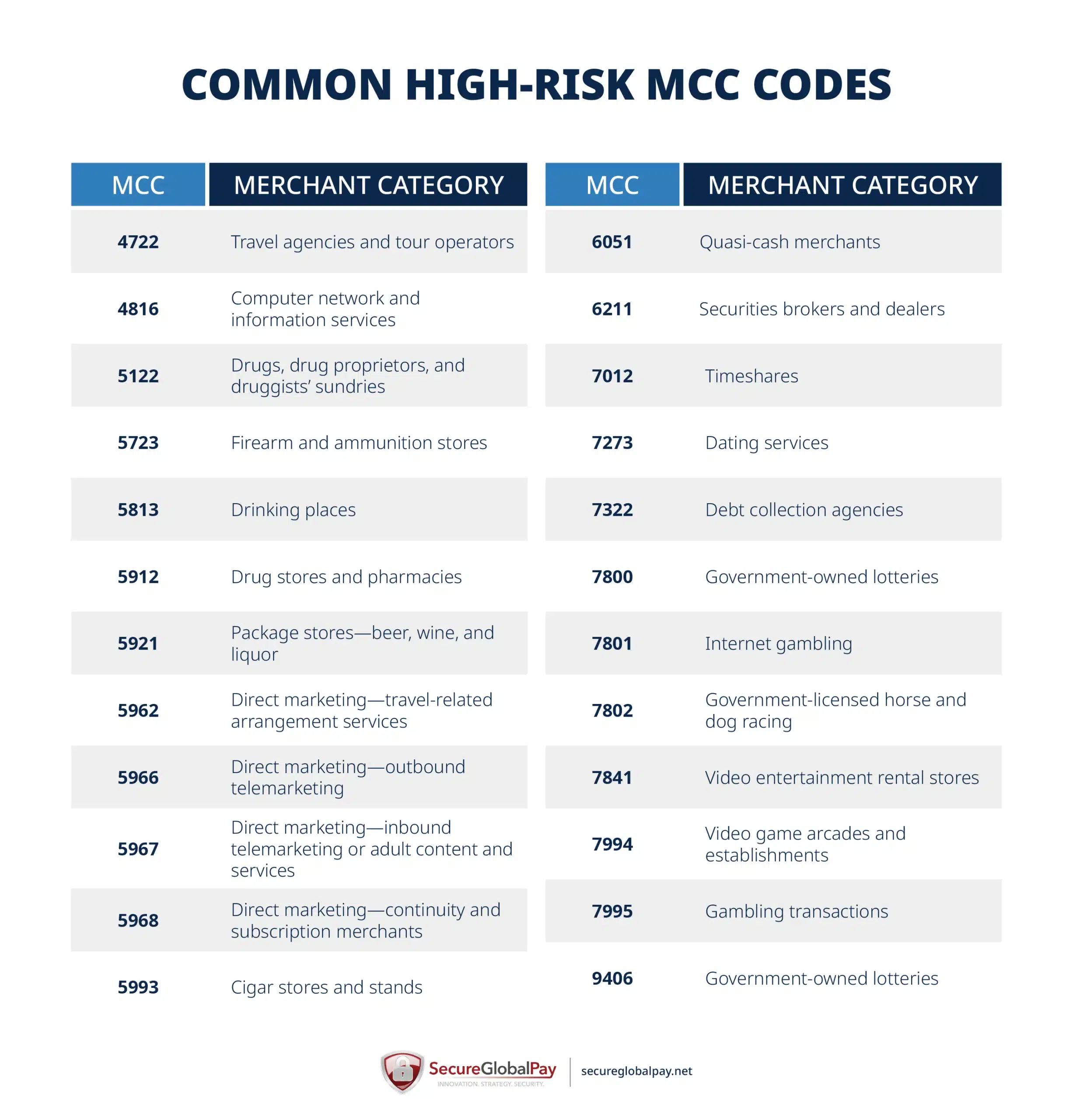
The following high-risk MCC codes list covers business categories that frequently receive additional scrutiny during underwriting.
Important note: Inclusion in this table does not mean every merchant using the respective MCC will automatically be classified as high risk. Some MCCs cover broad categories, and additional requirements may apply only to a specific activity, sales channel, product, or jurisdiction.
Here’s a quick list in the form of a graphic, followed by a table with additional information.
| MCC | Merchant category | Common business examples | Card-network registration required? |
| 4722 | Travel agencies and tour operators | Travel agencies, tour companies, and vacation-booking services | No, but acquirer or processor requirements may still apply |
| 4816 | Computer network and information services | Cyberlockers, file-sharing platforms, and online information services | Mastercard: Required for high-risk cyberlocker merchants |
| 5122 | Drugs, drug proprietors, and druggists’ sundries | Pharmaceutical wholesalers and online pharmaceutical suppliers | Visa and Mastercard: Applies to qualifying non-face-to-face pharmaceutical merchants |
| 5723 | Firearm and ammunition stores | Gun shops, ammunition retailers, and online firearms sellers | No, but MCC use is conditional on applicable law |
| 5813 | Drinking places | Bars, taverns, nightclubs, taprooms, and some breweries | No, but acquirer or processor requirements may still apply |
| 5912 | Drug stores and pharmacies | Retail pharmacies, online pharmacies, and some Canadian recreational cannabis merchants | Visa and Mastercard: Applies to qualifying non-face-to-face pharmaceutical merchants |
| 5921 | Package stores — beer, wine, and liquor | Liquor stores, wine shops, and online alcohol retailers | No, but acquirer or processor requirements may still apply |
| 5962 | Direct marketing — travel-related arrangement services | Discount travel clubs, subscription travel services, and direct-response vacation sellers | No, but acquirer or processor requirements may still apply |
| 5966 | Direct marketing — inbound telemarketing or adult content and services | Inbound teleservices, subscription websites, streaming platforms, and adult-content businesses | Visa and Mastercard: Applies when the MCC is used for adult content or services |
| 5968 | Direct marketing — continuity and subscription merchants | Subscription boxes, recurring physical-product programs, and negative-option offers | Mastercard: Applies to qualifying negative-option billing merchants selling physical products |
| 5993 | Cigar stores and stands | Online tobacco, cigar, nicotine, vape, and electronic-cigarette sellers | Mastercard: Applies to non-face-to-face tobacco-product sales |
| 6051 | Quasi-cash merchants | Cryptocurrency exchanges, foreign-currency sellers, and money-order businesses | Mastercard: Applies to cryptocurrency merchants; VIRP requirements may also apply |
| 6211 | Securities brokers and dealers | Online brokers, foreign-exchange trading services, and investment platforms | Mastercard: Applies to specified high-risk securities activities; Visa requirements must be confirmed with the acquirer |
| 7012 | Timeshares | Timeshare sellers, rental programs, and exchange services | No, but acquirer or processor requirements may still apply |
| 7273 | Dating services | Dating platforms, matchmaking services | No, but acquirer or processor requirements may still apply |
| 7800 | Government-owned lotteries | US state and government lottery operators | Mastercard: Applies to government-owned lotteries in the US and US territories |
| 7801 | Internet gambling | Licensed online casinos and online sports-betting operators in the US | Yes, Mastercard (Visa generally requires online gambling transactions to use MCC 7995) |
| 7802 | Government-licensed horse and dog racing | Licensed online horse-racing and dog-racing wagering services in the US | Yes, Mastercard (Visa generally requires online gambling transactions to use MCC 7995) |
| 7841 | Video entertainment rental stores | Video rental services and certain non-face-to-face adult-content businesses | Mastercard: Applies when the MCC is used for non-face-to-face adult content or services |
| 7994 | Video game arcades and establishments | Skill-game platforms, fantasy competitions, and games offering valuable prizes | Mastercard: Applies to qualifying skill-game merchants |
| 7995 | Gambling transactions | Online casinos, betting operators, lottery-ticket sellers, and race-track wagering | Visa and Mastercard: Applies to qualifying online or non-face-to-face gambling merchants |
| 9406 | Government-owned lotteries | Government lottery operators outside the US under Mastercard’s classification | Mastercard: Applies outside the US and US territories |
Mastercard publicly lists the MCCs and merchant activities covered by its Specialty Merchant Registration Program. Visa requires acquirers to register merchants classified under the Visa Integrity Risk Program, or VIRP. The complete MCC and activity mapping is maintained in the separate VIRP Guide, available through Visa Access (its client portal).
Card-network registration means that the acquiring bank must formally report and enroll the merchant in a Visa or Mastercard risk program before processing the applicable transactions. For merchants, that usually means additional documentation, compliance controls, potential registration fees, ongoing monitoring, and continuing disclosure obligations.
High-risk vs restricted vs prohibited categories
High risk, restricted, and prohibited labels describe different levels of payment-processing eligibility. The terms are not perfectly standardized, so a business that one provider accepts may appear on another provider’s list of restricted or prohibited businesses.
A prohibited category may still be legal — just not supported by particular payment processing providers.
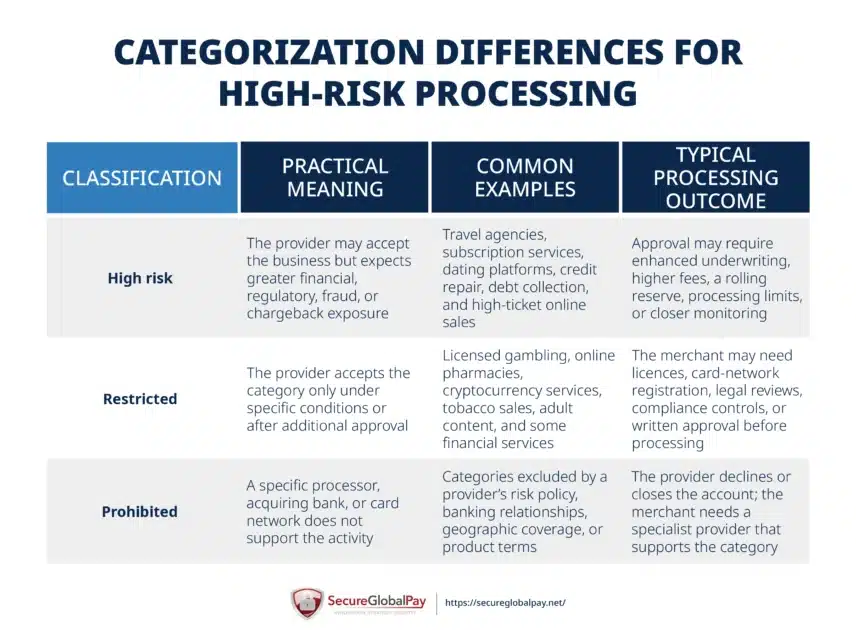
Stripe is a great example. It has a strict list of prohibited and restricted businesses. If you are on that list, you can’t use Stripe, but you can still process payments by opening a high-risk merchant account with a specialized provider like SecureGlobalPay.
A high-risk MCC is not the same as being listed in Mastercard’s MATCH system. The MCC describes the business category, while MATCH allows banks and processors to identify merchants that were previously terminated and the associated reason.
Ways to find your MCC code
Your MCC may not appear prominently in your payment dashboard. You can usually find it through your processor, transaction records, or merchant-account documents.
Follow these steps to find your MCC code:
- Check your merchant statement: Review your monthly processing statement for a field labeled “MCC,” “merchant category,” or “merchant type.”
- Review your processor dashboard: Some processors display the MCC in your business profile, account settings, tax information, or transaction details.
- Contact your processor or acquiring bank: Ask support to confirm the four-digit MCC assigned to your merchant account. Request written confirmation if the classification affects underwriting or compliance.
- Check transaction data: MCC information may appear in payment API responses, gateway reports, cardholder transaction records, or issuing-bank data.
- Compare the code with your actual business activity: Review the official MCC description and confirm that it accurately represents the products or services generating most of your payment volume.
- Check each merchant account separately: A business with multiple MIDs, websites, locations, or acquiring relationships may have more than one MCC.
Public MCC lookup tools can help you understand what a code means, but they cannot confirm which MCC your processor has assigned. Your acquiring bank or payment processor is the authoritative source for your account’s classification.
What should you do if your MCC code is incorrect?
If your MCC does not accurately describe your primary business activity, ask your payment processor or acquiring bank to review and correct it.
Describe what your business actually sells, how customers place orders, and which activity generates most of your card revenue. Explain whether the original code was assigned incorrectly or your business model has changed since the account was opened.
If you operate distinct business lines, websites, storefronts, or payment flows, the processor may recommend a separate MID and MCC.
For example, a hotel that operates a separately branded restaurant with its own point-of-sale system may need a lodging MCC for the hotel and a restaurant MCC for the dining business.
Do not intentionally use/request an inaccurate MCC to avoid higher fees, underwriting, registration, or monitoring requirements. Deliberate miscoding can lead to account suspension, withheld funds, termination, and concerns about transaction laundering. If your MCC is wrong, request a formal correction through your processor or acquiring bank.
Get reliable payment processing for any high-risk venture
SecureGlobalPay is an all-in-one high-risk merchant services provider that helps hard-to-place merchants get approved, open an account, and start processing. We’ll pair you with compatible acquiring banks, prepare your application for underwriting, and give you all of the tools and technology you need to take and process payments.
Businesses that sign up with SecureGlobalPay get access to:
- Domestic and offshore merchant accounts: We will find an acquiring relationship that fits your industry, location, processing volume, and risk profile.
- High-risk payment gateway: Accept online payments through a modern gateway with recurring billing, virtual terminal capabilities, multiple integrations, and built-in fraud-prevention tools.
- Chargeback and fraud support: Use fraud filters, transaction controls, and chargeback-management tools to reduce avoidable losses and protect your merchant account.
- Multiple payment channels: Process e-commerce, mobile, retail, recurring, MOTO, ACH, and eCheck payments, depending on your approval and business type.
- Flexible funding options: Qualified merchants may be eligible for same-day or next-day funding.
- Dedicated US-based support: Each client gets an industry veteran as their support manager, whom you can get in touch with via phone or email.
- Help preparing for underwriting: SecureGlobalPay can help you organize the documents, policies, processing records, and compliance information that acquiring banks may request.
An accurate MCC and a properly structured application can reduce delays, prevent classification problems, and improve your chances of finding a processor that supports your business.
Apply with SecureGlobalPay and get a payment processing partner that will always have your back.
Written by Roland G. Szasz - Director of Business Development - 25+ years in payment processing.
Roland has spent nearly three decades helping businesses navigate the complexities of payment processing. He now works closely with high-risk merchants that have been declined or restricted by conventional providers - and shares his experience and best practices on this blog.
Frequently asked questions
Visa and Mastercard use largely standardized four-digit MCCs, so most codes describe the same business category across both networks. However, each network maintains its own documentation and may apply different assignment, registration, and compliance requirements to the same MCC.
Yes. A merchant may have multiple MCCs when it operates clearly separate business lines, locations, merchant accounts, or payment flows.
Yes. Your processor or acquiring bank can correct or update your MCC if the original classification was inaccurate or your primary business activity changed. The provider may request updated product information, sales data, licenses, or other documents and may reassess your pricing, reserves, and underwriting requirements.
A high-risk MCC can reduce your chance of being approved by standard banks and PayFacs like Stripe and PayPal. You can minimize approval issues by signing up with high-risk merchant services providers like SecureGlobalPay.
As one of many underwriting factors, a high-risk MCC can make merchant account approval more difficult and may lead to higher processing fees, rolling reserves, slower funding, transaction limits, closer chargeback and fraud monitoring, and fewer processor or payment-method options.
Your MCC may change if your primary products, services, sales channel, or revenue-generating activity changes. Tell your processor before making a major business-model change so it can review your classification, update your MCC, or establish a separate MID.
Visa’s Integrity Risk Program, or VIRP, groups covered businesses into three tiers. Tier 1 covers activities where illegal conduct could cause significant harm to people’s health, safety, or well-being; Tier 2 covers activities that could cause financial or economic harm; and Tier 3 covers activities with an elevated risk of regulatory noncompliance or deceptive marketing. Covered merchants require registration and enhanced oversight through their acquirer.
Mastercard’s Specialty Merchant Registration Program requires an acquiring bank to register certain merchant types before processing their transactions. Depending on the category, the merchant may need to provide licenses, ownership information, legal opinions, proof of jurisdictional compliance, and evidence of controls such as age or location verification.
Covered activities include certain adult-content, gambling, pharmaceutical, tobacco, cryptocurrency, securities, cyberlocker, lottery, skill-game, and negative-option businesses.

Tailored payment solutions for high-risk merchants
- Domestic and offshore accounts
- Competitive, interchange plus pricing
- No long-term contracts or hidden fees
- Built in fraud protection
- Dedicated account manager; 24/7
Sign up in 5 minutes

A+ Rating
as of 06/17/26