


Home » Is a Third-Party Payment Processor, Gateway, or Merchant Account Right for You?
Is a Third-Party Payment Processor, Gateway, or Merchant Account Right for You?
| August 10, 2026
Choosing a payment processor is not just about transaction fees. You also need to decide what type of payment processing relationship makes sense for your business.
Third-party payment processors such as Stripe, PayPal, and Square make it easy to start accepting payments because they typically let merchants process under a shared or aggregated merchant account structure. A traditional merchant account works differently: your business is individually underwritten and receives its own dedicated processing account.
Neither model is automatically better. The right choice depends on your sales volume, industry, average transaction size, risk profile, integration requirements, and how much control you need over your payment infrastructure.
This guide explains how third-party payment processors work, lists top providers for different use cases, and shows when you may be better served by a dedicated merchant account.
QUICK TAKEAWAYS
- Third-party payment processors make it easier to start accepting payments by letting you process through their broader payment infrastructure instead of opening your own dedicated merchant account.
- Providers such as Stripe, PayPal, Square, and SumUp are convenient for many small and low-risk businesses, but often come with heavy account restrictions, holds, and sudden termination risk.
- The best provider depends on your business model, transaction volume, average ticket size, payment methods, integration needs, and risk profile.
- A dedicated merchant account can be a better fit if you process higher volumes, need more customized terms, or want a processing relationship built specifically around your business.
- High-risk merchants are better served by specialized providers that can set them up with a dedicated high-risk merchant account and gateway.
What are third-party payment processors?
A third-party payment processor is a payment service provider that lets your business accept electronic payments without setting up its own dedicated merchant account with an acquiring bank. Providers such as Stripe, Square, and PayPal are the most well-known examples.
You may also hear third-party payment processors called payment aggregators or, depending on the provider's legal and operational structure, payment facilitators (PayFacs).
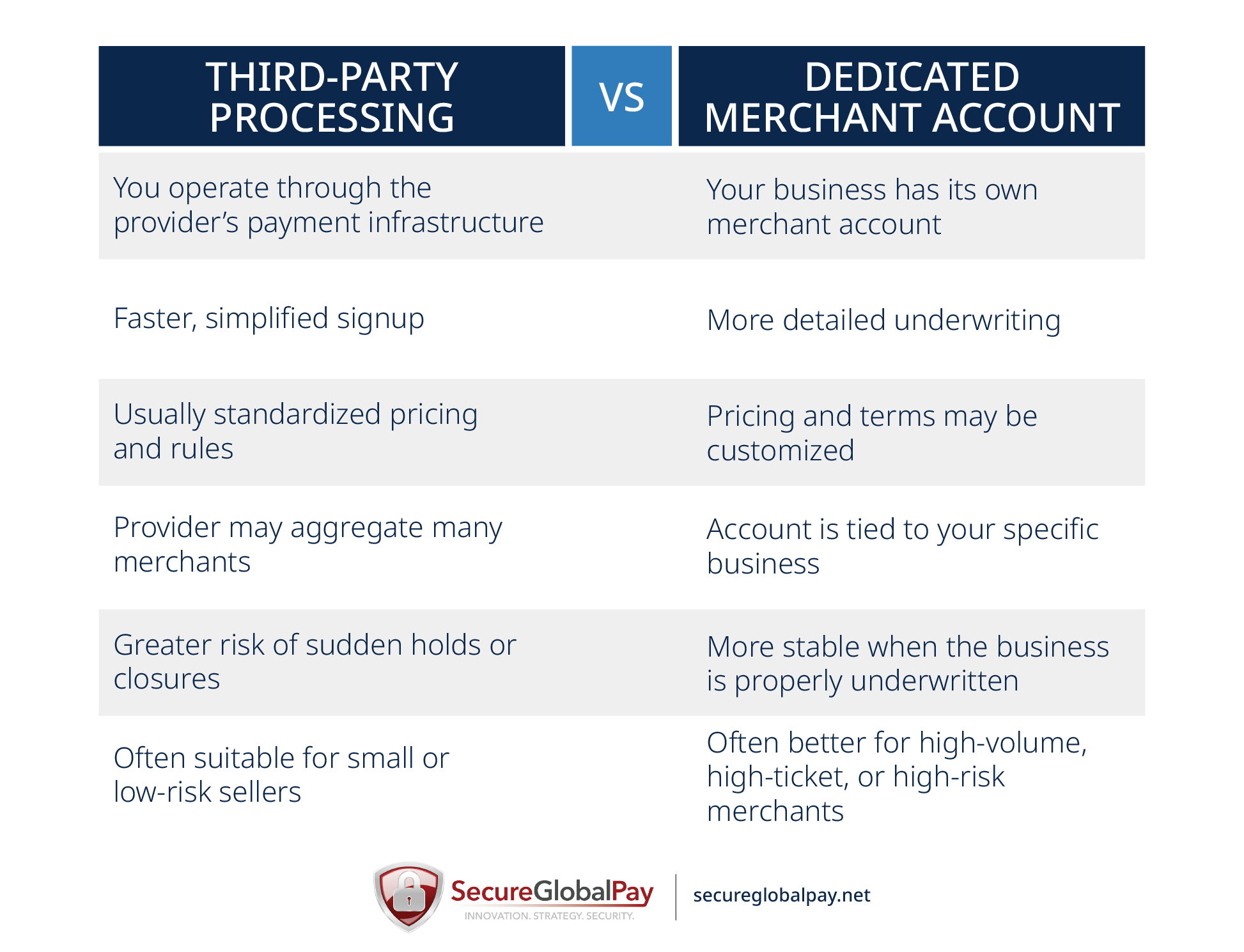
The main alternative to this model is opening a dedicated merchant account. Your business applies through an acquiring bank or merchant services provider, undergoes individual underwriting, and receives a merchant account established specifically for your business.
How do third-party payment processors work?
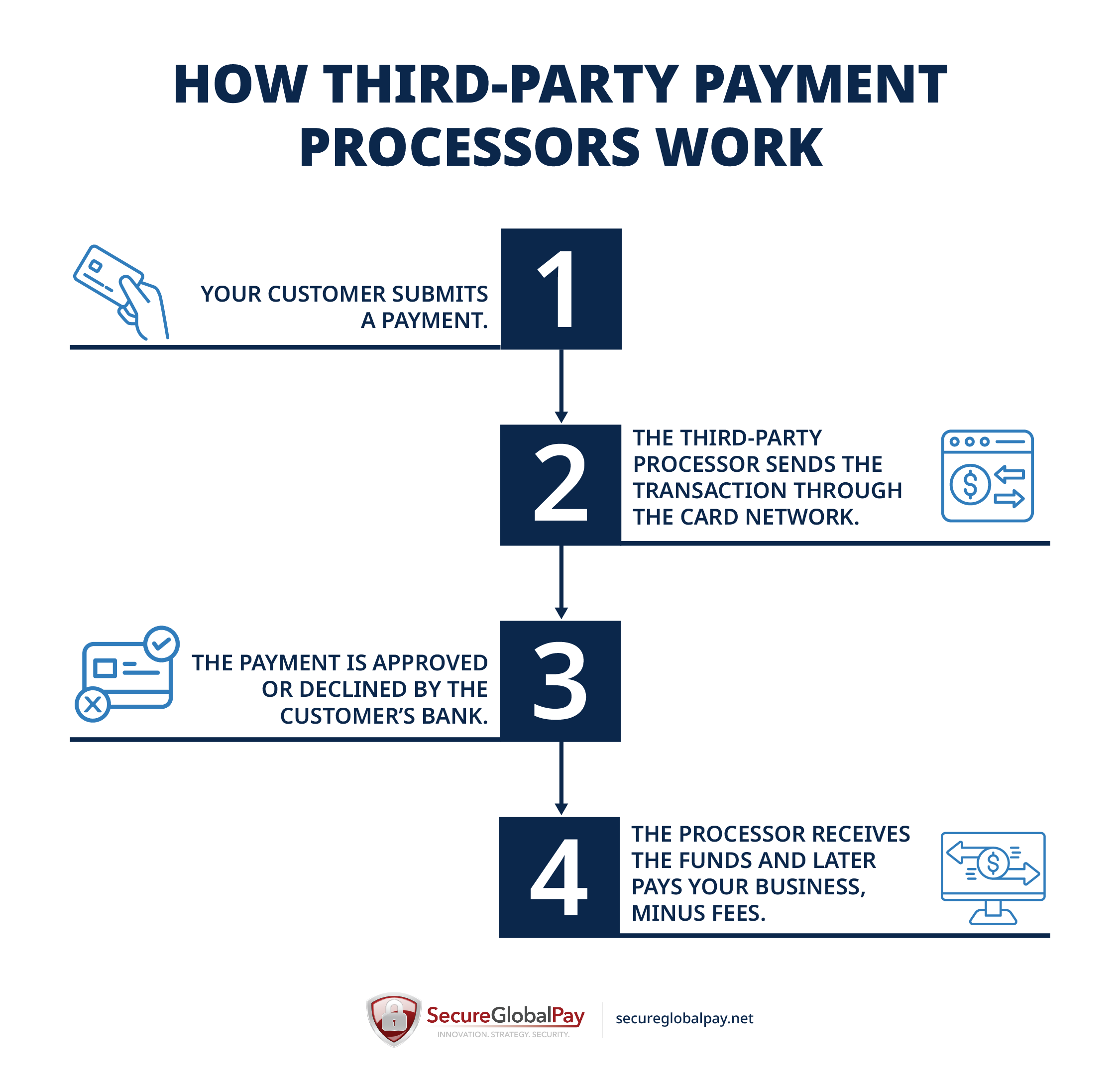
Third-party payment processors simplify payment acceptance by handling much of the infrastructure and acquiring relationship that you would otherwise need to arrange separately.
You sign up with the provider, connect its payment tools to your website, app, or point-of-sale system, and receive payouts to your business bank account.
In a payment facilitator model, the provider maintains a master merchant account and processes transactions for merchants operating as sub-merchants beneath that account. This allows merchants to accept payments without establishing their own direct merchant account relationship with an acquiring bank.
Third-party processors also commonly bundle technology that you might otherwise source from multiple vendors. Depending on the provider, this can include hosted checkout pages, payment gateways, APIs and SDKs, recurring billing, tokenization, fraud screening, payment links, reporting dashboards, dispute management, POS software, and payout tools.
A list of popular third-party payment processors
Third-party payment providers range from general-purpose platforms such as Stripe and PayPal to more specialized services focused on ecommerce, bank payments, SaaS, or higher-risk industries. The exact account structure also varies, so do not assume every provider below operates under an identical PayFac model.
| Provider | Notable payment features | Pricing model | Main limitation |
| Stripe | Cards, digital wallets, 100+ payment methods, hosted checkout, subscriptions, payment links, invoicing, fraud prevention, APIs, and in-person payments | Pay-as-you-go transaction pricing; custom and interchange-plus pricing available for eligible larger merchants | A sizeable list of prohibited and restricted business categories |
| PayPal | PayPal wallet, card processing, Venmo in the US, Pay Later, invoicing, subscriptions, POS, virtual terminal, and fraud tools | Transaction-based pricing that varies by payment method; custom pricing available for eligible high-volume merchants | Fees vary significantly by payment method and country; does not work with high-risk merchants |
| Square | POS hardware and software, ecommerce, invoices, payment links, virtual terminal, Tap to Pay, subscriptions, and APIs | Primarily flat-rate transaction pricing, with paid software plans and custom options for some larger merchants | Focus on small and midsized businesses; available in a relatively small number of countries |
| SumUp | Card readers, Tap to Pay, POS, payment links, invoicing, online payments, bookings, and business-account tools | Pay-as-you-go flat-rate processing or optional subscription plans with lower transaction rates; custom pricing may be available at higher volumes | Primarily designed around small-business payment acceptance rather than highly customized or complex enterprise setup |
| Shopify Payments | Integrated Shopify checkout, Shop Pay, cards, wallets, local payment methods, multi-currency payments, fraud analysis, and Shopify POS | Processing rates depend on your Shopify subscription plan, card type, and market | Only available to eligible Shopify merchants and cannot be used independently of the Shopify commerce platform |
| Mollie | Cards, European local payment methods, payment links, recurring billing, invoicing, online checkout, and in-person payments | Pay-per-transaction pricing with no standard monthly commitment; volume-based and IC++ pricing available to larger merchants | Primarily focused on European merchants, so it is not as universally available as some global providers |
| Amazon Pay | Amazon-account checkout, cards stored in Amazon accounts, recurring payments, fraud protection, and ecommerce integrations | Transaction-based processing and authorization fees, with additional cross-border charges where applicable | Mainly functions as an additional ecommerce checkout option rather than a complete omnichannel payment platform |
| GoCardless | Direct Debit, ACH & echecks, recurring payments, one-off bank payments, payment recovery, APIs, and accounting integrations | Pay-as-you-go percentage-plus-fixed-fee pricing, with higher-tier and custom plans available | Focuses primarily on bank payments rather than general-purpose credit card processing |
| Airwallex | Card acceptance, 160+ local payment methods, multi-currency payments, subscriptions, payment links, local acquiring, fraud controls, and APIs | Transaction-based card and payment-method fees, with rates varying by market and payment type | Its broader platform is geared toward international and technology-driven businesses; often overkill for local merchants |
| Wise Business | Card payment links, invoices, QR-code payments, multi-currency balances, international transfers, and currency conversion | Percentage-based card-processing fees with different rates for domestic, international, and business cards | Payment acceptance is more limited than full-service processors such as Stripe or PayPal and is closely tied to the Wise Business account |
| Paddle | Checkout, recurring billing, subscription management, global payments, fraud management, tax calculation and remittance, and revenue recovery | All-inclusive percentage-plus-fixed-fee pricing, with custom pricing for larger businesses | Paddle operates as a merchant of record, rather than a conventional payment aggregator; focus on SaaS businesses |
| CCBill | Card processing, payment gateway, recurring billing, fraud tools, and specialized processing for higher-risk industries | Its PSP model uses flat-rate pricing | Integration limitations; generally associated with business models that need additional risk management and underwriting |
Pros and cons of third-party payment processing
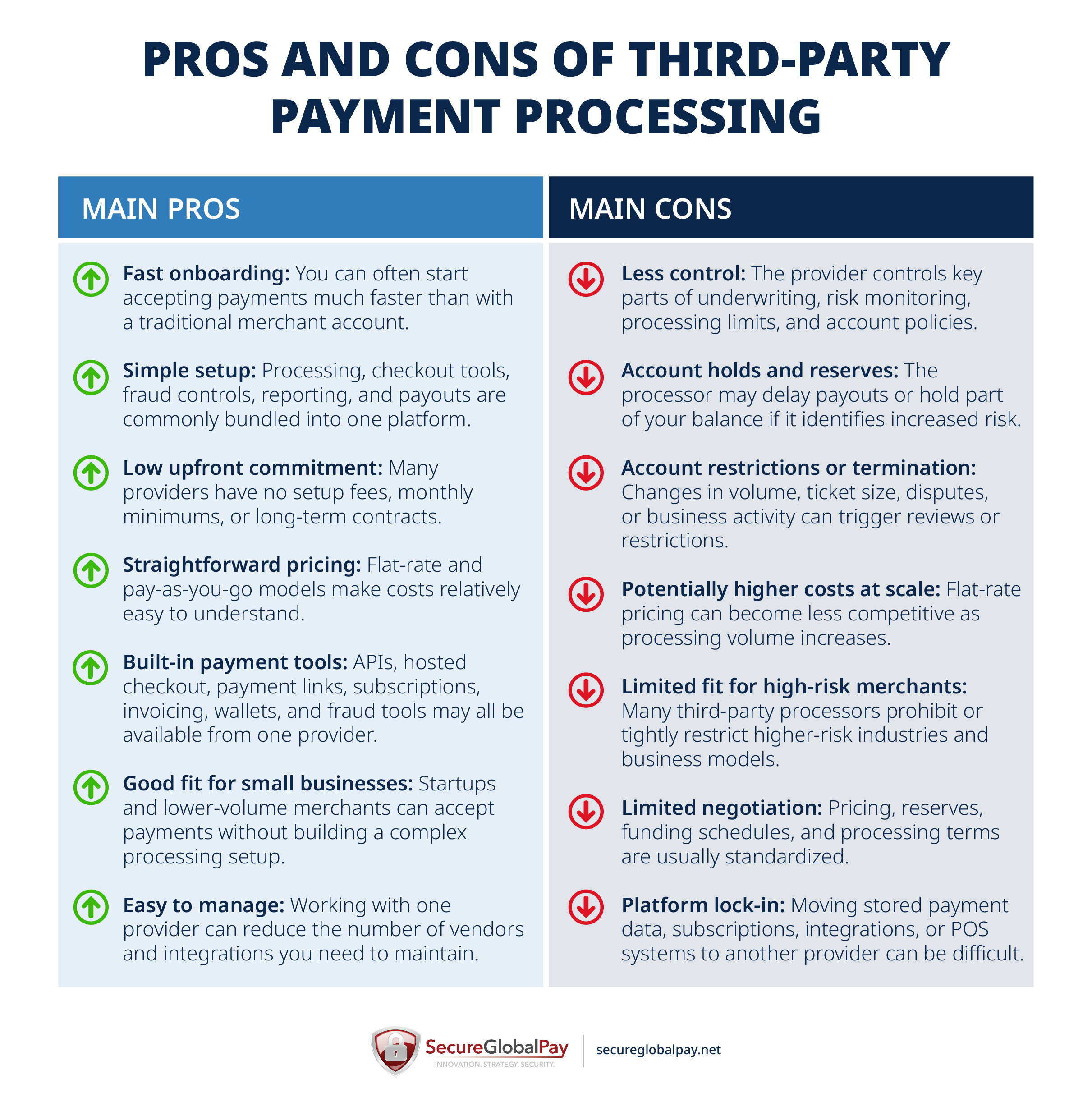
The main advantage of third-party payment processing is convenience. It’s relatively easy to start accepting payments, and you often get access to checkout tools, fraud controls, reporting, payouts, subscriptions, and other features in one platform. For small, low-risk, or growing businesses, this can reduce setup time, upfront costs, and the number of vendors you need to manage.
The main disadvantage is reduced control over your processing relationship. Third-party processors set their own underwriting standards, restricted-business policies, payout rules, processing limits, and risk thresholds. If your transaction volume, average ticket size, dispute rate, or business model changes, the provider may review your account, impose a reserve, delay payouts, or restrict processing. Flat-rate pricing can also become less competitive at higher volumes, and merchants in high-risk industries may find that mainstream aggregators are not a good long-term fit.
The best third-party payment processors across different use cases
There is no single best third-party payment processor for every business. The right provider depends on what you sell, how customers pay, where you operate, your transaction volume, your technical requirements, and how much payment risk the provider is willing to accept.
Before choosing a processor, compare its restricted-business policies, transaction and recurring fees, supported payment methods, integration options, payout schedule, fraud and chargeback tools, customer support, and rules around reserves or account holds. You should also consider how easily you could move to another provider if your processing needs change.
If your business is in the high-risk category, payment aggregators are a poor fit for you. Instead, look for high-risk merchant services providers like SecureGlobalPay. We can provide you with both domestic and offshore merchant accounts and a powerful payment gateway with hundreds of integrations, AI-fraud tools, and a multi-MID setup.
Here are some practical starting points for common use cases:
- General online payments and custom integrations → Stripe or Airwallex: Stripe is a strong option for ecommerce, SaaS, marketplaces, and businesses that want extensive APIs and developer tools. Airwallex is similar, with a stronger focus on cross-border operations, global accounts, FX, and moving money internationally.
- Small retail stores, restaurants, and service businesses → Square or SumUp: These two are particularly useful when you need in-person payments alongside relatively simple online payment tools.
- Businesses that want PayPal and wallet-based checkout → PayPal: PayPal is a natural choice when you want customers to pay using PayPal, Venmo in the US, cards, digital wallets, Pay Later, and other payment methods.
- Shopify sellers → Shopify Payments: Like AmazonPay for merchants that sell mostly on Amazon, Shopify Payments is generally the simplest starting point for eligible merchants that already run their store on Shopify. If you’re not eligible, look for a high-risk Shopify payment processor.
- European ecommerce businesses → Mollie: Mollie is worth considering if you have an ecommerce business and primarily sell in Europe.
- Recurring bank payments and memberships → GoCardless: GoCardless is particularly useful when customers pay by Direct Debit or other bank-to-bank methods rather than cards.
- SaaS and digital products that want tax handled for them → Paddle: Paddle can be a good fit when you want a provider to manage payments, subscription billing, sales tax, fraud, and related compliance. However, keep in mind that Paddle is a merchant of record, not simply a conventional third-party payment processor.
- Higher-risk online and subscription businesses → CCBill: CCBill may be worth considering when you are a high-risk merchant and do not have any specific integration requirements.
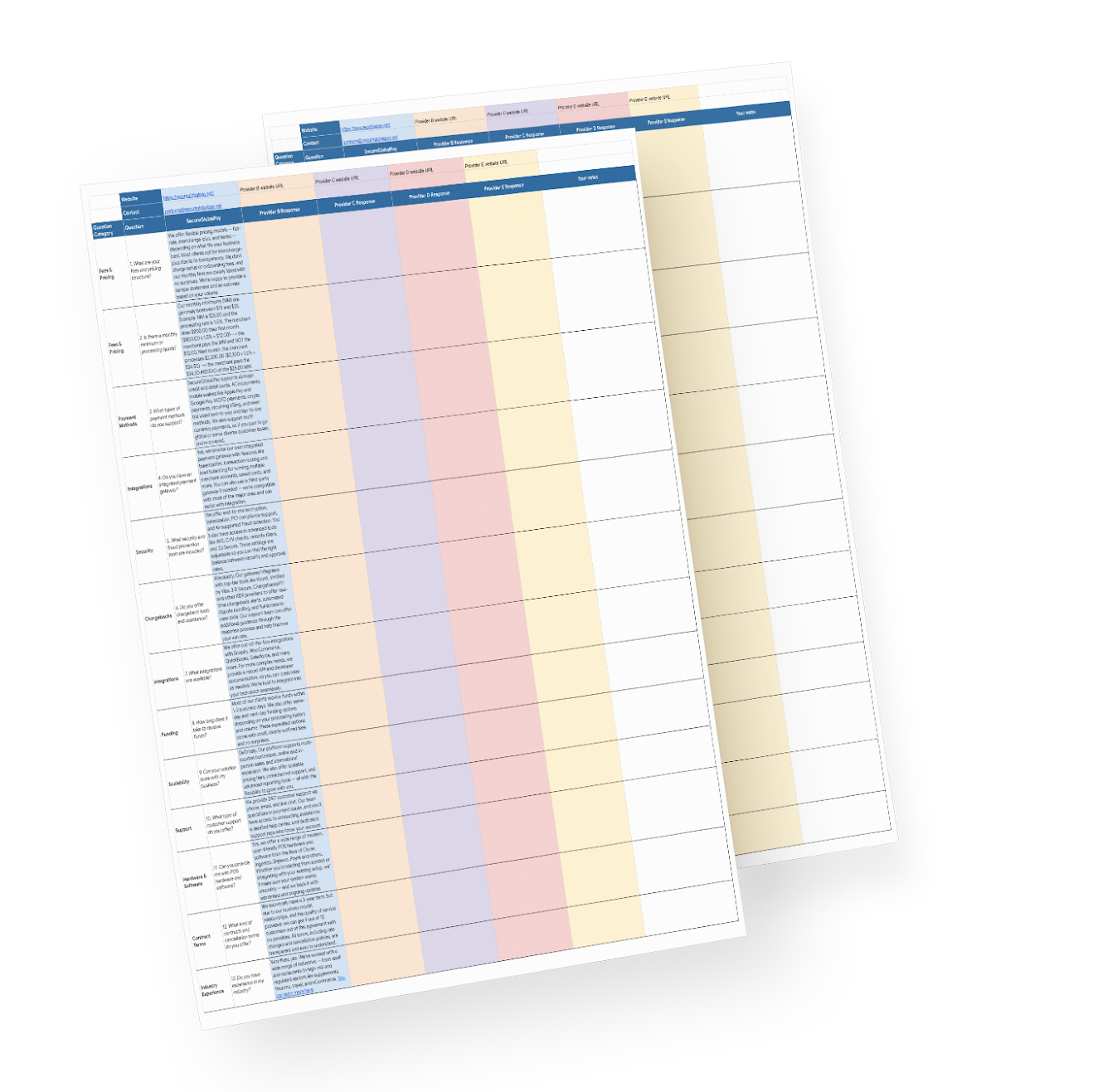
Free Template for Comparing Merchant Service Providers
Our Google Sheet template arms you with 13 critical questions you should ask each provider to catch red flags and cut through the sales talk — with SecureGlobalPay’s answers already filled in for comparison.
How to find a reliable third-party payment gateway
A third-party payment gateway is payment technology supplied by an outside provider that securely transfers transaction information between your checkout or point-of-sale system and the organizations involved in processing the payment.
Depending on the setup, the gateway may be purchased separately from your merchant account or bundled with one.
Payment gateways come in several configurations. The right option depends largely on whether you already have a merchant account and how much control you need over your payment setup.
| Gateway type | How it works | Examples |
| Standalone payment gateway | You use the gateway for payment technology while maintaining a separate merchant account or processing relationship | Authorize.net, NMI |
| Full-stack payment platform | The same provider supplies the gateway along with payment processing and other payment services | Braintree, Adyen |
| White-label gateway | A merchant services provider, ISO, SaaS platform, or other partner offers gateway technology under its own service relationship | NMI is commonly offered as a white-label gateway through payment providers |
| Gateway bundled with merchant services | A merchant services provider arranges your merchant account and gateway together, giving you one provider to work with for setup and support | SecureGlobalPay and many other merchant services providers |
If you already have a merchant account and only need a payment gateway, SecureGlobalPay can provide you just the gateway. Most merchants, however, choose to sign up for both, as it simplifies setup and may even reduce processing fees.
Get a high-risk merchant account and gateway from SecureGlobalPay
SecureGlobalPay is a good fit if your business has outgrown mainstream third-party processors or does not fit comfortably within their risk policies.
That includes high-risk and hard-to-place merchants, high-ticket and high-volume businesses, merchants that have previously been declined or had an account frozen, and businesses that need more flexibility than a standard aggregated processing setup can provide.
SecureGlobalPay works with retail and high-risk merchants across the US, Canada, the EU, and the UK. You’ll get a robust payment-processing setup. Depending on your needs, that can include:
- High-risk merchant accounts: Domestic and offshore merchant account options.
- Payment gateway: Online checkout, recurring billing, virtual terminal functionality, real-time reporting, fraud controls.
- Multiple merchant accounts: Multi-MID support with intelligent routing and load balancing for high-volume merchants and complex processing requirements.
- Multiple payment methods: Credit and debit cards, ACH, eCheck, digital wallets, MOTO payments, and other payment options.
- Integrations: Connections with 200+ ecommerce platforms, shopping carts, CRMs, billing tools, and fraud and chargeback solutions.
- Risk management: Tokenization, point-to-point encryption, AVS, 2FA, fraud detection, and chargeback-management tools.
- Personal support: Every merchant receives a dedicated account manager who can assist with setup, processing issues, and account management.
Get a merchant account and gateway built for your business. Apply with SecureGlobalPay or talk to a payment expert to discuss your processing requirements and available options.
Written by Roland G. Szasz - Director of Business Development - 25+ years in payment processing.
Roland has spent nearly three decades helping businesses navigate the complexities of payment processing. He now works closely with high-risk merchants that have been declined or restricted by conventional providers - and shares his experience and best practices on this blog.
FAQs
“Third-party merchant account” is typically used to describe an aggregated merchant account, where your business processes payments as a sub-merchant under a payment facilitator or payment service provider rather than receiving its own dedicated merchant account.
SecureGlobalPay offers dedicated high-risk merchant accounts, not an aggregated, third-party merchant accounts.
SecureGlobalPay can arrange offshore high-risk merchant accounts, but these are dedicated merchant account arrangements rather than typical third-party or aggregator accounts.
Common warning signs include:
- Unclear business eligibility: The provider does not clearly explain prohibited or restricted industries.
- Little upfront review: Nobody asks about your products, ticket size, volume, fulfillment model, or processing history.
- Vague hold and reserve policies: You cannot determine when funds may be withheld or delayed.
- Hidden or confusing fees: Important charges are difficult to identify before signing up.
- Unclear termination rules:<span style=”font-weight: 400;”> The agreement provides little guidance about what can trigger restrictions or account closure.
- el=”</yoastmark”>”1″>Poor support access: There is no clear way to reach a knowledgeable person when funds, disputes, or account reviews become an issue.
No. Zelle is a bank-to-bank payment network, not a third-party card processor such as Stripe, PayPal, or Square. It allows enrolled users to send money directly between eligible US bank accounts, and some participating financial institutions also allow small businesses to receive payments through Zelle.
ADP is primarily a payroll, HR, and workforce-management provider, although some ADP products facilitate payroll payments, bill payments, invoicing, and other money movement. It is not considered a third-party merchant payment processor like Stripe, Square, or PayPal.

Tailored payment solutions for high-risk merchants
- Domestic and offshore accounts
- Competitive, interchange plus pricing
- No long-term contracts or hidden fees
- Built in fraud protection
- Dedicated account manager; 24/7
Sign up in 5 minutes

A+ Rating
as of 06/17/26