


Home » All You Need to Know Before Opening a High Ticket Merchant Account

All You Need to Know Before Opening a High Ticket Merchant Account
| May 19, 2026
A high-ticket merchant account is used by businesses that regularly process large transactions. These merchant accounts are built to handle the additional risk that comes with larger payments, monthly volumes, and longer delivery timelines.
Traditional processors and third-party payment aggregators (Stripe, PayPal…) may suddenly freeze funds, impose rolling reserves, or terminate accounts altogether when transaction size and volume exceed their comfort level.
This is why specialized high-risk merchant services providers like SecureGlobalPay exist in the first place — offering tailored solutions for high-ticket businesses.
QUICK AND EASY ONLINE APPLICATION
Work with a high-risk merchant account provider that always has your best interests at heart
If you’re here to learn how high-ticket classification and payment processing work and how to open an account, please scroll below.
What counts as a “high ticket” in payment processing?
In payment processing, the term “high ticket” generally refers to businesses that process transactions with large order values. However, there is no universal threshold. What one processor considers a high ticket sale may be perfectly acceptable to another, depending on the industry, business model, processing history, and overall risk profile.
For example, some providers may classify businesses with average transaction sizes above $500 as high ticket, while others may only apply the label when transactions regularly exceed $2,000.
Typical characteristics of high-ticket businesses include:
- High average transaction values: Many high-ticket businesses process individual sales ranging from $500 to $ 2,000 or more per transaction.
- Large monthly processing volumes: It is common for these businesses to process anywhere from $50,000 to hundreds of thousands of dollars per month.
- Longer fulfillment timelines: Products or services are often delivered weeks or months after payment is collected, which increases financial exposure for processors.
- Elevated chargeback exposure: Larger transactions naturally create a higher dispute risk, and even a small number of chargebacks can represent substantial losses.
As you can imagine, many businesses fit such criteria:
- Coaching and consulting: Business coaching programs, executive consulting, online education packages, and mentorship programs often involve payments of $2,000–$20,000+.
- Luxury goods: Jewelry, designer watches, high-end fashion, collectibles, luxury vehicles, and premium electronics frequently involve large transaction amounts.
- Travel and hospitality: Luxury travel packages, destination weddings, private tours, yacht charters, and premium vacation bookings are often considered high ticket because of their price and the fact that payments are collected long before services are delivered.
- High-end ecommerce: Businesses selling premium furniture, specialized equipment, custom products, or luxury home goods often process large individual orders. They often need a high-risk eCommerce merchant account to help cover the product price.
- Medical and wellness services: Cosmetic procedures, dental treatments, wellness programs, and elective medical services commonly involve high-value upfront payments.
- Certain B2B products and services: Software implementations, industrial equipment, manufacturing services, and enterprise consulting contracts may involve very large invoices and recurring payments.
Because of these factors, high-ticket businesses should work with a high-risk merchant services provider that can ensure stable processing despite larger transactions, larger volumes, and additional risk exposure.
Why are high-ticket merchant accounts considered high risk?
It is important to understand that being classified as “high risk” does not mean a business is fraudulent or untrustworthy. The term simply refers to businesses that present a higher level of financial exposure to banks and payment providers.
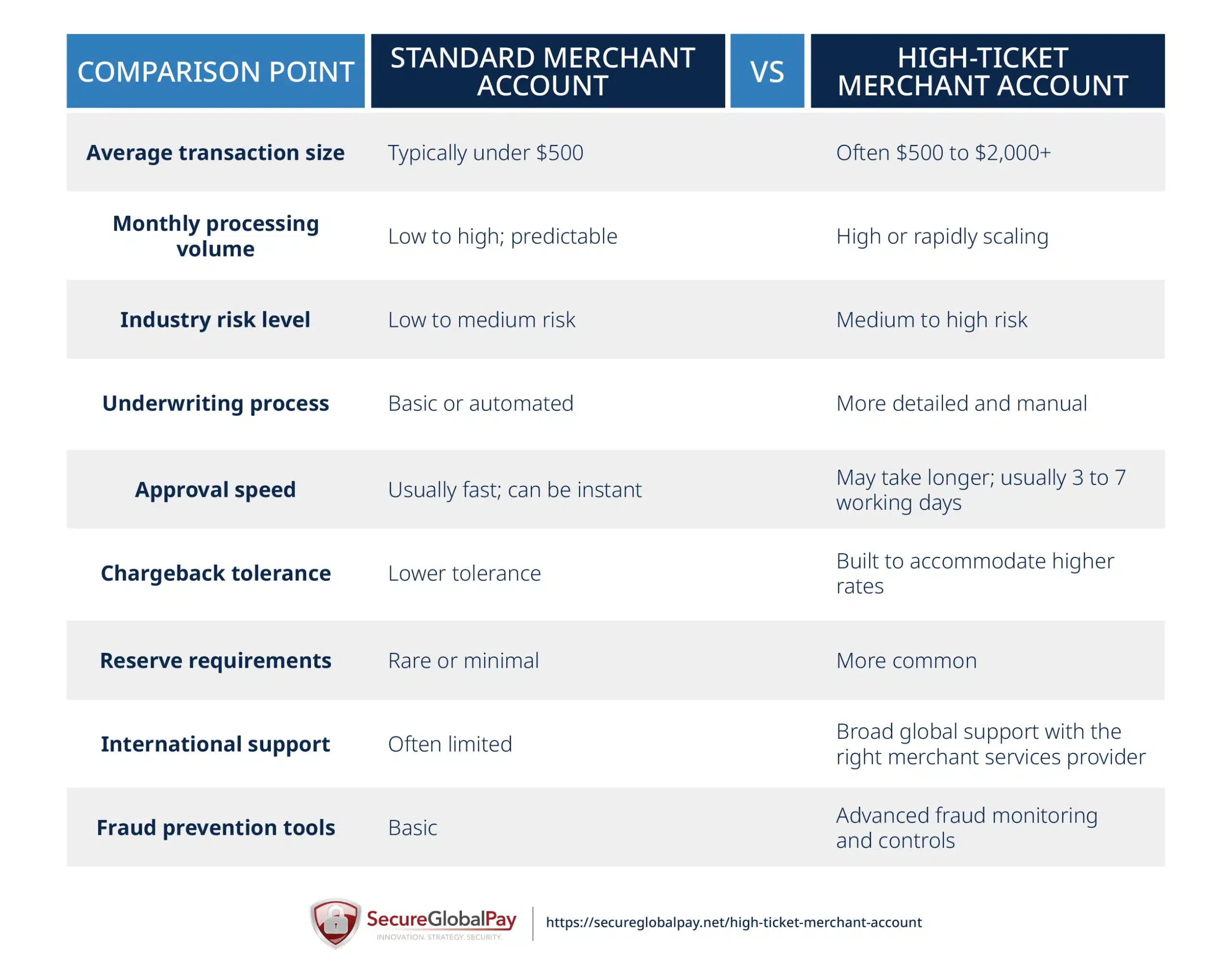
High-ticket businesses naturally attract more scrutiny because a single disputed transaction can result in a significant financial loss. When large payments are combined with delayed product delivery or international transactions, processors often categorize the merchant as high risk.
Because of that, many high-ticket merchants face longer approval times, higher processing fees, rolling reserves, or stricter compliance requirements compared to standard businesses.
However, there are also important advantages to working with providers that specialize in high-risk processing. You get access to stronger fraud prevention systems, better chargeback management tools, support for multiple payment methods, and broader international processing capabilities.
High-risk merchant account providers like SecureGlobalPay can offer greater account stability. That’s because we have relationships with acquiring banks that support more complex business models and larger transaction volumes. We also proactively monitor your account and will work with you to open and set up additional merchant accounts to ensure you do not blow through approved processing thresholds.
How to open a high-ticket merchant account
Since processors are evaluating financial exposure and operational stability, high-ticket merchants should expect a more lengthy underwriting process. Working with a high-risk provider that is familiar with your industry can make the process significantly smoother.
Here are the basic steps for opening a high-ticket merchant account:
- Define your processing needs: Before applying, determine your expected monthly processing volume, average transaction size, target markets, and preferred payment methods. This helps match your business with a provider that can realistically support your growth without processing limitations.
- Prepare your business documentation: Most high-risk providers will request documents such as business registration records, bank statements, processing history, identification documents, supplier information, and a working website.
- Ensure your website is compliant: Payment processors carefully review merchant websites during underwriting. Your website should clearly display refund policies, terms and conditions, contact information, shipping or fulfillment timelines, and secure checkout functionality.
- Submit your application online: These days, most providers allow you to sign up using an online merchant application form.
- Review pricing and reserve terms carefully: High-ticket accounts may include rolling reserves, volume caps, or customized pricing structures. It is important to fully understand the processing fees, reserve conditions, settlement timelines, and any potential restrictions before signing an agreement.
- Integrate your payment gateway and begin processing: Once approved, the provider will help configure the payment gateway and connect it to your e-commerce platform, accounting, and other solutions you might be using. Some providers, including SecureGlobalPay, offer integrated solutions that combine payment processing, gateway services, and fraud prevention tools in one setup.
When evaluating high-risk processors or merchant service providers, watch out for red flags such as unrealistic approval promises (the “instant approval” messages), vague pricing structures, unclear reserve requirements, and slow customer support. A reliable high-risk processor should be transparent about fees, risk controls, and account expectations from the beginning.
Why high-ticket and high-volume merchants avoid payment aggregators
We work with many high-ticket businesses that signed up with us only after their PayPal, Stripe, or Square accounts had been terminated (a few of them just became sick of fund holds and account freezes).
Here is the type of inquiry we get multiple times a year that illustrates this problem perfectly (it’s an actual email we got):
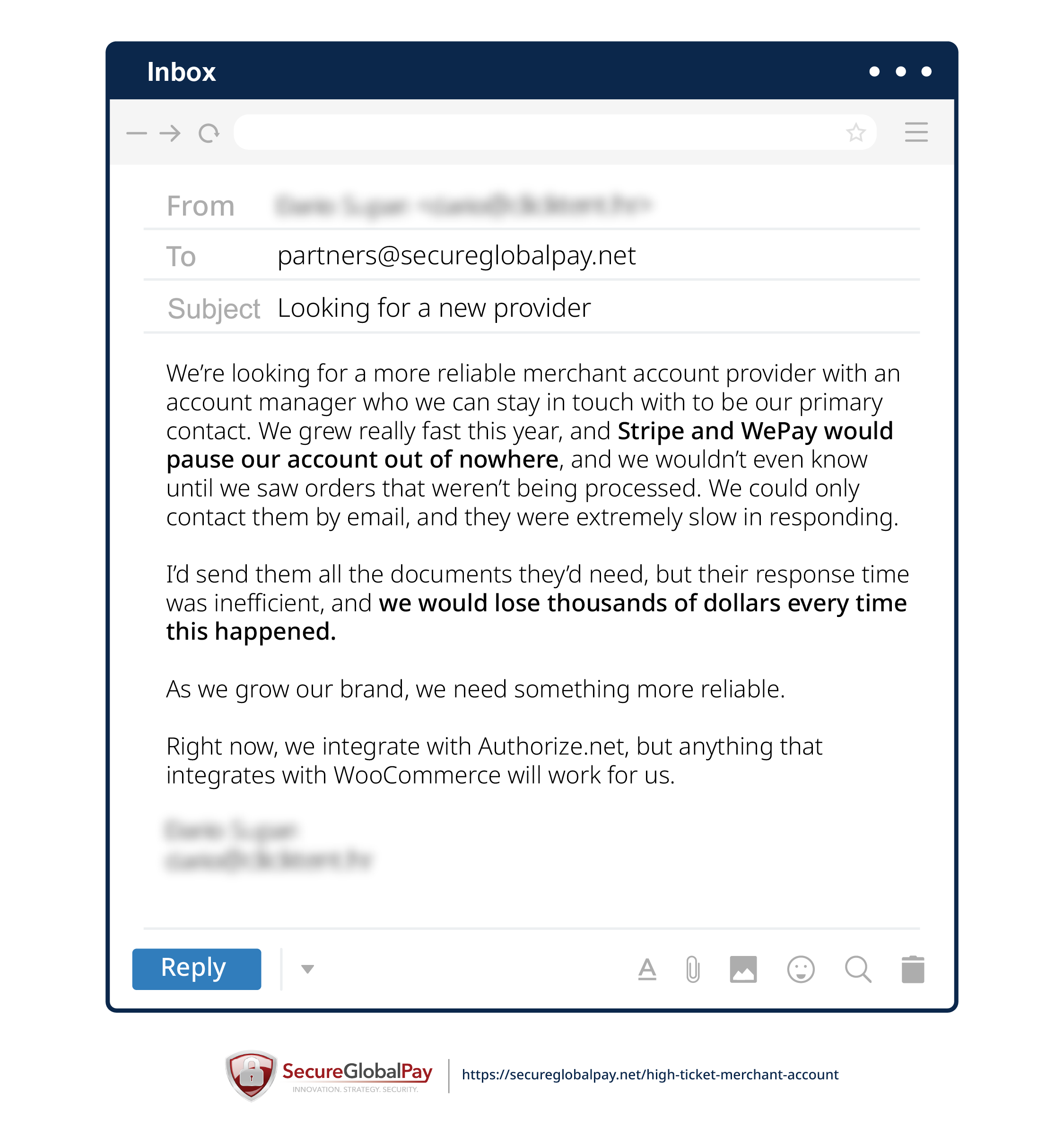
This merchant had to learn the lesson the hard way — but you do not.
Before we wrap things up, let us also mention that there is a third option. Some high-ticket businesses also choose to process payments through a Merchant of Record (MoR) provider.
In this model, the MoR technically becomes the seller of record and handles payment processing, tax compliance, fraud management, and certain regulatory responsibilities on behalf of the merchant. While this can simplify operations for some international businesses, it also means the merchant gives up much of the control over the customer relationship, payment experience, and fee structure.
Here is a quick comparison table.
| Feature | Dedicated high-risk merchant account | Payment aggregator (PayFac) | Merchant of record (MoR) |
| Account ownership | Dedicated account under your business | Shared master account | MoR owns the transaction |
| Underwriting process | Manual and customized | Mostly automated | Managed by MoR |
| Stability for high-ticket merchants | High | Often unstable | Moderate |
| Risk of sudden freezes | Lower | High | Lower |
| Disputes and fraud management | Merchant controlled | Platform controlled | Mostly managed by MoR |
| Payment customization | Flexible | Limited | Moderate |
| Fees | Customized | Standardized | Usually higher overall |
| Brand & customer control | Full control | Full control | Partial control |
| Best suited for | Any high-ticket businesses | Low-risk businesses that need simplicity | Global SaaS or digital businesses |
For most high-ticket and high-volume merchants, a dedicated high-risk merchant account remains the most reliable long-term solution.
Why high-ticket merchants choose SecureGlobalPay
Selling expensive products and services comes with many challenges, and payment processing should not be one of them.
You need a provider that can be your long-term partner. Someone who has the tools, technology, and relationships to ensure stable processing, regardless of your transaction size or volume.
SecureGlobalPay provides all of that, and more:
- Domestic and offshore merchant accounts.
- Fully transparent, interchange plus pricing.
- Powerful payment gateway with built-in fraud detection, alerts, and chargeback management tools.
- Support for numerous standard and alternative payment options, including recurring billing and MOTO transactions.
- Dedicated account managers are available via phone or email.
Scale confidently while minimizing payment processing disruptions. Sign up online or jump on a quick exploratory call to find the right setup for your business.
Written by Roland G. Szasz - Director of Business Development - 25+ years in payment processing.
Roland has spent nearly three decades helping businesses navigate the complexities of payment processing. He now works closely with high-risk merchants that have been declined or restricted by conventional providers - and shares his experience and best practices on this blog.

Tailored payment solutions for high-risk merchants
- Domestic and offshore accounts
- Competitive, interchange plus pricing
- No long-term contracts or hidden fees
- Built in fraud protection
- Dedicated account manager; 24/7
Sign up in 5 minutes

A+ Rating
as of 06/17/26