


Home » Opening a Medium-Risk Merchant Account

Opening a Medium-Risk Merchant Account
| July 6, 2026
Not every business fits neatly into a low-risk or high-risk category. Many growing companies land somewhere in the middle, which is where aptly named medium-risk merchant accounts come in.
These accounts are for businesses that need more flexibility and stronger fraud protection, backed by acquiring banks that support their industry and business model.
In this guide, you will learn which limitations and restrictions may come with medium-risk classification, how this compares to low-risk and high-risk merchants, and how to find the right medium-risk merchant services based on your industry and processing needs.
What are medium-risk merchant accounts?
A medium-risk merchant account is a merchant account for businesses that banks and payment processors see as having more processing risk than a standard low-risk business, but less risk than a high-risk business.
That “risk” can come from a variety of sources — industry, sales model, transaction size, chargeback exposure, refund patterns, international customers, or how long your business has been processing payments.
For example, subscription businesses, online coaching companies, travel-related businesses, ticketing companies, some nutraceutical brands, and businesses with above average order values may all be categorized as medium-risk merchants.
Here are the key business characteristics that define this category:
- Higher average transaction value or volume: Larger purchases and notable monthly processing volume can create more financial exposure for banks and processors.
- Recurring billing or subscriptions: Subscription models can lead to more billing disputes, cancellations, and chargebacks.
- Online or card-not-present sales: E-commerce and remote transactions naturally carry more fraud risk than in-person payments.
- International customer base: Cross-border payments can add fraud, currency, compliance, and dispute risks.
- Seasonal or inconsistent sales volume: Sudden spikes in payment volume can make processors review your account more closely.
- Limited processing history: Newer businesses may be seen as riskier because processors have less data to review.
Being categorized as a medium-risk business does make it somewhat more complicated to open a merchant account, as you might not be able to simply sign up with the likes of Stripe or PayPal. It can also affect the terms you receive. You may see slightly higher processing fees, rolling reserves, monthly volume caps, or extra documentation requirements.
None of those are particularly hard issues to solve. You can sign up with a high-risk merchant services provider like SecureGlobalPay, and you can always renegotiate better terms and rates down the line if you have a good track record.
High-risk vs medium-risk vs low-risk merchants
One of the biggest challenges with merchant risk classification is that there isn’t a clear line between low-risk, medium-risk, and high-risk businesses. Different banks, processors, and payment facilitators may review the same business and come back with different requirements.
For example, one provider may approve your business as medium-risk with standard pricing and a small rolling reserve. Another provider may classify your business as high-risk and require higher fees, stricter processing limits, or more documentation.
In general, merchant risk levels break down like this:
- Low-risk merchants: Businesses with predictable sales, low chargeback rates, smaller transaction sizes, and stable monthly volume.
- Medium-risk merchants: Businesses with some elevated risk factors, such as higher ticket sizes, subscription billing, international sales, moderate chargeback rates, seasonal spikes, or limited processing history.
- High-risk merchants: Businesses in highly regulated industries, high chargeback and fraud rates, large ticket sizes, high monthly volume.
Here is a table for easier comparison:
| Comparison point | Low-risk merchant account | Medium-risk merchant account | High-risk merchant account |
| Processing fees | Usually the lowest, around 1.5%–3.5% plus transaction fees | Moderate, around 2.5%–4.5% plus transaction fees | Usually higher, often 3.5%–6%+ plus transaction fees |
| Approval time | Fastest, often 1–3 business days, can be instant | Moderate, 2–5 business days on average | Longer, often 3–7+ business days |
| Chargeback rates | Low and consistent, staying below 0.5% | Slightly elevated or harder to predict, often around 0.5%–1% | High (often 1%–1.5%+), closely monitored |
| International sales | Usually limited or low-volume | May include regular cross-border sales | Covers international transactions |
| Transaction size | Small and predictable, often under $100 per transaction | Moderate to higher average order values | Higher ticket sizes or greater processor exposure |
| Transaction volume | Stable and predictable | Growing, seasonal, or occasionally inconsistent | Highly volatile, or rapidly scaling volume |
| Typical examples | Local retail shops, coffee shops, salons, gyms, small online businesses | Subscription brands, online coaching, ticketing, travel-related services, telemedicine | CBD, adult, debt collection, credit repair, gambling, forex, firearms, alcohol sales |
The important takeaway is that your classification is not always permanent. As your business builds a stronger processing history, lowers chargebacks, and keeps payment activity consistent, you may qualify for better pricing, fewer restrictions, and more flexible processing terms.
The best processing provider for medium-risk merchants
Medium-risk merchants are in an interesting position. While most are better off going with a high-risk payment processor, some can sign up with traditional providers or PayFacs (Stripe, Square, PayPal…).
The right choice depends on your industry, how stable your business is today, and how much flexibility and protection you need as your business grows.
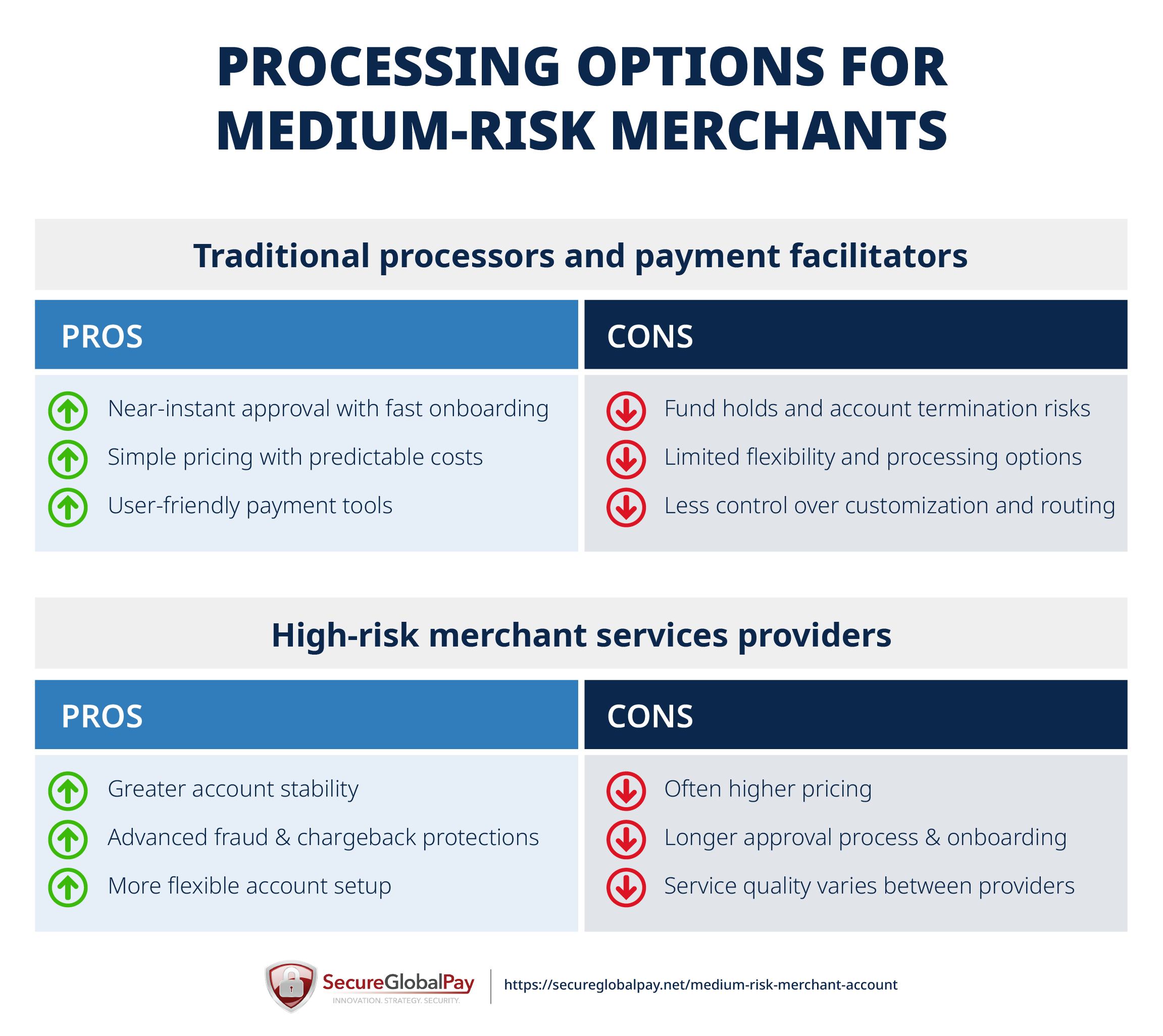
Traditional processors and payment facilitators
Traditional processors and payment facilitators can be a good fit if your business has a clean processing history, low chargebacks, predictable sales volume, and a business model that fits their policies.
The main benefit is convenience. These providers often offer fast onboarding, simple pricing, and easy-to-use tools that customers are familiar with.
The risk is account stability. If your business starts seeing higher transaction volume, more disputes, larger orders, or more international sales, your account can be flagged, limited, frozen, or terminated with little warning and no recourse.
High-risk merchant services providers
A high-risk merchant services provider is the smarter option for many medium-risk merchants.
You get a partner that can handle more complex underwriting, higher transaction volume, fraud concerns, chargeback exposure, and industry-specific requirements. You’ll get more flexible terms, stronger risk controls, and better long-term account stability.
Depending on the provider, you also get access to more advanced tools, such as fraud protection, chargeback mitigation, multi-MID support, and intelligent transaction routing. You may not need every tool on day one, but having those options available can help you protect your account as your business grows.
The tradeoff is that fees may be higher, especially if your business is new or has limited processing history. However, the added stability is well worth it, as payment interruptions can seriously hurt your revenue.
Ask each provider what happens if your business grows quickly. A good medium-risk payment partner should be able to explain how they handle higher monthly volume, larger transactions, additional MIDs, reserves, fraud tools, and chargeback prevention as your business scales.
Get reliable medium-risk merchant services from SecureGlobalPay
SecureGlobalPay provides all-in-one merchant services for businesses across different risk levels, with a focus on medium-risk and high-risk industries.
It’s everything you need in one place — domestic and offshore merchant accounts, modern payment gateway, POS hardware, risk management tools, and hands-on, personalized onboarding and ongoing support.
With SecureGlobalPay, you get a payment partner that understands risk, can predict scalability and processing issues, and places importance on long-term account stability.
Sign up with us and enjoy:
- Transparent pricing: Most of our merchants use the integrachange-plus pricing. The fees scale according to your processing history, business model, and risk level.
- Powerful payment gateway: Our gateway supports multi-MID capabilities and intelligent transaction routing to help improve payment reliability and keep you under approved processing thresholds.
- Standard and alternative payment methods: You can accept the payment options your customers prefer, including traditional card payments and available alternative payment methods like digital wallets, ACH & eChecks, MOTO transactions, and more.
- Free POS: Qualifying businesses may be eligible for free POS solutions to support in-person payments.
- Flexible integrations: Our gateway integrates with hundreds of shopping carts, eCommerce platforms, CRMs, chargeback services, and invoicing software.
- Dedicated U.S. customer support: Whether you are switching providers or starting fresh, every merchant gets an experienced account manager who is available via phone or email.

Need a medium-risk merchant account from a provider that will support your business as it grows? Complete our online application to get started.
Written by Roland G. Szasz - Director of Business Development - 25+ years in payment processing.
Roland has spent nearly three decades helping businesses navigate the complexities of payment processing. He now works closely with high-risk merchants that have been declined or restricted by conventional providers - and shares his experience and best practices on this blog.
FAQs
Yes. A medium-risk business can be reclassified over time based on its processing history, chargeback rate, refund patterns, transaction volume, industry changes, and overall account behavior.
For example, if you keep chargebacks low, maintain stable sales volume, and build a strong processing history, you may qualify for better terms. If your chargebacks increase, your sales volume becomes more volatile, or your business model changes, a processor may move you into a higher-risk category.
Yes, we offer merchant services designed to support businesses across different risk levels, including medium-risk and high-risk merchants.
Approval time depends on your industry, processing history, business documents, chargeback profile, transaction volume, and underwriting requirements.
Some medium-risk merchants may be approved in a day or two, while the underwriting businesses with more complex risk factors may take one week. To speed up approval, prepare your business documents, recent processing statements, bank information, website details, and any relevant compliance information before you apply.
Some medium-risk merchants can use payment facilitators like Stripe or PayPal, especially if their business model fits the provider’s policies. However, medium-risk businesses should understand the account stability risk. If your chargebacks, transaction volume, international sales, or product category trigger a review, your account may face holds, limits, or even termination.

Tailored payment solutions for high-risk merchants
- Domestic and offshore accounts
- Competitive, interchange plus pricing
- No long-term contracts or hidden fees
- Built in fraud protection
- Dedicated account manager; 24/7
Sign up in 5 minutes

A+ Rating
as of 06/17/26