


Home » Frozen PayPal Account? Here’s How to Recover Your Funds and Prevent Future Issues
Frozen PayPal Account? Here’s How to Recover Your Funds and Prevent Future Issues
| September 23, 2026
Frozen PayPal accounts aren’t a new problem; they’re as old as PayPal itself. Online forums are full of business owners and regular users describing the same fight: money sitting locked in an account, unclear explanations, and a long wait to get it back.
We’ve seen this firsthand. Over the years, we’ve onboarded dozens of merchants who came to us after one too many fund holds or account freezes with PayPal. Some of the advice below is based on what worked for them.
In this article, we’ll cover why PayPal limits accounts and freezes funds, how to pinpoint what’s happened to your account, the steps to recover your money, and how to protect your business from running into the same problem again.
Why PayPal limits accounts and freezes funds
PayPal limits accounts and freezes funds when its automated risk systems detect unusual or risky activity. Most freezes fall into one of these categories:
- PayPal has detected fraudulent activity on your account: Suspected fraud — whether by you, a buyer, or a third party — is the fastest route to a frozen account, because PayPal is liable for fraudulent transactions it processes.
- You’ve received an abnormally large amount of money: A large payment or monthly sales volume far above your account’s average looks suspicious to PayPal’s risk systems.
- Someone has filed a complaint about your business: Buyer complaints signal potential seller performance issues and can prompt an account review.
- A series of chargebacks have been placed against your account: Multiple chargebacks in a short window suggest a high-risk seller. PayPal will typically freeze funds while it investigates.
- Your website has questionable content: PayPal may crawl and assess your website, and content that appears to violate its policies can trigger a limitation.
- You’re violating PayPal’s use policy: Selling drugs, counterfeit goods, or anything else prohibited under PayPal’s Acceptable Use Policy can get your account limited or permanently banned.
- Your account information is outdated or unverified: Anti-money-laundering laws require PayPal to verify your identity, so missing ID documents, an old address, or an unverified account can lead to limitations.
- Someone has logged into your account from a strange location: Logins from unfamiliar devices or locations look like a potential account takeover, so PayPal sometimes freezes the account until it confirms that it was you.
- Your credit score or background history flags you as higher risk: While it gives you the option to open an account nearly instantly, PayPal will eventually review your business to assess risk. PayPal does not provide a high-risk merchant account, so if they are not happy with your industry or processing history, holds or reserves on your account are the best-case scenario.
Many high-risk merchants try their luck with the likes of Stripe and PayPal because they are simple to set up and get started. However, most of them will get their funds frozen and their account closed. If that happened to you, reach out to SecureGlobalPay. We can set you up with a merchant account and gateway so you can get your processing back online with minimal downtime.
What exactly happened to your PayPal account?
The right recovery steps depend on what PayPal did to your account — being locked out of your login is a very different problem from a payment hold or a permanent limitation.
People often use “frozen account” to describe all of these, but PayPal treats them as separate situations with separate fixes:
| ACCOUNT STATUS | WHAT IT MEANS | TEMPORARY OR PERMANENT? |
|---|---|---|
| Locked out | You cannot access the account, usually because of login/security issues or because PayPal needs to verify that you own it. | Usually temporary |
| Funds hold (frozen) | PayPal makes particular funds temporarily unavailable — for example, while a transaction dispute is investigated. The account itself may otherwise remain usable. | Temporary |
| Limited account | PayPal restricts certain account functions — like sending or withdrawing money. Typically resolved by completing specific verification or corrective steps listed in the Resolution Center. | Usually temporary |
| Permanently limited | PayPal decides the imposed limitation will not be removed. You can still log in, but depending on the limitation, this can make the account functionally unusable for taking payments. | Permanent |
| Account closed/ deactivated | PayPal decides it can no longer provide services to the account/customer. Successful appeals are rare. PayPal can hold any remaining balance for up to 180 days. | Permanent |
How to recover money from a frozen PayPal account
Getting your money back from a frozen PayPal account usually comes down to three things: figuring out exactly what PayPal wants from you, addressing it quickly and thoroughly, and knowing when to escalate if the standard process stalls.
1. Complete every step in the Resolution Center
The Resolution Center is where PayPal tells you why your account is limited and what it needs from you.
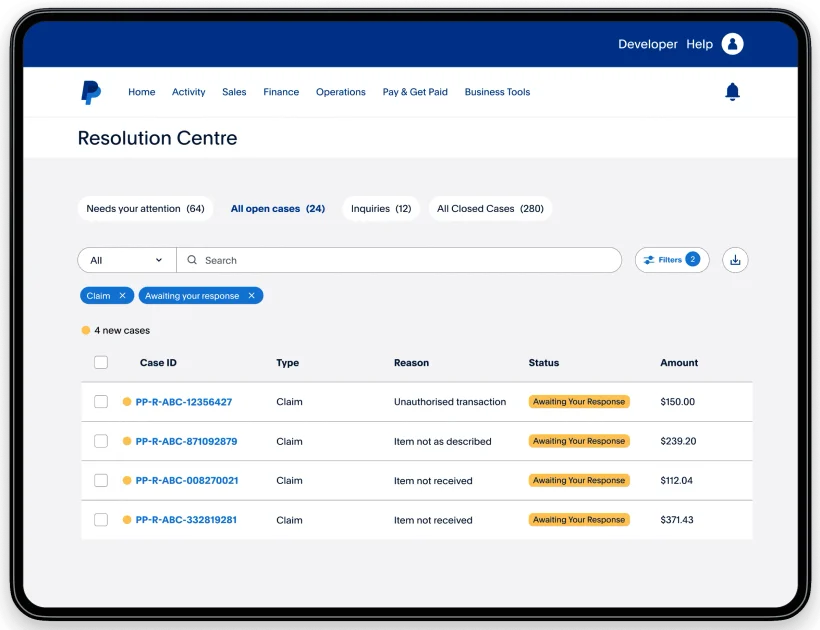
Work through the process like this:
- Check the Resolution Center and your notifications: See exactly what PayPal is requesting before you send anything.
- Submit all requested documentation: This may include identity documents, business registration, transaction records, supplier invoices, or proof of fulfillment.
- Keep information complete and consistent: Details on your documents should match the name, address, and business information already on your PayPal account.
- Respond quickly to follow-up requests: Delays on your side extend the review on PayPal’s side. Their support can be slow, so you need to be fast.
PayPal says its account review usually takes about three business days after you complete all required steps, though complex cases can take longer.
The review ends in one of four outcomes:
- The limitation is removed
- PayPal requests more information
- Your funds remain restricted
- The account receives a permanent limitation.
2. Clear individual payment holds
A payment hold is not the same as an account-wide freeze.
PayPal can make one specific transaction unavailable while the rest of your account keeps working. Each held payment has its own release conditions. Find the transaction and check what PayPal requires.
Depending on what you sold, the fastest paths to release are:
- For physical goods: Add valid shipment tracking as soon as the order ships. PayPal says eligible funds can generally be released about 24 hours after an approved carrier confirms delivery.
- For services or digital products: Update the order status to Completed if the option is available. PayPal says funds can then be released after seven days.
- For disputed transactions: Work to resolve any associated buyer dispute, chargeback, or fulfillment issue promptly — the hold stays in place until the matter is closed.
Some holds can remain for as long as 21 days even after these steps, depending on risk factors such as unusual selling activity.
Keep in mind that clearing one transaction hold does not remove an account-level limitation. If your whole account is limited, you still need to go through the Resolution Center.
3. Escalate the issue with PayPal
If the Resolution Center steps don’t resolve things, contact PayPal support first. Ask for clarification on three points:
- The specific reason for the restriction
- Exactly which funds are being held
- The conditions for their release.
Getting these answers in writing gives you a clear record if you need to push further.
If support can’t resolve the issue, you can move to PayPal’s formal dispute process. For U.S. accounts, PayPal’s current User Agreement requires you to send a completed Notice of Dispute form by certified mail before starting arbitration or small-claims proceedings. PayPal then has a 60-day window to negotiate a resolution with you.
A formal dispute makes sense when a significant amount is held, PayPal hasn’t given a clear justification, or the standard process has stalled — not as a first move for a routine 21-day hold.
4. Take legal measures
If PayPal support and the formal dispute process fail, you have two legal routes: small claims court or arbitration.
PayPal’s current U.S. user agreement generally requires individual arbitration for covered disputes but allows qualifying disputes to be pursued in small claims court — and either way, the Notice of Dispute process from the previous step comes first.
Legal remedies vary by country, so merchants should check the agreement governing their particular PayPal account rather than assuming U.S. procedures apply everywhere.
Before paying a lawyer, try regulatory escalation — it’s free, and user reports suggest it works. In one r/PayPal thread, a small business owner with roughly $26,000 frozen filed a CFPB complaint, and even called multiple representatives from their state. PayPal eventually released the funds.
Based on user reports across Reddit and other community forums, legal action only makes sense when:
- A large sum is involved: One r/PayPal user reported a $3,000 retainer quote just for a demand letter, which is hard to justify over a small balance.
- PayPal’s stated release date has passed: You will have a stronger argument if the money is still inaccessible after the official 180-day window PayPal has to release it.
- You’ve exhausted PayPal’s own process: Support, appeals, and formal Notice of Dispute have all failed.
- You have a clean paper trail: Written records of every PayPal communication, release conditions, and deadlines.
Steps to unfreeze your PayPal account
Before doing anything, work out exactly what PayPal did and why. Check these four places:
- Account notifications (the bell icon on your dashboard)
- The Resolution Center
- Email notices from PayPal
- Dashboard alerts
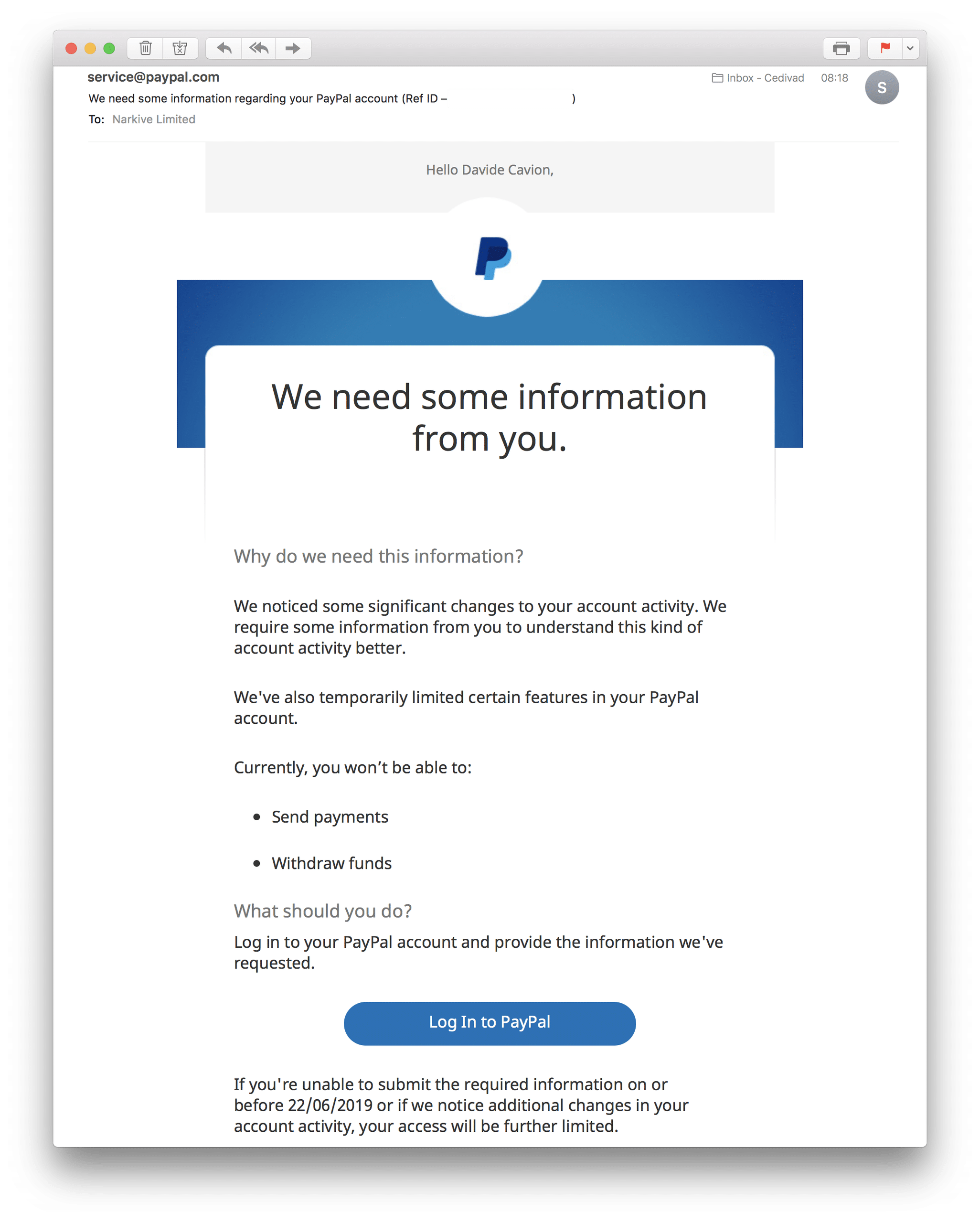
An example of an email notification from PayPal. Source
Together, these will tell you whether you’re dealing with a login/security issue, a temporary limitation, a payment hold, a reserve, or a permanent limitation. Once you know, follow these steps:
- Complete the requirements in the Resolution Center: The Resolution Center lists exactly what PayPal wants from you (typically a government-issued photo ID, proof of address, business registration documents, supplier invoices, proof of fulfillment or tracking numbers, or an explanation of specific transactions). Submit everything requested, and make sure the details match the information already on your account.
- Resolve outstanding disputes or fulfillment problems: Open buyer disputes, chargebacks, and undelivered orders are often what triggered the restriction in the first place. Respond to every open case in the Resolution Center, ship any unfulfilled orders and add tracking, and refund transactions you can’t fulfill.
- Contact PayPal: Escalate when the Resolution Center doesn’t specify what’s wrong, you’ve completed all steps and heard nothing well past the review window, or you believe the limitation is a mistake. You can reach PayPal through the Message Center, live chat, or by phone at the number listed on its Contact page. Ask them specifically what triggered the limitation and what’s still missing from your file.
- Wait for PayPal’s review decision: PayPal says the account review usually takes about 3 business days after you complete all required steps, and it will notify you by email.
The 3-business-day figure is PayPal’s own estimate, and it holds mostly for straightforward limitation review once everything PayPal requested has been submitted. However, it can unfortunately take weeks or months in more complicated cases.
Do not try to circumvent the limitation by simply opening another PayPal account. PayPal's current User Agreement specifically prohibits attempts to bypass account restrictions by opening additional accounts. You are better off looking for a new or backup payment processor.
Protect your business from future processing issues
Even if you can’t force a faster release, you can lower the odds of a repeat and limit the damage if it happens:
- Do not treat your PayPal account as your bank account: Regularly transfer eligible funds to your business bank account. Money sitting in PayPal is money PayPal can freeze.
- Keep your account and business information current: Make sure PayPal has accurate information about your business, ownership, address, bank account, products or services, and expected processing activity.
- Ensure your business complies with PayPal’s policies: Review PayPal’s Acceptable Use Policy before launching new products, services, or business models. Some activities are banned outright; others need prior approval. PayPal states that violating the Acceptable Use Policy also violates the user agreement.
- Keep chargebacks and customer disputes under control: Reduce this risk by describing products accurately, using recognizable billing descriptors, responding quickly to customer questions, publishing clear refund and cancellation policies, issuing legitimate refunds promptly, and actively monitoring and managing dispute ratios.
- Export your records: Save transaction histories, customer information you are entitled to retain, reconciliation records, invoices, and dispute documentation. You will need this if you completely switch to a different provider or decide to open an additional merchant account with a different provider.
- Set up another processing relationship. A second processor turns a frozen account from an existential threat into an inconvenience.
PayPal’s size and aggregator model is a double-edged sword. Simple to sign up and get started, but you end up at the mercy of its automated risk systems and inefficient support.
When you have a dedicated high-risk merchant account, you can warn your processor before a marketing push or seasonal spike — and we can try to raise your processing thresholds or open additional accounts and set up load balancing.
PayPal gives you no one to notify in advance; its systems flag first and ask questions later. So you have no way to prevent that. Your only defense is having documentation ready to submit fast, and even then, resolving things with PayPal support can take weeks.
Sick of PayPal holding your funds? Switch to SecureGlobalPay
SecureGlobalPay is an all-in-one merchant services provider that works predominantly with high-risk merchants.
You’re a strong fit for SecureGlobalPay if you operate in a high-risk category, process high-volume or high-ticket transactions, and need stronger fraud control and more flexible chargeback management.
We regularly onboard former PayPal merchants who went through multiple holds or account limitations and just want reliable processing without getting ripped off.
With SecureGlobalPay, you get:
- Stable processing through our strong acquiring relationships.
- Access to a modern payment gateway with built-in fraud controls and hundreds of integrations.
- Multi-MID capabilities with smart payment routing and load balancing — perfect for high-volume merchants and more complex payment setups.
- Support for hundreds of currencies and numerous payment methods.
- A dedicated US account manager, available 24/7 by phone or email.
Stop building your business around a platform that can freeze your funds without warning. Sign up with SecureGlobalPay by filling out our simple online application.
Written by Roland G. Szasz - Director of Business Development - 25+ years in payment processing.
Roland has spent nearly three decades helping businesses navigate the complexities of payment processing. He now works closely with high-risk merchants that have been declined or restricted by conventional providers - and shares his experience and best practices on this blog.
FAQs
PayPal freezes accounts or holds funds when its risk systems flag something as suspicious: unusual transaction activity, a spike in disputes or chargebacks, incomplete identity verification, a policy violation, or a login from an unfamiliar location. Check your Resolution Center and account notifications for the specific reason PayPal has given you.
Risk-based holds generally last up to 21 days, though PayPal can extend a hold to up to 180 days if a payment is disputed or under investigation. For account limitations, PayPal says review typically takes about 3 business days once you’ve completed all required steps, though more complex cases can take longer.
Yes. PayPal can hold funds indefinitely if they’re tied to an open investigation, a disputed transaction, or a policy violation — the 180-day figure in its user agreement is a stated maximum for standard cases, not a guarantee of release.
No. PayPal’s user agreement explicitly prohibits opening new or additional accounts once one has been restricted, suspended, or limited, including using different personal or business information to do so.
PayPal is a payment processor, not a bank. It has no legal or technical control over your personal bank account and cannot lock your funds sitting in a separate bank. PayPal can only freeze or “limit” your PayPal balance and block you from sending, receiving, or withdrawing money through their platform.

Posted in - Merchant Accounts, Payment Aggregators
Tailored payment solutions for high-risk merchants
- Domestic and offshore accounts
- Competitive, interchange plus pricing
- No long-term contracts or hidden fees
- Built in fraud protection
- Dedicated account manager; 24/7
Sign up in 5 minutes

A+ Rating
as of 06/17/26