


Home » How to Open a Multi-Currency Account for Your Business

How to Open a Multi-Currency Account for Your Business
| May 16, 2026
Are you losing customers because your checkout only supports a limited number of currencies? Are you sick of foreign exchange (FX) fees slowly eating into your margins every month? Do cross-border payments feel confusing, slow, and difficult to manage as your business grows?
If so, you need a multi-currency merchant account.
They allow businesses to accept, hold, and manage payments in multiple currencies, making international transactions much smoother for both the business and the customer.
Whether you’re selling internationally or planning to expand into new markets, this guide will help you understand how multi-currency accounts work, compare the best providers, and show you how to open one step-by-step.
What is a multi-currency account?
A multi-currency account is a type of business account that allows you to send, receive, hold, and manage money in multiple currencies from a single account.
Instead of opening separate bank accounts for USD, EUR, GBP, CAD, and other currencies, a multi-currency merchant account lets businesses handle international payments in one place. This makes it much easier to work with customers, suppliers, and partners across the globe.
For businesses that sell internationally, this can help reduce unnecessary currency conversions, simplify accounting, and improve the customer payment experience.
For comparison, a standard business account is usually designed to operate primarily in one local currency. If you receive payments in foreign currencies, the funds are converted automatically — often with high FX fees and unfavorable exchange rates.
Businesses typically open multi-currency accounts to:
- Sell products or services internationally
- Reduce FX conversion fees
- Offer customers localized checkout experiences
- Receive payouts from global marketplaces
- Pay overseas suppliers or contractors
- Manage international revenue more efficiently
- Improve approval rates for international transactions
A multi-currency account and a foreign currency account are not the same. A foreign currency account allows you to hold and transact in one specific foreign currency, such as only USD or only EUR. A multi-currency account, as its name implies, supports multiple currencies.
How do multi-currency merchant accounts work?
Instead of forcing every payment through a single local currency, these accounts allow businesses to accept and manage payments in multiple currencies more efficiently.
In most cases, the process works like this:
- The customer selects their preferred currency at checkout.
- The payment gateway securely processes the transaction and sends the payment information to the processor for authorization.
- The customer’s bank approves the transaction, and the payment is completed.
- The funds are either converted or settled in the original currency, depending on how the merchant account is configured.
- The money is deposited into the business’s merchant account based on the provider’s settlement schedule.
Many businesses choose to hold funds in multiple currencies to reduce unnecessary FX conversions and improve international cash flow management.
Behind the scenes, payment gateways and processors play a major role in making this possible. The payment gateway handles secure transaction routing, fraud protection, and checkout integrations, while the payment processor manages communication between banks and settlement of funds.
The best platforms for opening a multi-currency business account
There are now many providers offering multi-currency business accounts, but not every platform is built for the same type of business. Some are better suited for startups and freelancers, while others are designed forhigh-volume eCommerce brands or businesses operating in high-risk industries.
When comparing providers, consider these factors:
- Foreign exchange and transaction fees
- Supported countries and currencies
- Integration options for eCommerce platforms and marketplaces
- Settlement speed and payout flexibility
- Compliance requirements and onboarding process
- Fraud prevention and security features
The right provider ultimately depends on your business model, where your customers are located, and how you plan to scale internationally.
Below is a quick overview of popular platforms for opening a multi-currency account and accepting global payments.
| Provider | Best for | Potential limitations |
| Payoneer | Freelancers, digital service providers, marketplace sellers, and small-to-medium eCommerce businesses. | FX and withdrawal fees can become expensive; limited support for advanced merchant processing |
| Airwallex | Scaling eCommerce brands, SaaS companies, and startups | Some features may be too advanced for smaller businesses; country availability varies |
| Wise | Small businesses, remote teams, freelancers, and companies focused on international transfers and low FX costs | Limited merchant acquiring and online payment gateway functionality; some business types and industries may face restrictions |
| SecureGlobalPay | High-risk, high-volume, and high-ticket businesses selling internationally | Approval requirements may be stricter for certain industries, and pricing varies depending on risk profile and processing volume |
| OFX | Businesses handling large international transfers and supplier payments | Less suitable for eCommerce checkout and card payment processing |
| WorldFirst | Cross-border eCommerce sellers and Amazon merchants | Limited payment gateway customization and acquiring tools; not suitable for high-risk processing |
| HSBC | Established businesses and enterprises with global operations | Slower onboarding, higher fees, and less flexibility compared to other providers on this list |
1. Payoneer
Payoneer is a global payment platform that helps businesses receive and send international payments in multiple currencies. The platform provides local receiving accounts in several major currencies, making it easier for businesses to get paid globally without opening multiple foreign bank accounts.
Ideal for: Freelancers, digital service providers, marketplace sellers, and small-to-medium eCommerce businesses.
Key features:
- Supports multiple currencies, including USD, EUR, GBP, CAD, AUD, and more.
- Local receiving accounts for international payments.
- Marketplace integrations with platforms like Amazon, Fiverr, Upwork, and Airbnb.
- International supplier and contractor payments.
- Virtual cards and business payment tools.
- Cross-border transfer capabilities.
Main pros:
- Strong marketplace integration ecosystem.
- Easy international payment collection.
- Simple onboarding for small businesses and freelancers
Main limitations:
- Limited customization for larger enterprise businesses.
- FX and withdrawal fees can add up.
- Not designed for complex or high-risk payment processing.
2. Airwallex
Airwallex is a global payments and financial platform built for businesses that operate internationally. It combines multi-currency accounts, payment processing, expense management, and global payouts into a single platform, making it a strong option for fast-growing online businesses.
Ideal for: Most eCommerce businesses, SaaS companies, startups, and international brands that need scalable international payment infrastructure with strong API capabilities.
Key features:
- Supports 20+ currencies and global payment collection.
- Multi-currency business accounts and local receiving accounts.
- Global payouts to suppliers and partners.
- Integrations with Shopify, WooCommerce, Xero, and NetSuite.
- API-driven payment and treasury infrastructure.
- Virtual and physical business cards.
- Built-in expense management tools.
Main pros:
- Strong global payment infrastructure.
- Competitive FX and international transfer rates.
- Excellent API and automation capabilities.
Main limitations:
- Some features may be overly advanced for smaller businesses.
- Many reviewers on TrustPilot are unsatisfied with their customer support.
- Airwallex does not support higher risk industries and business models.
3. Wise Business
Wise offers multi-currency business accounts designed to make international banking and transfers more transparent and cost-effective. The platform is widely known for its competitive exchange rates and simple approach to managing global payments.
Ideal for: Small businesses, remote teams, freelancers, and startups that frequently send or receive international transfers.
Key features:
- Hold and manage 20+ currencies.
- Local account details for major currencies like USD, EUR, and GBP.
- International transfers with mid-market exchange rates.
- Custom account controls for setting spending permissions and configuring team access.
- Integrations with accounting platforms like Xero and QuickBooks.
- Volume discounts on monthly transfers over 20,000 GBP or equivalent.
Main pros:
- Transparent and competitive FX pricing.
- Simple and user-friendly platform.
- Strong support for international bank transfers.
Main limitations:
- Limited payment gateway and merchant processing capabilities.
- Not ideal for high-volume card processing.
- Higher-risk business types and industries will face restrictions and have trouble opening an account.
4. SecureGlobalPay
SecureGlobalPay provides multi-currency payment processing solutions for businesses operating internationally, including merchants in high-risk industries. The company focuses on flexible payment solutions, global acquiring support, fraud prevention, and scalable integrations for online businesses that require more advanced payment processing capabilities.
Ideal for: High-risk businesses, international eCommerce brands, subscription platforms, and online businesses selling expensive items or services.
QUICK AND EASY ONLINE APPLICATION
Reduce fees and improve conversions with a multi-currency merchant account
Key features:
- Multi-currency payment processing support through domestic or offshore merchant accounts.
- Global payment coverage and international acquiring, with support for over 150 currencies (depending on the processor).
- Powerful payment gateway with advanced fraud protection and multi-MID capabilities.
- Over 200 integrations with shopping carts, eCommerce platforms, chargeback management tools, accounting and invoicing software, and other business applications.
- Open API and developer support for platforms and apps that want to connect to and use our payment gateway.
- Dynamic Currency Conversion (DCC), which allows for the settlement of international payments in the merchant’s home currency.
- Fast settlement options, including next-day and same-day payouts for businesses that qualify.
Main pros:
- Built for international, high-risk, and high-volume payment processing.
- Flexible gateway and integration capabilities with highly scalable infrastructure.
- Dedicated customer success manager available via phone or email.
- Transparent, interchange plus pricing with competitive rates.
Main limitations:
- May offer more advanced functionality than small businesses and freelancers need.
- Pricing can vary depending on risk profile and processing volume.
- High-risk businesses may face rolling reserves and other restrictions until they prove credibility.
5. OFX
OFX is a global foreign exchange and international payments provider that focuses primarily on cross-border money transfers and currency management for corporations. The platform is widely used by companies that regularly move large amounts of money internationally and want more competitive exchange rates than traditional banks.
Ideal for: Businesses making large international transfers, import/export companies, and organizations managing global supplier payments.
Key features:
- Global payment network coverage with support for 25+ currencies and over 180 countries.
- Competitive FX rates for larger transfers.
- Currency risk management tools.
- Ability to group and approve/schedule thousands of payments at once.
- Integration options for accounting and financial workflows.
Main pros:
- Competitive rates for larger transactions.
- Dedicated support for business clients.
- Ability to customize and create multi-layer approval workflows.
Main limitations:
- Limited merchant payment gateway functionality.
- Less focused on eCommerce checkout integrations.
- Not ideal for businesses needing advanced online payment processing tools or those operating in higher-risk industries.
6. WorldFirst
WorldFirst is a global payments platform that helps businesses manage international transactions, marketplace payouts, and cross-border commerce. The platform is especially popular among eCommerce sellers that operate on international marketplaces and source products globally.
Ideal for: Cross-border eCommerce sellers, airline and travel agencies, and businesses managing international supplier payments.
Key features:
- Multi-currency business accounts.
- Local receiving accounts in major currencies.
- Marketplace integrations with Amazon and other global platforms.
- International supplier payments.
- Competitive FX exchange services.
- Business debit cards and payment tools.
Main pros:
- Strong support for global marketplace sellers.
- Easy international fund management.
- Competitive FX services for eCommerce businesses.
Main limitations:
- Limited advanced merchant acquiring capabilities.
- Less suitable for complex high-risk payment processing.
- Fewer customization options compared to enterprise-focused platforms.
7. HSBC
HSBC is one of the world’s largest international banks and offers multi-currency business banking solutions for companies operating across global markets. Its services are designed for businesses that need traditional banking infrastructure combined with international payment capabilities.
Ideal for: Established businesses, enterprises, import/export companies, and organizations with large international operations.
Key features:
- Multi-currency business banking accounts.
- International wire transfers and global banking network.
- Foreign exchange and treasury management services.
- Corporate payment and cash management solutions.
- Trade finance and international business support.
- Access to traditional banking infrastructure.
Main pros:
- Strong global banking presence.
- Comprehensive international financial services.
- Transfer money to China from Europe with same-day USD payments (they say that 150,000+ Chinese suppliers are already on WorldFirst).
Main limitations:
- More complex onboarding and compliance processes.
- Higher fees compared to many fintech alternatives.
- Less flexible and slower-moving than modern payment-focused platforms.
Steps to open a multi-currency account as a business owner
Opening a multi-currency merchant account is much easier today than it was a few years ago. Many providers now offer online merchant application forms, fully digital onboarding, faster approvals, and integrations designed specifically for online businesses.
Here’s a step-by-step look at how the process typically works.
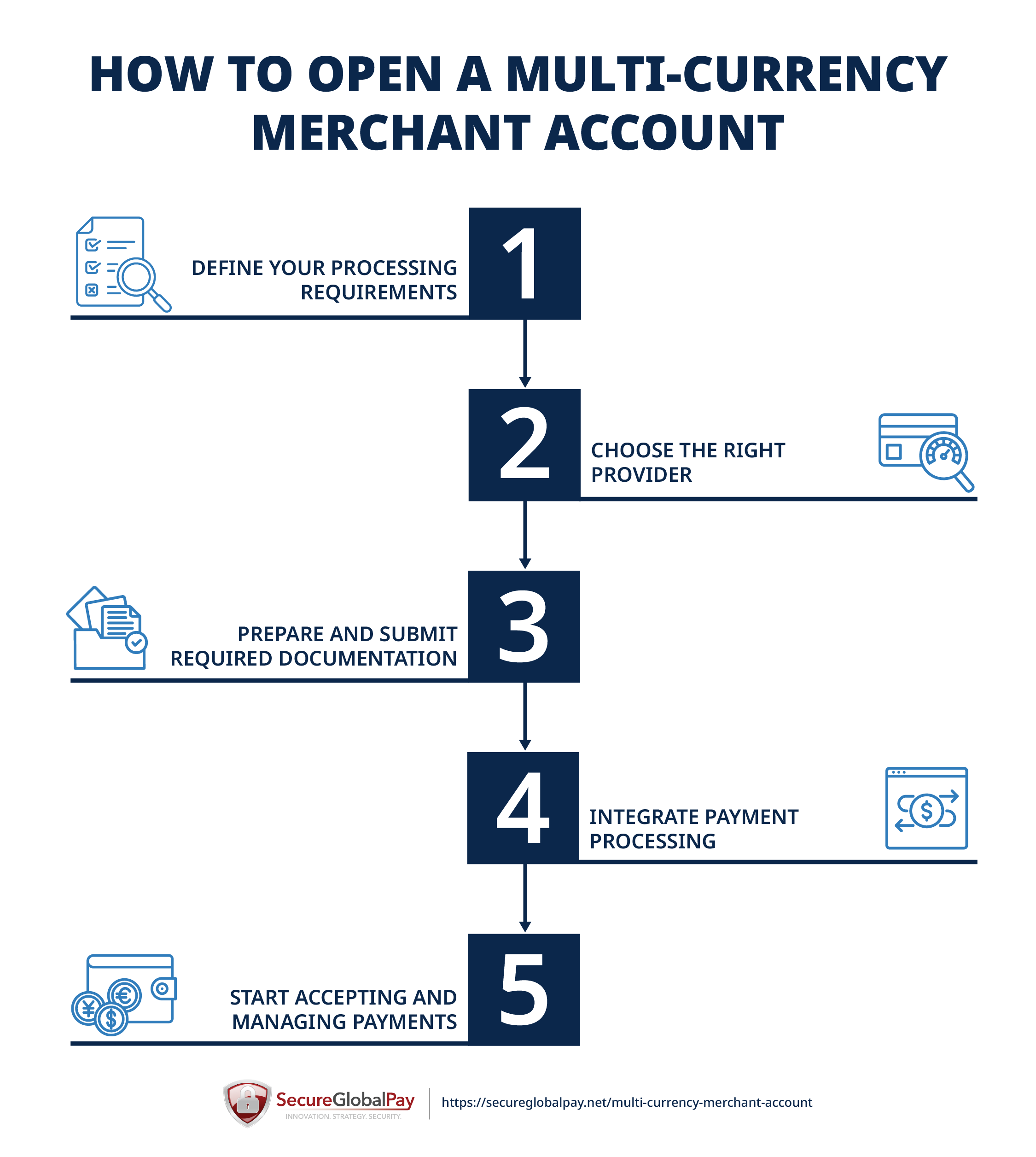
Step 1: Define your processing requirements
Before comparing providers or submitting applications, define what your business actually needs:
- Which currencies you need to accept
- Where your customers are located
- Which countries you plan to expand into
- Your expected monthly transaction volume
- How you want settlements and payouts to work
For example, an eCommerce business selling globally may need support for multiple checkout currencies and marketplace integrations, while a SaaS company may prioritize recurring billing and international subscription payments.
It’s also important to think about operational needs beyond payment acceptance. Some businesses want to hold balances in multiple currencies to reduce FX costs, while others prefer automatic conversion into their local currency for simpler accounting.
Taking the time to define these requirements early will make it much easier to choose the right provider later in the process.
Step 2: Choose the right provider
Not all multi-currency merchant account providers offer the same features, pricing structure, or level of support. Some platforms are designed for freelancers and small businesses, while others specialize in high-volume processing, enterprise payments, or high-risk industries.
When comparing providers, pay close attention to:
- Supported currencies and countries
- FX and transaction fees
- Settlement speed
- Available integrations
- Built-in fraud protection and chargeback tools
- Ease of onboarding
- Scalability as your business grows
For example, an eCommerce brand may prioritize integrations with platforms like Shopify or WooCommerce, while a SaaS business may focus more on recurring billing support and API flexibility.
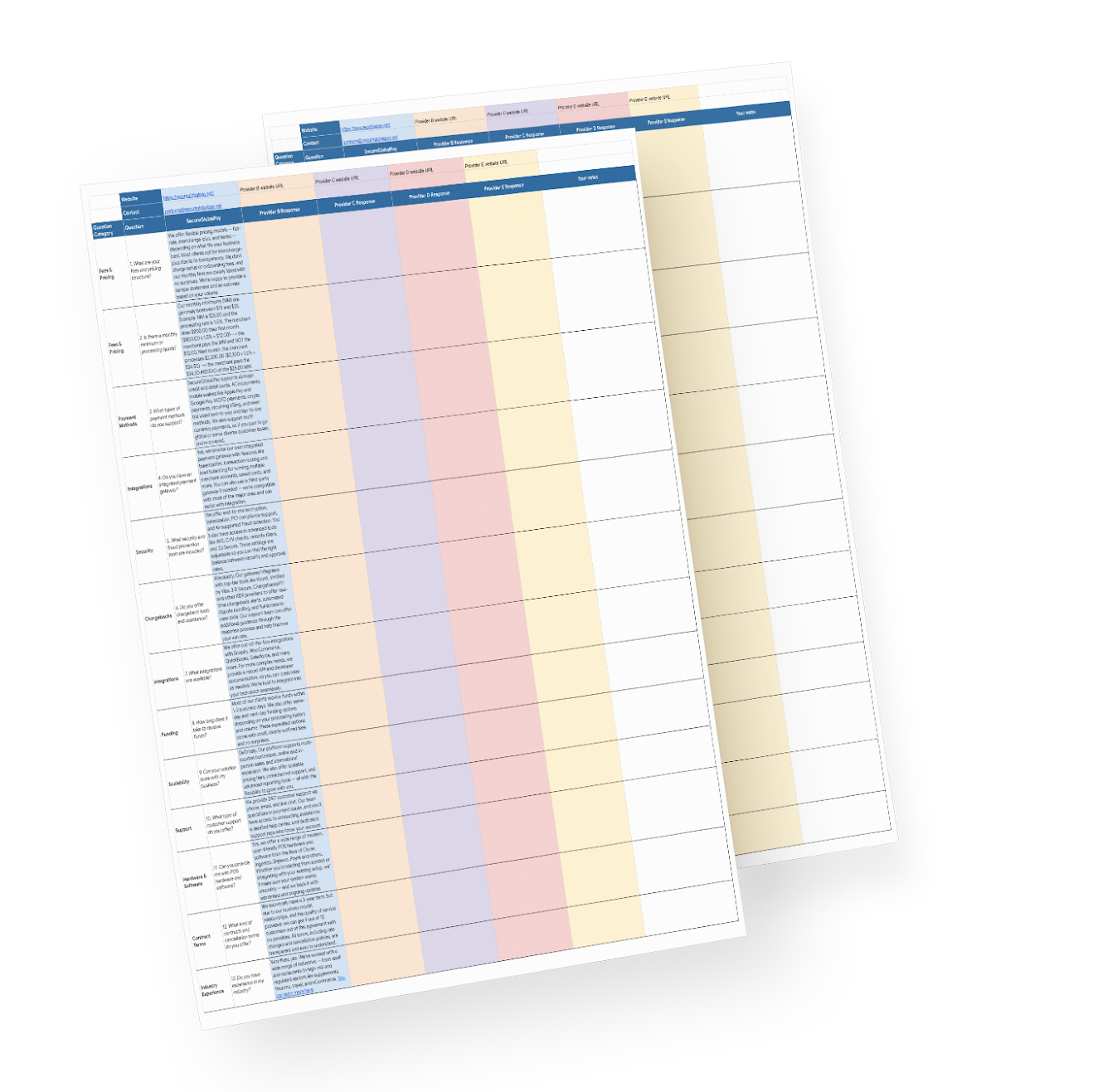
Free Template for Comparing Merchant Service Providers
Our Google Sheet template arms you with 13 critical questions you should ask each provider to catch red flags and cut through the sales talk — with SecureGlobalPay’s answers already filled in for comparison.
Step 3: Prepare and submit required documentation
While filling out the application form for your merchant account, you will have to provide documents such as:
- Business registration or incorporation documents
- Proof of identity for business owners or directors
- Recent bank statements
- Proof of address
- Website URL or business model information
- Target markets
- Chargeback and processing history (or estimated transaction volume if there is none)
- Relevant compliance documents (for example, a telemedicine business might need to provide a medical license and controlled-substance policy)
These checks are part of standard KYC (Know Your Customer) and AML (Anti-Money Laundering) compliance procedures.
Businesses operating in regulated or high-risk industries may also go through additional underwriting and compliance reviews before approval.
For many modern payment platforms, onboarding can be completed entirely online. Depending on the provider and business type, approval usually takes between 2 and 5 business days.
Step 4: Integrate payment processing
Once approved, the next step is connecting your merchant account to your payment infrastructure.
This usually involves integrating one or more of the following:
- A payment gateway
- eCommerce plugins
- APIs
- Shopping cart systems
- Subscription billing tools
Many providers, SecureGlobalPay included, offer ready-made integrations for platforms like Shopify, WooCommerce, Magento, and BigCommerce. More often than not, you can also get access to their APIs for custom setups.
After you connect tools and before going live, it’s important to:
- Test transactions in different currencies
- Verify settlement settings
- Check fraud filters, payment routing, and security settings
- Confirm the checkout experience works smoothly across devices
A properly configured setup reduces payment issues, improves authorization rates, and creates better shopping experiences for your international customers.
To make the integration process as fast and smooth as possible, SecureGlobalPay provides hands-on guidance, native integrations, an open API, and dev support for custom integrations.
Step 5: Start accepting and managing payments
Once your payment setup is live, it’s important to keep an eye on:
- Transaction activity
- Settlement schedules
- FX conversions
- Chargeback and dispute rates
- Reporting and reconciliation.
Many providers offer dashboards that make it easier to track payments, hold balances in different currencies, and manage international cash flow in real time.
As your business grows, you may also decide to optimize how currencies are settled. For example, some businesses choose to hold funds in certain currencies to reduce conversion costs or pay overseas suppliers directly.
How SecureGlobalPay supports multi-currency payment processing
SecureGlobalPay helps businesses simplify international payment processing through flexible multi-currency solutions designed for global and high-risk merchants.
You’ll get everything you need to start processing international payments without worry of account freezes or shutdowns:
- A multi-currency merchant account paired with a bank that supports your business model.
- A secure and robust payment gateway that supports a wide variety of payment methods, including recurring billing and subscription payments.
- Dedicated support for configuring your account, gateway, and integrations.
Want to simplify global payments while reducing processing costs? Sign up with SecureGlobalPay!
Written by Roland G. Szasz - Director of Business Development - 25+ years in payment processing.
Roland has spent nearly three decades helping businesses navigate the complexities of payment processing. He now works closely with high-risk merchants that have been declined or restricted by conventional providers - and shares his experience and best practices on this blog.

Tailored payment solutions for high-risk merchants
- Domestic and offshore accounts
- Competitive, interchange plus pricing
- No long-term contracts or hidden fees
- Built in fraud protection
- Dedicated account manager; 24/7
Sign up in 5 minutes

A+ Rating
as of 06/17/26