


Home » Get Medical Merchant Services & Healthcare Payment Processing

Get Medical Merchant Services & Healthcare Payment Processing
| November 17, 2026
A pediatrician collecting copays and a telehealth clinic billing monthly subscriptions both work in healthcare. To a payment processor, though, they are two very different businesses.
The healthcare services you offer — and how you bill for them — decide whether processors and banks treat your practice as low, medium, or high risk. That affects how easily you get approved, what you pay in fees, and how stable your merchant account will be.
SecureGlobalPay provides medical merchant services and payment technology for all types of practices and business models, from family doctors, dental offices, and hospitals to telehealth and elective-care providers.
Let’s review which healthcare providers need specialized merchant accounts, what your payment setup should include, the documents you’ll need to apply, and how to keep chargebacks under control.
Which medical practices need specialized merchant accounts
Not every medical office needs a high-risk merchant account. A family doctor who collects copays at the front desk is about as low-risk as it gets for a payment processor.
Things change when a practice charges large amounts upfront, bills patients on a recurring basis, treats patients only online, or sells prescription medication and other regulated products. Traditional processors are often reluctant to take on these businesses, so many end up needing a specialized merchant account.
The table below shows how processors typically view different medical businesses, based on our experience. Every acquiring bank has its own risk criteria, so treat it as a rough general guide.
| Medical business type | Typical processing risk | Explanation |
|---|---|---|
| Family practice, pediatrics, and dental offices | Low | Most payments are small copays and balances collected in person, and patients rarely dispute them. |
| Specialist clinics and urgent care | Low to moderate | Bills are larger and often arrive weeks after the visit, once insurance has paid its part. That can lead to an occasional dispute over what the patient actually owes. |
| Therapy and mental health practices | Low to moderate | In-person practices are easy to underwrite. Online sessions, cards kept on file, and late cancellation fees add some risk. |
| Concierge and membership-based practices | Moderate | Patients pay monthly or annual fees in advance. Recurring billing tends to bring more disputes, usually from patients who forgot about the charge or believed they had canceled. |
| Med spas and cosmetic or elective procedures | Moderate to high | Tickets are high, treatments are often sold as prepaid packages, and patients who are unhappy with the results may dispute the charge |
| Telehealth providers | Moderate to high | Every payment is card-not-present, and many providers bill on a subscription. Those that prescribe medication online may also have to meet additional card network requirements. |
| Weight-loss, hormone, and wellness clinics | High | Subscription billing combined with prescription treatments and results that vary from patient to patient. Refund requests and chargebacks are more common, and banks look closely at how these services are marketed. |
| Online pharmacies and medical product sellers | High to very high | Regulated products sold online. Acquiring banks need to verify licensing and how prescriptions are handled before approving the account. |
Just compare these two examples:
- Family practice: A two-doctor office processing $40,000 per month, mostly in-person copays and balances averaging $60, may only need a standard merchant account, a countertop terminal that accepts HSA and FSA cards, and a simple way for patients to pay a bill online.
- Telehealth clinic: An online clinic processing $130,000 per month, with the majority from $199 monthly subscriptions, may need a high-risk merchant account approved for telehealth, a payment gateway with recurring billing and secure card storage, fraud screening, and chargeback alerts.
Both are healthcare providers, but their processing needs are quite different.
What should your chosen healthcare payment solutions include
Patients now expect to pay a medical bill the same way they pay for everything else: by card at the front desk, from their phone, or automatically each month. A good healthcare payment setup covers all of these without making your staff juggle separate systems.
Here’s what to look for:
- In-office payments: A countertop or wireless POS terminal that accepts chip, swipe, and contactless payments, including Apple Pay and Google Pay. A wireless terminal is useful for rare situations where you’d like to collect payments in the exam room instead of sending patients back to the front desk. SecureGlobalPay offers these through our partnership with brands like Clover and Dejavoo.
- Support for online and remote payments: A modern payment gateway lets patients pay through your website or patient portal. Email or text payment links are an easy way to collect outstanding balances after a visit, and an easy-to-use virtual terminal lets your staff key in card details when a patient calls to pay over the phone.
- Recurring billing and cards on file: If you offer memberships, payment plans, or ongoing treatment programs, you need a way to store cards securely and charge them on a schedule. Get the patient’s written consent before saving a card, and make it clear how much they will be charged and how often. This keeps you compliant with card network rules and helps prevent disputes.
- HSA and FSA card acceptance: Many patients pay with health savings and flexible spending account cards. Medical practices can usually accept these cards like any other debit card, as long as the merchant account is set up under a healthcare merchant category code (MCC). Businesses that sell health products without a healthcare MCC, such as some online stores, need additional registration and a system that identifies eligible items at checkout.
- Fraud and chargeback tools: Fraud is less common in a doctor’s office than in an online store, but the risk grows once you take payments online or set up recurring billing. Look for address verification (AVS), card security code checks, and 3D Secure for online payments, plus chargeback alerts that give you a chance to resolve a dispute before it becomes a chargeback.
- Integrations: Your payment system should work with the medical practice management, EHR, or billing/accounting software you already use. When payments are posted to the patient’s account automatically, your staff doesn’t have to enter them twice, and end-of-day reconciliation takes minutes instead of hours.
A small practice may only need the first two or three items on this list. Telehealth providers, membership practices, and multi-location groups usually need all of them.
SecureGlobalPay gateway integrates with many EHR and practice management platforms to process card and ACH payments directly inside clinical workflows. Notable out-of-the-box and custom integrations include Cerbo EHR, as well as Webflow-based telemedicine and med spa systems for compliant intake and HSA/FSA card billing. Since we have a developer-friendly gateway, numerous custom-built practice platforms and independent medical billing vendors (such as AGMS, MannyPay, and Titan) plug directly into our API to support POS terminals, virtual terminals, and automated text-to-pay links within their proprietary software.
The documentation you’ll need to apply for a medical merchant account
To open a medical merchant account, you’ll need to provide documents that verify your business, its owners, and its financial stability. Healthcare providers are also asked to show that they are licensed to offer the services they bill for.
While the exact requirements depend on the payment processor, your business model, and your risk profile, most healthcare providers will need to provide the documents listed below.
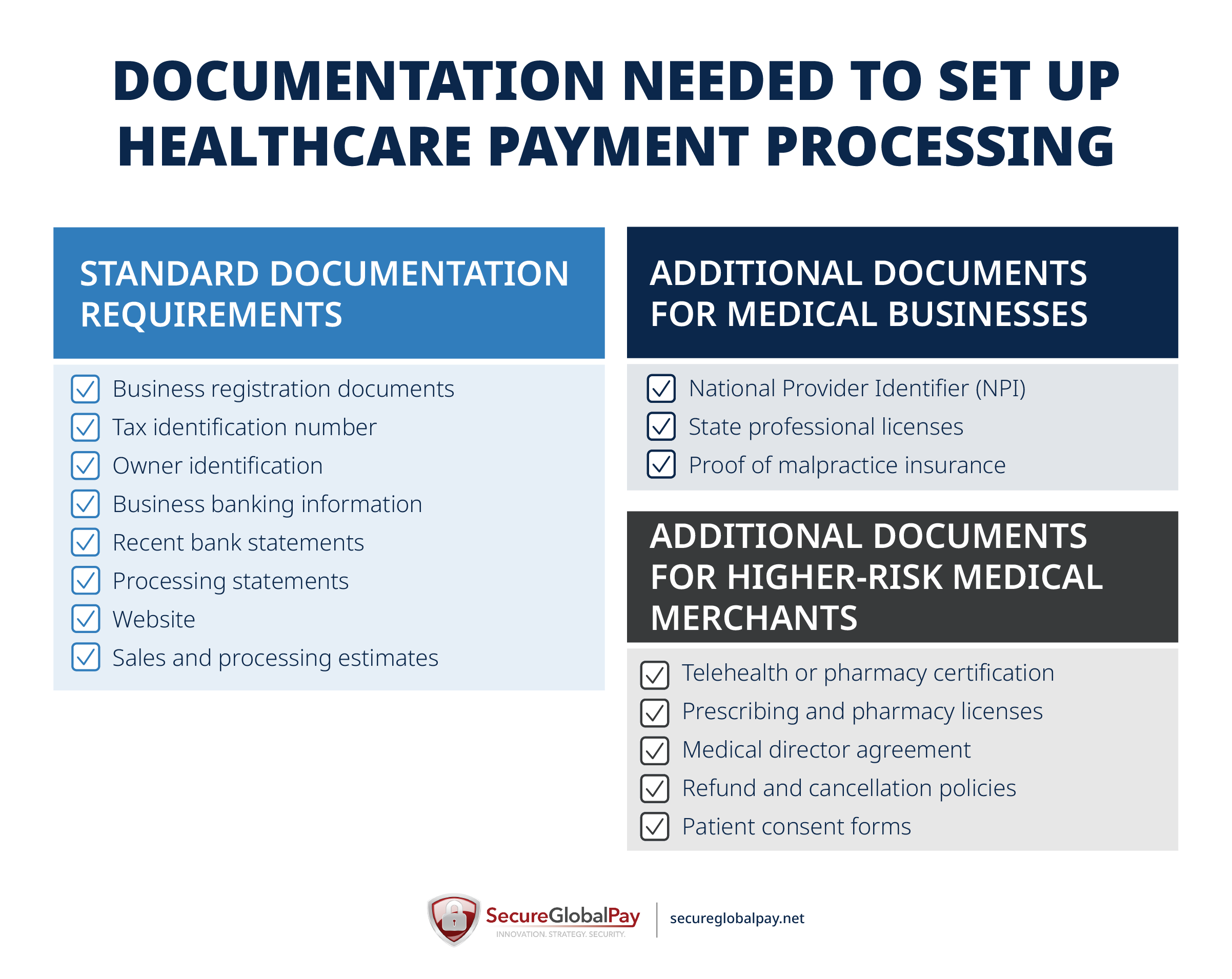
Standard documentation requirements
Most medical merchant account applications require some combination of the following:
- Business registration documents: Articles of incorporation, a business license, or other documents proving that your practice is legally registered.
- Tax identification number: Your Employer Identification Number (EIN) or another applicable business tax ID.
- Owner identification: A government-issued photo ID, such as a driver’s license or passport, for the practice owners and any other individuals the processor needs to verify.
- Business banking information: A voided check or bank letter for the account where your funds will be deposited. Make sure the business name on the account matches the name on your registration documents.
- Recent bank statements: Typically three to six months of statements, depending on the processor.
- Processing statements: If you already accept card payments, expect to provide three to six months of statements showing your volume, average ticket, refunds, and chargebacks.
- Website: If you have one, it should list your services, practice address, and contact information, along with a privacy policy and your cancellation or refund terms.
- Sales and processing estimates: Your expected monthly card volume, average and highest transaction amounts, and the split between in-person, online, and recurring payments.
Additional documents for medical businesses
On top of the standard paperwork, the acquiring bank will usually want to confirm your credentials as a healthcare provider:
- National Provider Identifier (NPI): The ten-digit number assigned to healthcare providers in the U.S., for the practice and, in some cases, its individual providers.
- State professional licenses: Current medical, dental, nursing, or other professional licenses for the providers who deliver care.
- Proof of malpractice insurance: Some banks ask for a certificate of insurance, particularly from practices that perform procedures.
Additional documents for higher-risk medical merchants
Finally, depending on your business model and what you do, you may be asked for additional information, such as:
- Telehealth or pharmacy certification: Card networks require additional certification for businesses that prescribe or sell prescription medication online. LegitScript certification is the most common way to meet this requirement.
- Prescribing and pharmacy licenses: State pharmacy licenses, DEA registration if controlled substances are involved, and proof that your providers are licensed in every state where you treat patients.
- Medical director agreement: Med spas and wellness clinics that aren’t owned by a physician are often asked to show who provides medical oversight.
- Refund and cancellation policies: Clear terms for prepaid treatment packages, memberships, and subscriptions, including how patients can cancel and what happens to unused sessions.
- Patient consent forms: Treatment consent forms and signed authorizations for recurring charges or cards kept on file.
You don’t need every document on this list to start an application. When you fill out SecureGlobalPay’s online application form, our team will review your application and website in detail and let you know if anything is missing before we forward it to our acquiring partners.
How to set up healthcare payment processing for your practice
Setting up healthcare payment processing comes down to four steps: choosing a provider, applying, reviewing the agreement, and configuring your payment setup.
1. Find the right medical merchant services provider
Payment aggregators like Stripe, Square, and PayPal are a quick way to start, and they work fine for many small practices. However, they restrict certain medical services and products, and they may hold funds or close an account when a practice’s billing model falls outside their comfort zone.
Telehealth providers, med spas, and membership-based practices are safer with a high-risk merchant services provider like SecureGlobalPay that underwrites their business properly upfront.
When comparing providers, pay particular attention to:
- Healthcare experience: Ask whether the provider works with practices like yours, with similar services and billing models.
- Transaction and volume limits: Check that the provider can support your expected monthly volume and your largest payments without triggering holds or declines.
- Processing fees: Compare transaction rates, monthly fees, gateway charges, chargeback fees, and any additional costs that come with higher-risk accounts.
- Fraud and chargeback protection: Look for tools such as AVS, card security code checks, 3D Secure, and chargeback alerts.
- HIPAA and PCI compliance: PCI DSS protects card data, while HIPAA protects patient health information, so being compliant with one doesn’t cover the other. Simply processing card payments doesn’t require a Business Associate Agreement (BAA). But if you’ll use the provider’s tools to send patient invoices, keep cards on file, or run a payment portal, ask whether they will sign one. Whichever provider you choose, keep diagnoses and treatment details out of payment descriptions and receipts.
- Payment methods and integrations: Confirm that the provider supports all the ways your patients need to be able to pay, and that their gateway works with the software you already use.
- Customer support: Especially if you are on the higher-risk side of things, you will want a dedicated account manager you can quickly reach via phone or email.
SecureGlobalPay provides merchant accounts and a dedicated payment gateway for both standard and higher-risk medical practices, with solutions for in-office, online, and recurring payments.
Feel free to email us at partners@secureglobalpay.net or call +1-800-419-1772 to discuss your practice, billing model, and processing requirements.
2. Apply online and submit supporting documents
Most providers have an online application form where you enter your business details, describe the services you offer, provide estimated processing volumes, and upload supporting documents.

In the screenshot above, you can see the starting screen of our online merchant application. It guides you through the required information and documentation. If you’re unsure about certain fields, you can leave them blank, and we’ll follow up if anything important is missing.
During underwriting, the acquiring bank may come back with additional questions. To avoid delays, describe your services and billing model accurately, disclose any memberships, prepaid packages, or prescription products, and respond promptly to requests for more documents.
3. Review terms and sign the contract
Once your medical merchant account is approved, review the merchant agreement before signing. Pay particular attention to:
- Processing rates and transaction limits
- Monthly and gateway fees
- Reserve requirements
- Funding and settlement times
- Chargeback fees
- Contract terms (length, cancellation procedures, early termination fees, and any minimum processing commitments)
- Approved services and sales channels (which services, products, websites, and locations your merchant account is authorized to support)
If you plan to add telehealth visits, launch a membership program, or start selling products online, contact your merchant services provider beforehand. New services or billing models may need additional approval.
4. Configure and test your payment setup
After approval, you’ll need to connect your merchant account to the terminals, gateway, and software your practice uses. The exact setup depends on how your patients pay.
Here are the most common scenarios:
- Collecting payments at the front desk: Set up your POS terminal and confirm it accepts chip, contactless, and HSA and FSA cards.
- Accepting payments through a website or patient portal: Connect the payment gateway to your website, portal, or practice management software. This is usually done by entering API credentials or installing a plugin.
- Taking payments over the phone: Set up a virtual terminal and give access only to the staff who need it.
- Billing memberships and payment plans: Configure recurring billing schedules, secure card storage, and notifications for failed payments.
- Running multiple locations: Choose a setup that lets you track payments, refunds, and deposits for each location through centralized reporting.
Before you start charging patients, run a few test transactions. Check that payments are authorized, refunds go through, and transactions appear correctly in your reporting dashboard and your patient accounts.
If you need help with the technical setup, SecureGlobalPay’s hands-on support team is always at your disposal.
Get the best merchant services for medical practices from SecureGlobalPay
SecureGlobalPay is a U.S.-based merchant services provider that has been helping retail and high-risk businesses accept and process payments since 2013.
Whether you run a family practice, a multi-location clinic, a med spa, or a telehealth service, we can help you secure a suitable medical merchant account and set up payment processing that fits the way you bill your patients.
You’ll get everything you need in one place: a stable merchant account, a secure payment gateway with recurring billing, an easy-to-use virtual terminal, and modern POS systems. All of it is backed by a dedicated U.S. support team with years of experience in payment processing.
To get started, simply fill out our online application. We look forward to working with you!
Written by Roland G. Szasz - Director of Business Development - 25+ years in payment processing.
Roland has spent nearly three decades helping businesses navigate the complexities of payment processing. He now works closely with high-risk merchants that have been declined or restricted by conventional providers - and shares his experience and best practices on this blog.

Posted in - Merchant Accounts
Tailored payment solutions for high-risk merchants
- Domestic and offshore accounts
- Competitive, interchange plus pricing
- No long-term contracts or hidden fees
- Built in fraud protection
- Dedicated account manager; 24/7
Sign up in 5 minutes

A+ Rating
as of 06/17/26