


Home » Get Jewelry Merchant Services & Credit Card Processing
Get Jewelry Merchant Services & Credit Card Processing
| October 28, 2026
Selling jewelry can be a very profitable business, but getting credit card processing up and running isn’t always straightforward. Depending on your average transaction value, monthly volume, and how you operate, payment processors may classify your jewelry business as medium-risk or high-risk.
The good news? Jewelry merchant services providers like SecureGlobalPay support everything from small online boutiques to high-end jewelry stores.
Continue reading to learn who needs specialized jewelry merchant accounts, what documentation you’ll need to apply, and how to find the right payment processing solution.
Which jewelry businesses need specialized merchant accounts
Not all jewelry businesses need to open a high-risk merchant account. However, many do, especially those that offer expensive products, have long fulfillment timelines, sell internationally, or experience higher levels of chargebacks.
The table below provides an illustrative risk assessment for different jewelry businesses based on our experience. Different acquiring banks have different risk estimations, but this is generally what you can expect.
| Jewelry business type | Typical processing risk | Explanation |
|---|---|---|
| Affordable handmade and costume jewelry | Low to moderate | Lower transaction values and relatively simple fulfillment reduce financial exposure, especially for established sellers. |
| Fashion jewelry stores | Low to moderate | Generally affordable products, although online sales and high refund rates can increase risk. |
| Traditional jewelry retailers | Moderate | Higher average transaction values and occasional expensive purchases may require additional underwriting. |
| Fine jewelry and engagement ring stores | Moderate to high | Expensive products, potential fraud, and disputes over product quality or authenticity increase exposure. |
| Custom and made-to-order jewelry | Moderate to high | Large upfront deposits, long fulfillment times, and disagreements over custom designs can all lead to increased chargebacks. |
| Online luxury jewelry stores | High | High-ticket, card-not-present transactions increase potential fraud losses and make payment verification more important. |
| Diamond, gemstone, and precious metal dealers | High to very high | High-value, easily resold products, large transactions, and international trading often attract greater scrutiny from acquiring banks. |
| Luxury watch and secondhand jewelry dealers | High | Expensive resale inventory, authentication disputes, and the risk of stolen or misrepresented goods complicate underwriting. |
Consider two common examples:
- Small handmade jewelry business: An online seller processing $8,000 per month, with an average order value of $45, may only need a basic eCommerce payment gateway, standard fraud protection, and a merchant account with low monthly fees.
- High-end jewelry store: A retailer processing $200,000 per month, with individual purchases ranging from $500 to $25,000, may need a specialized merchant account with higher transaction limits, a payment gateway with multi-MID capabilities and smart routing, advanced fraud screening, strong chargeback protection, and support for both in-store and online payments.
Both businesses sell jewelry, but their processing requirements end up being significantly different.
The documentation you’ll need to apply for a jewelry merchant account
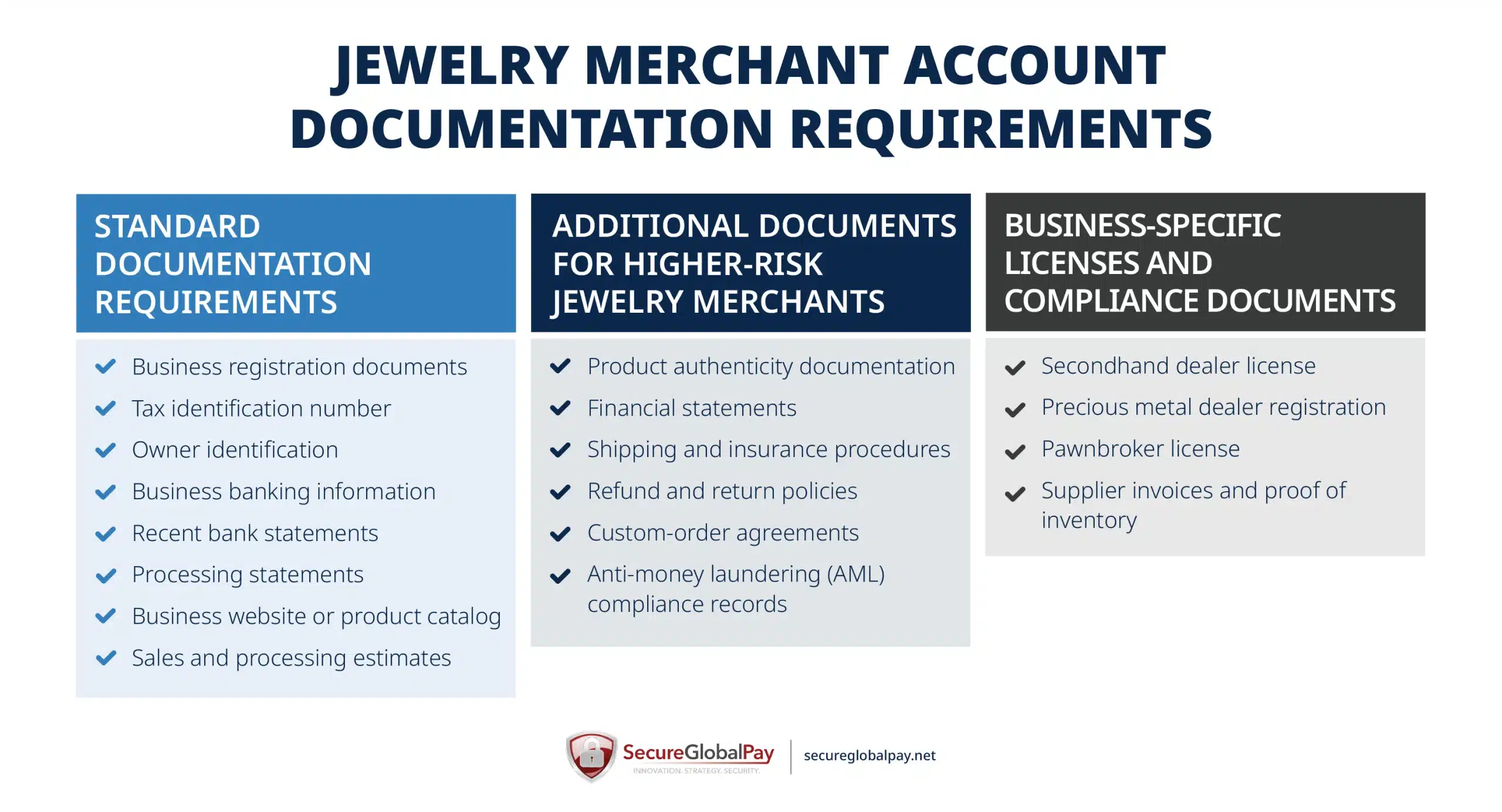
To open a jewelry merchant account, you will typically need to provide documents that verify your business, its owners, financial stability, and the products you sell.
The exact requirements depend on your payment processor, business model, and risk profile. High-end jewelry stores and businesses processing large online transactions may face additional underwriting requirements.
Standard documentation requirements
Most jewelry merchant account applications require some combination of the following:
- Business registration documents: Articles of incorporation, business licenses, or other documents proving that your jewelry business is legally registered.
- Tax identification number: Your Employer Identification Number (EIN) or another applicable business tax ID.
- Owner identification: A government-issued photo ID, such as a passport or driver’s license, for business owners and other individuals the processor needs to verify.
- Business banking information: A voided check, bank verification letter, or other proof of the business bank account where processing funds will be deposited.
- Recent bank statements: Typically three to six months of statements, depending on the processor, to help assess your financial stability.
- Processing statements: If you already accept card payments, you may be asked for three to six months of statements showing transaction volume, average ticket size, refunds, and chargebacks.
- Business website or product catalog: Your website, online store, or product catalog showing what you sell, clear and transparent pricing, and how customers can contact you.
- Sales and processing estimates: Your expected monthly card sales volume, average transaction value, maximum transaction amount, and breakdown of online versus in-store sales.
If you sell jewelry online, make sure your website includes clear product descriptions and pricing, contact information, shipping and delivery terms, a privacy policy, and visible refund and cancellation policies.
Pay particular attention to custom orders, deposits, and non-refundable purchases. Clearly disclosing these terms during checkout can help prevent disputes and support compliance with card network requirements.
Additional documents for higher-risk jewelry merchants
Depending on your products and transaction values, the acquiring bank may request additional information like:
- Product authenticity documentation: Grading reports, certificates, or other supporting records for diamonds, gemstones, and branded luxury goods, where applicable.
- Financial statements: Profit and loss statements, balance sheets, or other financial records, particularly for new businesses expecting high processing volumes.
- Shipping and insurance procedures: Information about how you ship expensive products, insure deliveries, verify recipients, and handle lost or damaged shipments.
- Refund and return policies: Clear policies explaining when customers can request refunds, how returns are handled, and whether custom-made jewelry is refundable.
- Custom-order agreements: Contracts or terms covering deposits, production timelines, customer approvals, cancellations, and final payments for made-to-order jewelry.
- Anti-money laundering (AML) compliance records: Certain precious metal, gemstone, and jewelry dealers may need to demonstrate compliance with applicable AML requirements, including maintaining a written AML program.
You don’t necessarily need every document listed above to start an application. Just prepare the standard documents and explain your business model clearly.
When you fill out SecureGlobalPay’s online application form, our team will review your application and website in detail and let you know if anything is missing or should be added before we forward your application to our acquiring partners.
Business-specific licenses and compliance documents
Depending on their business model and location, a jewelry merchant might also be asked to provide:
- Secondhand dealer license: May be required if you purchase used jewelry, gold, or luxury watches directly from consumers.
- Precious metal dealer registration: Certain businesses buying and selling precious metals may need state or local registration, licensing, or other regulatory documentation.
- Pawnbroker license: Generally required if your business offers loans secured by jewelry, watches, or other valuables.
- Supplier invoices and proof of inventory: Documents showing where you source your jewelry, diamonds, gemstones, precious metals, or luxury watches. Imports of rough diamonds require Kimberley Process certification.
How to set up credit card processing for your jewelry store
Setting up credit card processing for a jewelry business involves choosing a merchant services provider, completing the application and underwriting process, and configuring your payment equipment or gateway.
1. Find the right jewelry merchant services provider
Traditional payment processors, as well as aggregators like Stripe and PayPal, decline or heavily restrict certain jewelry sales. Look for a jewelry merchant services provider that understands your business model and supports your products and transaction volumes.
When comparing providers, pay particular attention to:
- Jewelry industry experience: Ask whether the provider works with businesses selling similar products at comparable price points.
- Transaction limits: Check whether the provider can support your expected monthly processing volume and largest individual purchases without triggering unnecessary holds or declines.
- Processing fees: Compare transaction rates, monthly fees, gateway charges, chargeback fees, and any additional costs associated with high-risk accounts.
- Fraud and chargeback protection: Look for tools such as Address Verification Service (AVS), card security code checks, 3D Secure, and transaction monitoring to reduce fraud exposure.
- Supported payment methods and integrations: Confirm that the provider supports your sales channels, whether you need a robust payment gateway, an in-store POS terminal, a virtual terminal, or a combination. Also, make sure that their gateway can seamlessly integrate with the eCommerce platforms you (plan to) use.
- Customer support: Look for a provider that can assist with underwriting questions, technical setup, account reviews, and payment disputes.
SecureGlobalPay provides merchant accounts and a dedicated gateway for both retail and higher-risk jewelry merchants. You’ll get payment processing technology suited to your jewelry business, including online and in-store solutions.
Do not hesitate to email us at partners@secureglobalpay.net or call +1-800-419-1772 to discuss your products, transaction values, and processing requirements.
2. Apply online and submit supporting documents
These days, most providers have an online application form where you’ll enter your business details, describe the jewelry you sell, provide estimated processing volumes, and upload supporting documents.
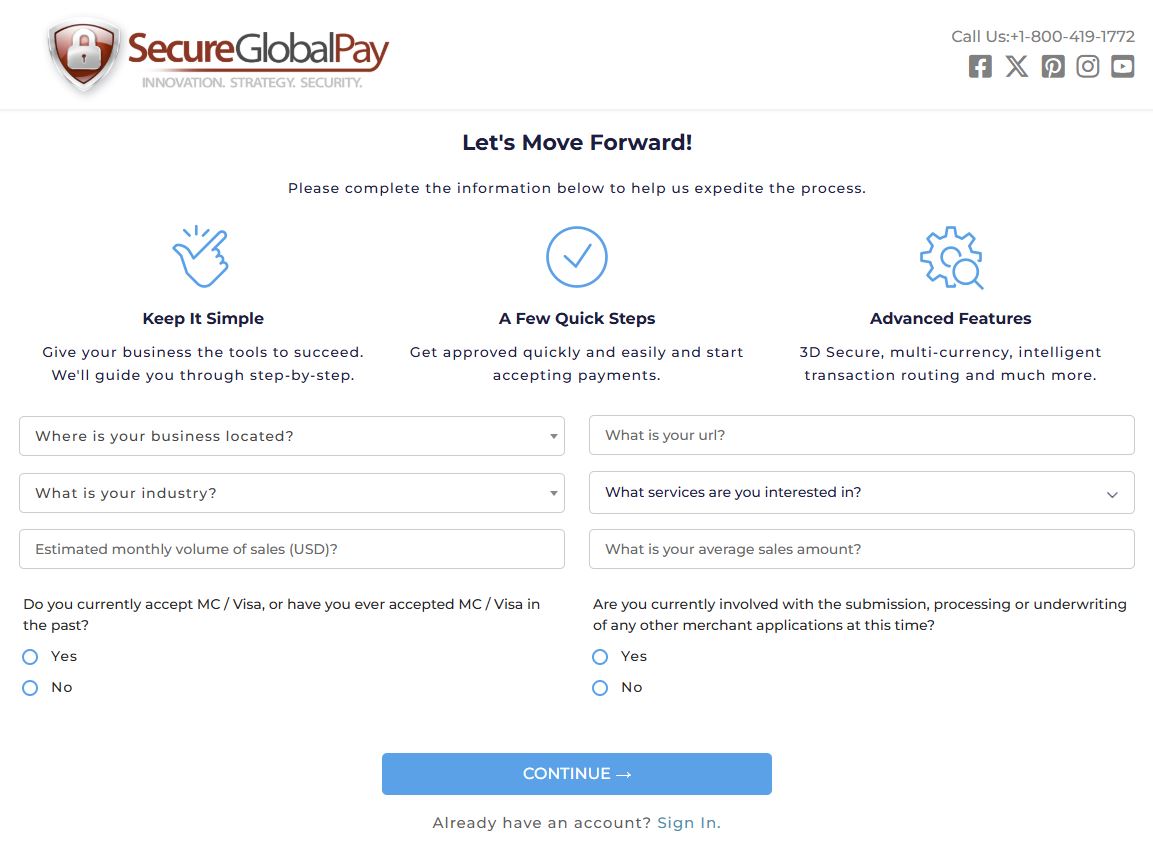
In the screenshot above, you can see the starting screen of SecureGlobalPay’s online merchant application. It guides you through the required information and documentation. If you’re unsure about certain fields, you can leave them blank, and we’ll follow up if anything important is missing.
During underwriting, the acquiring bank may ask additional questions. To avoid unnecessary delays, provide accurate processing estimates, disclose your highest expected transaction amounts, and respond promptly to requests for additional documentation.
3. Review terms and sign the contract
Once your jewelry merchant account is approved, review the merchant agreement before signing. Pay particular attention to:
- Processing rates and transaction limits
- Monthly and gateway fees
- Reserve requirements
- Funding and settlement times
- Chargeback fees
- Contract terms (length, cancellation procedures, early termination fees, and any minimum processing commitments)
- Approved products and sales channels (which jewelry categories, websites, physical locations, and countries your merchant account is authorized to support).
If you plan to expand into luxury jewelry, introduce new product categories, or significantly increase your transaction volume, contact your merchant services provider beforehand to confirm whether additional approval is required.
4. Configure and test your payment setup
Once your merchant account is approved, you’ll need to connect it to your payment gateway, ecommerce platform, or point-of-sale (POS) system. The exact setup depends on how and where you sell your products.
Here are the most common scenarios:
- Selling online through your website: Integrate your payment gateway using the provider’s API or a supported payment integration. Configure accepted payment methods, fraud screening, and secure checkout.
- Selling through an ecommerce platform: Connect the payment gateway to platforms like Shopify, WooCommerce, or BigCommerce. This is usually done by copy/pasting API credentials or installing a plugin.
- Operating a physical jewelry store: Set up and configure your POS hardware and software. For high-value purchases, consider additional identity verification and fraud prevention procedures.
- Selling through multiple channels: If you operate both an online store and physical locations, choose a setup that supports all your sales channels. Ideally, you should be able to track transactions, refunds, and settlements through centralized reporting.
- Accepting phone orders or deposits for custom jewelry: Configure MOTO payments through a virtual terminal, secure payment link, or supported invoicing solution. Make sure your setup supports deposits and subsequent payments when orders are completed.
Before accepting real customer orders, run a few test transactions to verify that everything works correctly. Check that payments are authorized, refunds can be processed, and transaction details appear correctly in your reporting dashboard.
For expensive jewelry, also verify that your maximum transaction limits are configured correctly. Where possible, use your gateway’s test environment before processing live payments.
If you need help with the technical setup, SecureGlobalPay’s hands-on support team is always at your disposal and can be reached via phone or email.
Get jewelry business merchant services from SecureGlobalPay
SecureGlobalPay is a U.S.-based merchant services provider helping retail and high-risk businesses accept and process payments since 2013.
Whether you operate a small jewelry boutique, an online fine jewelry store, or a high-volume luxury jewelry business, we can help you secure a suitable merchant account and configure your payment setup.
You’ll get everything you need in one place — from a stable merchant account and state-of-the-art payment gateway to an intuitive virtual terminal and modern POS systems. All backed by dedicated U.S. customer support full of industry veterans.
To get started, simply fill out our online application. We look forward to working with you!
Written by Roland G. Szasz - Director of Business Development - 25+ years in payment processing.
Roland has spent nearly three decades helping businesses navigate the complexities of payment processing. He now works closely with high-risk merchants that have been declined or restricted by conventional providers - and shares his experience and best practices on this blog.
FAQ
In the U.S., you generally don’t need a jewelry-specific license to sell new jewelry. However, you may need a general business license, sales tax permit, or other local permits. Additional licensing requirements may apply if you buy and resell secondhand jewelry, trade precious metals, or operate a pawnshop. Requirements vary by state and municipality.
Payment processors may classify online luxury jewelry stores, diamond and precious gemstone dealers, precious metal traders, and secondhand luxury jewelry sellers as high-risk. Common reasons include high transaction values, fraud exposure, high chargeback potential, and international sales.
Getting a merchant account is usually straightforward for established jewelry businesses selling lower-priced products. High-ticket jewelry merchants and online luxury retailers may face stricter underwriting requirements, including additional financial documentation, transaction limits, or reserve requirements. Working with a provider experienced in jewelry payment processing can simplify the application process.
The best platform depends on the type of jewelry you sell. Etsy is a popular option for handmade and vintage jewelry, eBay supports new and secondhand jewelry, and Shopify is suitable for building your own branded online jewelry store. For established luxury jewelry businesses, a dedicated eCommerce website may offer greater control over branding, customer experience, and payment processing.
Jewelry businesses choose SecureGlobalPay as their payment processor because of our affordable rates, experience within the jewelry industry, 200+ gateway integrations, and an amazing support team that provides hands-on assistance with everything from account approval and payment setup to ongoing processing needs.

Posted in - High-Risk Payment Processing, Merchant Accounts
Tailored payment solutions for high-risk merchants
- Domestic and offshore accounts
- Competitive, interchange plus pricing
- No long-term contracts or hidden fees
- Built in fraud protection
- Dedicated account manager; 24/7
Sign up in 5 minutes

A+ Rating
as of 06/17/26