


Home » How to Set Up a High-Risk Peptides Merchant Account and Payment Processing

How to Set Up a High-Risk Peptides Merchant Account and Payment Processing
| September 25, 2026
Selling peptides online can make payment processing more complicated than it is for a typical ecommerce business. Banks and processors apply additional scrutiny because peptide products can fall into different regulatory categories, involve health-related claims, and carry higher compliance and chargeback risk.
That does not mean peptide merchants cannot accept credit and debit cards. It means you need a high-risk merchant account for peptides that is underwritten for your specific products, business model, sales channels, and customer base.
In this guide, we explain what documents and website requirements peptide sellers should prepare, where you can apply, what to expect during application and review, what you can do to maximize your chances of approval — and how SecureGlobalPay can help.
What is a high-risk merchant account for peptides?
A high-risk peptide merchant account is a payment processing account specifically underwritten to support a peptide-related business. Approval is based on a closer review of your products, website, business model, marketing practices, processing history, and any regulatory requirements that apply to you.
This means approval for one business model or product range does not automatically cover everything you may want to sell later.
If you add new peptide compounds, launch another website, expand into new countries, or add a new sales channel, notify your account provider, as you may need additional approval.
What documents do you need to apply for a peptide merchant account?
A company supplying research peptides to laboratories presents a completely different risk profile from an online pharmacy dispensing prescription peptides or a small business that sells specific peptide products to customers through their webshop.
Here are the differences between these models in the eyes of underwriters and acquiring banks.
| PEPTIDE BUSINESS MODEL | WHAT UNDERWRITERS FOCUS ON | BUSINESS-SPECIFIC DOCUMENTATION |
|---|---|---|
| Online supplement or nutraceutical seller | Labeling, health claims, recurring billing, fulfillment, refund rates, and whether any products contain restricted or questionable ingredients | Supplement labels, ingredient lists, COAs, manufacturer documentation, product-claim substantiation |
| Cosmetic or topical peptide seller | Whether products are genuinely marketed as cosmetics rather than drugs, ingredient safety, product claims, manufacturing, and fulfillment | Product labels, ingredient lists, supplier or manufacturer documentation, testing or COAs, documentation supporting product claims |
| Licensed or compounding pharmacy | Pharmacy licensing, prescription requirements, dispensing practices, product sourcing, jurisdictions served, and online pharmacy compliance | Pharmacy licenses, pharmacist credentials, dispensing or compounding documentation, healthcare certification or accreditation where required |
| Research-use-only peptide supplier | Whether products are genuinely sold for laboratory or research use, customer types, product labeling, marketing claims, sourcing, and whether the website suggests human use | Product catalog, certificates of analysis (COAs), supplier invoices, product labels, intended-use policy, explanation of customer base |
| Peptide manufacturer, wholesaler, or distributor | Supply chain, customers, manufacturing standards, jurisdictions, product traceability, and whether the company distributes regulated pharmaceutical products | Manufacturing or wholesale licenses where applicable, supplier or manufacturing agreements, batch records, COAs, GMP-related documentation |
Keep in mind that “peptide business” is not an underwriting category in itself. The processor and acquiring bank need to understand exactly what you sell and how you operate before determining which MCC, banking relationship, documentation, and compliance requirements apply.
If you apply for a peptides merchant account with SecureGlobalPay, our team will review your application first. We will warn you about any major issues or missing documents before forwarding your application to the acquirer.
Below is a more detailed breakdown of documentation requirements.
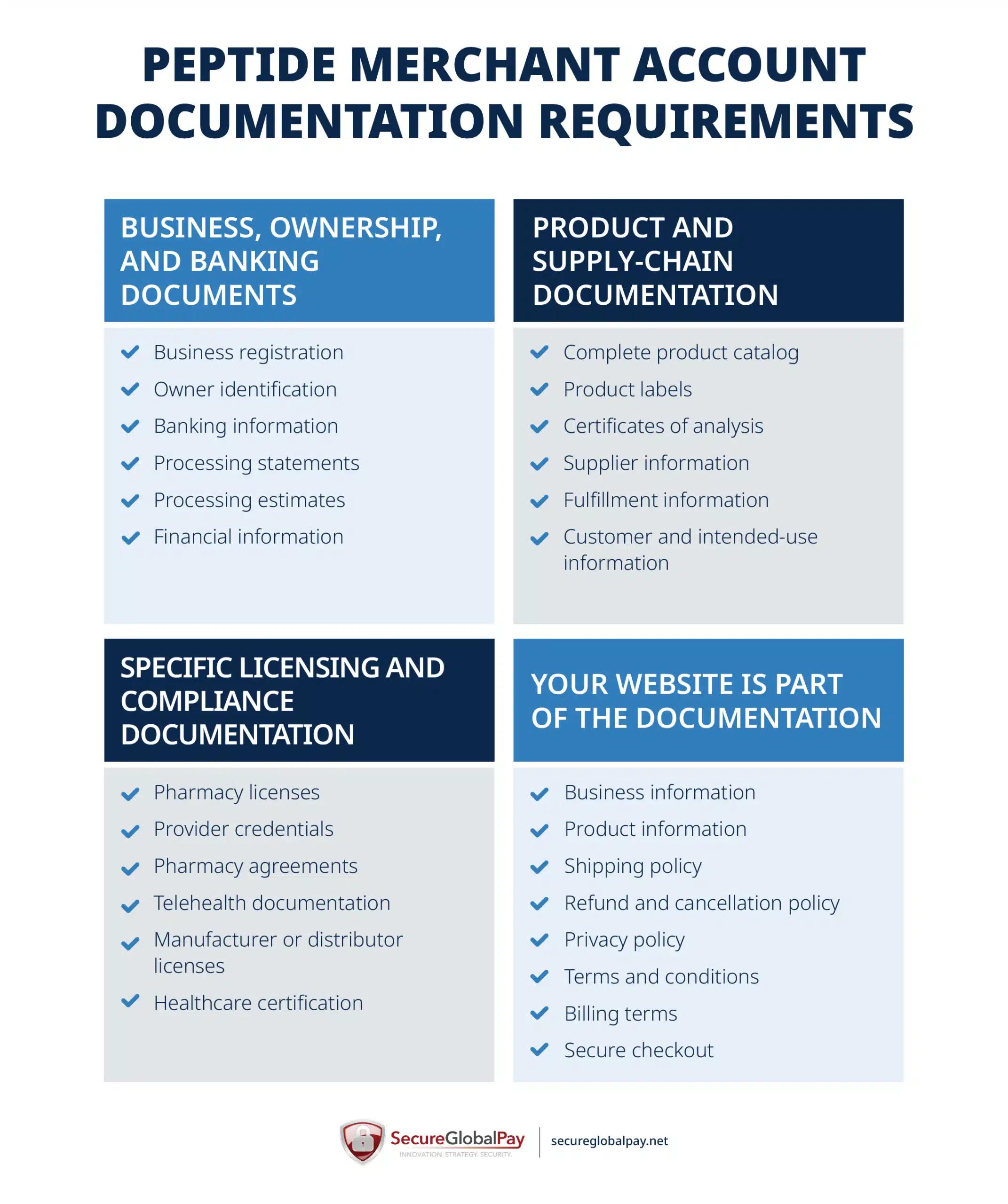
1. Business, ownership, and banking documents
Most applications start with standard documents that allow the provider and acquiring bank to verify your company, its owners, and where processing funds will be deposited.
You may be asked for:
- Business registration: Articles of incorporation, business license, EIN, or equivalent registration documents.
- Owner identification: Government-issued ID and ownership information for principals or beneficial owners.
- Banking information: A voided check, bank letter, and recent business bank statements.
- Processing statements: Usually several months of statements if you already accept payments.
- Processing estimates: Expected monthly volume, average transaction size, maximum ticket, and customer locations.
- Financial information: Higher-volume merchants may sometimes be asked for financial statements or additional evidence of financial stability.
Underwriters will also want to understand your chargeback history, previous processing volumes, and any past merchant account closures.
2. Product and supply-chain documentation
Peptide merchants should be prepared to show what they sell and where those products come from. Depending on your operation, requested documentation may include:
- Complete product catalog: A list of peptide compounds and other products sold through the website.
- Product labels: Packaging and labeling showing product identity, intended use, warnings, and other relevant information.
- Certificates of analysis: COAs or testing documentation for applicable products and batches.
- Supplier information: Supplier names, invoices, manufacturing agreements, or other sourcing records.
- Fulfillment information: Details about where inventory is stored and who fulfills customer orders.
- Customer and intended-use information: Particularly important for businesses representing themselves as research-use-only suppliers.
3. Specific licensing and compliance documentation
Additional documentation may be required when the business involves prescription products, pharmacy services, telehealth, medical providers, pharmaceutical distribution, or other regulated healthcare activities.
So, depending on your business model, this could include:
- Pharmacy licenses: State or jurisdiction-specific licenses for pharmacies selling or dispensing peptides.
- Provider credentials: Medical licenses for doctors or other professionals involved in prescribing.
- Pharmacy agreements: Agreements with the pharmacy responsible for dispensing and fulfilling prescriptions.
- Telehealth documentation: Policies, prescribing workflows, and documentation showing compliance with applicable telemedicine requirements.
- Manufacturer or distributor licenses: Where pharmaceutical manufacturing, wholesale, or distribution rules apply.
- Healthcare certification: LegitScript or another recognized certification when required by the processor, card network, advertising platform, or acquiring bank.
LegitScript Healthcare Certification, for example, covers activities such as selling prescription medications online, telemedicine that can result in prescriptions, card-not-present prescription drug sales, and pharmaceutical manufacturing or distribution.
LegitScript currently states that businesses selling only research-use chemicals, including research-use peptides, are generally outside the scope of this certification. However, this does not guarantee underwriters will not request this information when applying for credit card acceptance. This will always depend on the sponsor bank and their appetite for risk.
4. Your website is part of the documentation
Your website is effectively another underwriting document. The acquiring bank will often review it to confirm that what customers see matches the products and business model described in your application.
Before applying, make sure the site clearly shows:
- Business information: Legal business name, contact information, and customer support details.
- Product information: Accurate descriptions, pricing, labels, and intended-use information.
- Shipping policy: Fulfillment times, shipping methods, restrictions, and applicable geographic limitations.
- Refund and cancellation policy: Clear instructions explaining when customers can receive refunds or cancel orders.
- Privacy policy: How customer information is collected, stored, and used.
- Terms and conditions: Rules governing purchases and use of the website.
- Billing terms: Particularly if you offer subscriptions or recurring purchases.
- Secure checkout: HTTPS and an appropriately secured payment flow.
Peptide merchants should pay particular attention to consistency between their product labels, website content, and claimed business model. For example, describing products as "research use only" while publishing information suggesting dosing, weight loss, treatment, injection, or other human use can create serious underwriting and regulatory problems.
Steps to open a high-risk peptides merchant account
To get their accounts approved, peptide merchants go through a standard high-risk merchant account underwriting process.
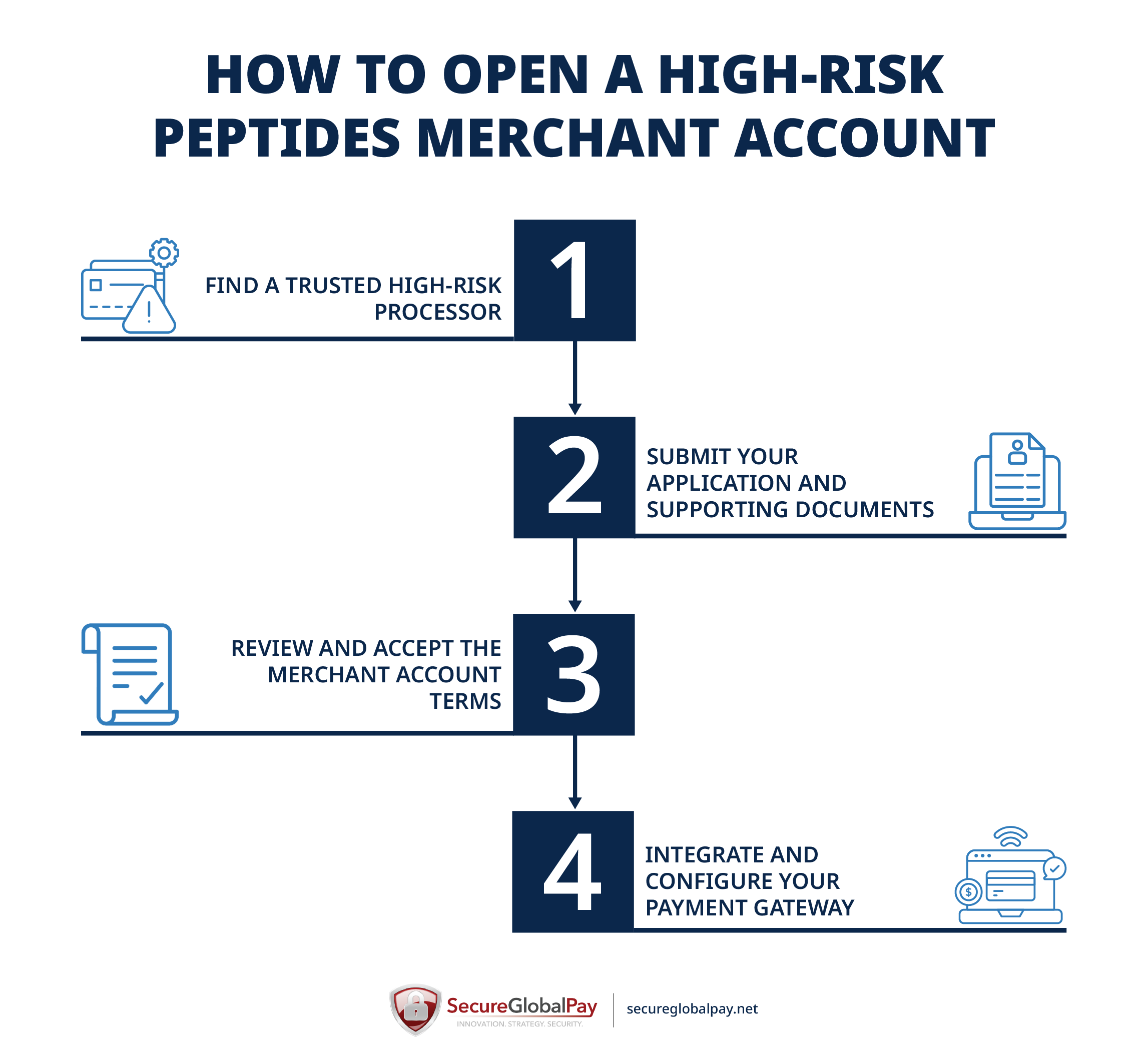
Step 1: Find a trusted high-risk processor
Not every processor that advertises high-risk merchant accounts will support peptide sales. You need a provider that understands your particular business model and works with acquiring banks willing to underwrite those products.
Before applying, email or call the provider to double-check whether they support your specific peptide products, sales model, and customer locations.
For reference, SecureGlobalPay works with most peptide sellers, as we have good relationships with many acquiring banks. Still, don’t hesitate to send an email to partners@securegloalpay.net or call us at +1-800-419-1772 if you have any questions.
Step 2: Submit your application and supporting documents

In the screenshot above, you can see the starting screen of our online merchant application form. Most providers have a similar form you will need to fill out.
The form is designed to guide you through the documentation you need to submit. If there are any fields you are unsure about, feel free to skip them. We will reach out if any necessary documents that apply to you are missing.
During the underwriting process, follow-up questions are common with peptide merchant accounts. Responding quickly and providing complete documentation is the best way you can speed up the process.
Step 3: Review and accept the merchant account terms
After approval, review the merchant agreement before signing. Pay particular attention to:
- Processing rates and transaction fees: The percentage and fixed fee applied to each transaction.
- Monthly and gateway fees: Recurring costs associated with the account and payment gateway.
- Reserve requirements: Whether a portion of your funds will be held in a rolling or fixed reserve.
- Processing limits: Approved monthly volume and maximum transaction size.
- Chargeback fees: Costs associated with customer disputes.
- Contract terms: Contract length, termination requirements, and any early termination fees.
- Approved products and websites: Which products, domains, sales channels, and markets the acquiring bank has agreed to support.
That last point is especially important for peptide merchants. Approval for your current catalog does not necessarily mean you can begin selling additional compounds or launch a new website without first notifying your processor.
Step 4: Integrate and configure your payment gateway
Once the merchant account is active, the only thing left is to connect the payment gateway to your website or ecommerce platform. Depending on your setup, this may involve a simple plugin, hosted payment page, or custom checkout integration.
Before you turn payments on, whenever needed, we can help you configure AVS, CVV checks, fraud rules, billing descriptors, and integrations with other tools. You’ll also want to run a few test transactions to make sure everything checks out.
SecureGlobalPay can provide both the merchant account and payment gateway, helping peptide merchants manage the acquiring relationship and technical integration through one provider. The gateway supports ecommerce integrations, fraud and chargeback controls, recurring billing, reporting, multi-MID setups, and other tools that can be configured around the needs of your peptide business.
Why are peptides high risk for payment processing?
Peptides are considered high risk for payment processing because they can combine regulatory uncertainty, strict marketing rules, healthcare-related compliance requirements, and standard e-commerce risks such as fraud and chargebacks.
1. Regulatory and product classification risk
Peptides can fall into very different regulatory categories. Some are approved prescription drugs, some may be compounded under specific conditions, while others are sold for laboratory research, cosmetic use, or other purposes.
For acquiring banks, this creates additional underwriting work. They need to determine whether the specific products can legally be sold in the merchant’s target markets and whether the business has the licenses, certifications, or other documentation required for that model.
FDA enforcement against peptide sellers has also increased scrutiny around unapproved products marketed for human use.
2. Marketing and intended-use risk
How a peptide is marketed can be just as important as how it is labeled. A website that describes a product as “research use only” may still raise compliance concerns if other content suggests dosing, reconstitution, weight loss, treatment, or other human uses.
Recent FDA warning letters show this clearly. The agency has cracked down on “research-only” peptide sellers who feature product claims, dosing information, peptide calculators, and other content indicating human use on their website and in promotional materials.
3. Card network and acquiring bank requirements
Some peptide businesses can also fall under pharmaceutical or healthcare processing rules. Prescription-only products, online pharmacies, and certain telehealth models may require additional preapproval, registration, licensing checks, or other compliance verification before an acquiring bank will support them.
4. Ecommerce, fraud, and chargeback risk
Peptide merchants also face many of the same risks as other high-risk ecommerce businesses. Card-not-present fraud, international orders, shipping disputes, refund requests, subscription billing, and customers who do not recognize a billing descriptor can all contribute to higher chargeback rates.
These risks become more significant when combined with regulatory concerns or rapidly growing transaction volumes. As a result, acquiring banks may apply closer monitoring, processing limits, reserves, or stricter fraud and chargeback controls to peptide merchant accounts.
Tips to improve your approval odds and keep your peptide merchant account in good standing
Getting approved is only the first step. Peptide merchants also need to keep their products, website, processing activity, and compliance practices aligned with what the acquiring bank originally approved.
A few practices can make both approval and long-term account stability easier:
- Disclose your complete product catalog: Provide an accurate list of the peptides and related products you sell. Do not leave out products that could materially affect how the bank evaluates your business.
- Keep your website and application consistent: Your product descriptions, intended-use statements, customer type, fulfillment model, and geographic markets should match the information submitted during underwriting.
- Avoid unsupported health or treatment claims: Be careful with claims related to weight loss, disease treatment, performance, anti-aging, or other health outcomes unless those claims are legally permitted and appropriately substantiated.
- Make research-use positioning consistent: If you operate as a research-use-only supplier, your labeling, product descriptions, educational content, marketing, and customer targeting should consistently reflect that business model.
- Notify your processor before making major changes: Adding new compounds, websites, brands, countries, fulfillment partners, or sales models may require additional underwriting or approval.
- Keep licenses and certifications current: Pharmacies, telehealth businesses, clinics, manufacturers, and other regulated businesses should make sure required licenses, registrations, and certifications do not expire.
- Maintain good supplier records: Keep supplier invoices, COAs, manufacturing records, and other sourcing documentation organized so you can provide them quickly if the processor requests an account review.
- Monitor chargebacks closely: Investigate the reasons behind disputes and address recurring problems with fulfillment, billing, product expectations, or customer service.
- Use clear billing descriptors: Customers should be able to recognize the charge on their card statement. Unclear descriptors can create avoidable chargebacks.
- Set realistic processing expectations: Give the provider accurate estimates for monthly volume, average ticket size, and maximum transaction amount. If sales increase significantly, discuss the change before suddenly exceeding your approved limits.
- Keep fulfillment predictable: Use reliable shipping methods, provide tracking where possible, and clearly communicate delivery timelines to customers.
The most important principle is transparency. A processor that understands exactly what you sell and how your business operates is in a much better position to place and maintain your account than one that discovers important details only after transactions begin flowing in.
Get a high-risk merchant account for peptides with SecureGlobalPay
SecureGlobalPay helps peptide businesses secure a merchant account and payment gateway that fits their specific products and sales model.
We support many different types of peptide businesses. Merchants that sign up with us get access to:
- Merchant account and gateway in one setup: We can help arrange both domestic and offshore acquiring relationships and provide the technology you need to accept payments online.
- 200+ gateway integrations: Connect with ecommerce platforms, shopping carts, CRMs, accounting software, chargeback tools, and other business systems.
- Flexible payment options: Depending on your approval conditions, you can accept cards, ACH, eCheck, recurring payments, digital wallets, MOTO payments, and other payment methods.
- Fraud and chargeback protection: Use built-in fraud-detection and integrate chargeback management tools to help reduce payment risk.
- Multi-MID and transaction routing: Higher-volume businesses can manage multiple merchant accounts through a single gateway. This comes with rule-based load balancing and smart routing capabilities.
- Transparent account terms: We provide straightforward pricing and do not lock merchants into long contracts with nasty cancellation policies. No application, setup, or other hidden fees.
- Hands-on support: SecureGlobalPay has been in this industry for more than 25 years. You will get expert, dedicated US support you can reach via phone or email — both during setup and ongoing processing.
Apply for a merchant account today or talk to a SecureGlobalPay payment expert about your products, processing needs, and available options.
Written by Roland G. Szasz - Director of Business Development - 25+ years in payment processing.
Roland has spent nearly three decades helping businesses navigate the complexities of payment processing. He now works closely with high-risk merchants that have been declined or restricted by conventional providers - and shares his experience and best practices on this blog.
FAQs
Approval time depends on the complexity of the business and how complete the application is. Straightforward applications with complete documentation can be approved in a few days.
Total processing costs for a peptide merchant account vary based on your business model, products, processing volume, chargeback history, customer locations, and other risk factors.
Not all peptide businesses need LegitScript. LegitScript currently states that research-use-only chemical businesses, including peptide sellers, are generally outside the scope of its Healthcare Certification, while online prescription drug sales, telemedicine, pharmacies, and certain pharmaceutical businesses may fall within it. However, this does not guarantee underwriters will not request this information when applying for credit card acceptance. This will always depend on the sponsor bank and their appetite for risk.
It depends on the products and business model. Stripe restricts certain pharmaceuticals, research chemicals, nutraceuticals, and pseudo-pharmaceutical products, and generally does not support online prescription-drug sales. Peptide merchants should confirm their specific products with Stripe before using the platform, or sign up with a high-risk merchant account provider like SecureGlobalPay.
Requirements depend on where you operate and exactly what you sell. In the U.S., you will generally need the appropriate business registrations, licensing, and permits, while products classified or marketed as drugs can trigger additional federal and state requirements.
Yes. SecureGlobalPay supports ACH and eCheck payments for eligible peptide merchants in addition to cards and other approved payment methods. Available options depend on the merchant’s underwriting and processing setup. Currently, ACH is the most popular method of accepting payments for many peptide merchants that do not yet have LegitScript certification.
Potentially, but all websites and brands should be disclosed during underwriting. Whether they can operate under one merchant account or require separate MIDs depends on ownership, product mix, branding, transaction flow, and the acquiring bank’s requirements.

Posted in - High-Risk Payment Processing, Merchant Accounts
Tailored payment solutions for high-risk merchants
- Domestic and offshore accounts
- Competitive, interchange plus pricing
- No long-term contracts or hidden fees
- Built in fraud protection
- Dedicated account manager; 24/7
Sign up in 5 minutes

A+ Rating
as of 06/17/26