


Home » Stripe vs Dedicated Merchant Account: Which is Right for Your Industry and Volume?

Stripe vs Dedicated Merchant Account: Which is Right for Your Industry and Volume?
| October 13, 2026
You signed up for Stripe in minutes. You’ve got your first card payment a couple of days later. It feels like you have a merchant account — but you really don’t.
A standard Stripe setup and a dedicated merchant account run on different processing models. That difference affects onboarding, pricing, account stability, and underwriting.
Neither model is inherently better. The right choice depends on your volume, industry, risk profile, and processing requirements. Continue reading to see which one fits your business better.
QUICK TAKEAWAYS
- Stripe is a payment facilitator, so you process under its master merchant account instead of using your own dedicated merchant account.
- Stripe gets you processing faster, while a dedicated merchant account takes more upfront underwriting but gives you more control and stability.
- Stripe's flat-rate pricing can get expensive at high volume, unless you are big enough to negotiate custom interchange-plus pricing.
- Many high-risk and restricted businesses do not qualify for Stripe, and even approved accounts can face holds, reserves, or freezes.
- Whichever you choose, high-volume merchants should keep a backup processor so one frozen account can't stop their sales.
Is Stripe a merchant account?
The short answer is no. Stripe is a payment facilitator (also called a payment aggregator), which means you process payments under Stripe’s master account instead of getting your own dedicated merchant account.
A merchant account is what lets a business accept card payments. It’s established directly with an acquiring bank, and card sales settle into it before they’re paid out to your bank account. With the payment facilitator model, Stripe holds one master merchant account and signs up businesses as sub-merchants underneath it.
A dedicated merchant account works differently:
- Your own merchant ID: Your transactions are processed under your business, not pooled with other merchants.
- Individual underwriting: A bank or processor reviews your business before approval, so your terms reflect your actual risk profile.
- Direct relationship: You have your own contract and point of contact with the merchant service provider and acquiring bank.
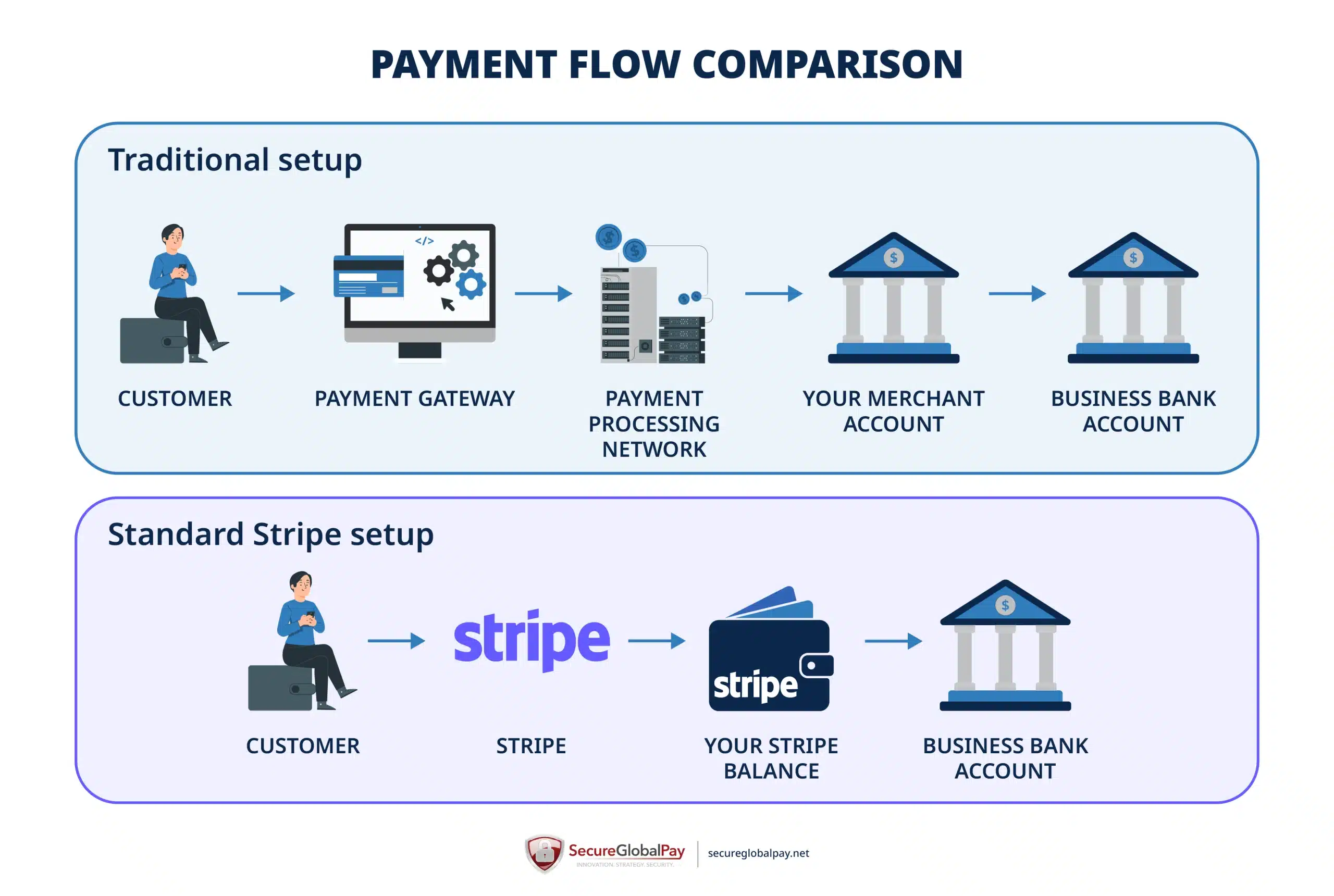
The trade-off is speed versus stability. Stripe gets you processing faster, but a dedicated merchant account is far less likely to result in frozen funds or sudden termination, especially if you’re a high-risk, high-volume, or high-ticket merchant.
Stripe account vs dedicated merchant account at a glance
Here’s how Stripe’s payment facilitator model compares with a dedicated merchant account across the most important factors.
| Factor | Stripe | Dedicated merchant account |
|---|---|---|
| Account structure | Payfac/submerchant model | Merchant-specific account |
| Signup | Near-instant online signup | Slower; online application form + 2 to 5 days of underwriting and setup |
| Pricing | Standardized flat-rate for most; custom for enterprises | Often interchange-plus pricing; exact rates vary based on service provider and merchant risk profile |
| Negotiability | Little to no room to negotiate | You can negotiate terms and rates if you have good processing history |
| High-volume economics | Flat-rate pricing can become quite expensive on larger volumes | Custom pricing can be advantageous, especially for higher risk merchants |
| High-risk businesses | Highly restricted eligibility | There are many specialized high-risk merchant service providers |
| Reserves | Will be imposed based on risk | Set during underwriting; may be negotiated over time |
| Account stability | Substantial risk of fund holds, account limitations, and account terminations | Risk and processing terms are assessed and set upfront so the accounts are much more stable |
| Gateway | Included | May be from a separate vendor, but often bundled together with your dedicated merchant account |
| Integrations/API | Major strength | Depends on provider/gateway |
| Best suited for | Businesses with simple payment needs that prioritize convenience and fast setup | High-risk, high-volume, and high-ticket merchants; businesses with complex payment setups |
While they are on opposite sides in this table, there’s nothing stopping you from using both. After all, you do not want to have all your eggs in one basket, especially if your volume is increasing.
Another advantage of working with dedicated merchant account providers like SecureGlobalPay is that we can often set you up with multiple accounts on the same gateway. This way, if you have issues with one account for whatever reason, you can process through the other one with no downtime and lost sales.
Is Stripe a good choice for high-volume businesses?
Stripe does support high-volume processing, though its flat rate can get expensive. Businesses with very large processing volumes can get custom interchange-plus pricing. However, Stripe doesn’t publish the volume needed to qualify.
Stripe currently (October 2026) offers a standard flat rate of 2.9% + 30¢ per domestic card transaction, with these potential extra fees stacked on top:
- International cards: +1.5%
- Currency conversion: +1%
- Disputes: $15 each
In the best-case scenario (all domestic sales in the primary currency and zero chargebacks), a standard fee for $1 million in domestic monthly sales with a $100 average order is about $32,000, or 3.2%.
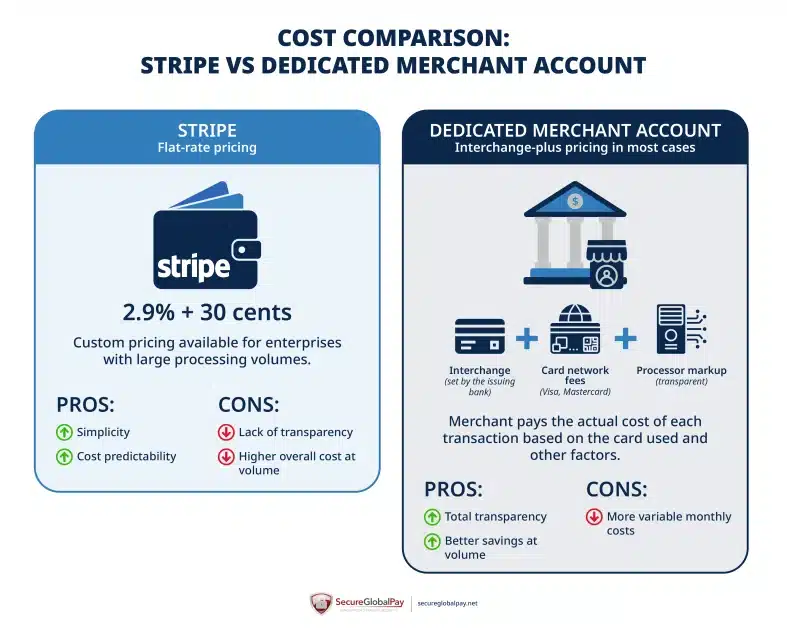
Cost isn’t the only downside. The more you process, the more closely your account is watched, and there’s always a risk of Stripe holding your funds or freezing your account.
A spike in sales, a rise in disputes, or a change in your business structure can all lead to payout delays, reserves, or other processing restrictions, with little recourse.
Stay away from Stripe if you are a high-risk merchant
Stripe maintains an extensive list of prohibited and restricted businesses. Some categories can’t use Stripe at all, while others need additional due diligence or prior approval, and Stripe notes that this approval can be modified or revoked under its agreement.
A successful signup doesn't mean Stripe has underwritten your high-risk business. Its onboarding is built for speed, so getting an account only means you passed an initial check. It doesn't mean Stripe is comfortable with everything you sell or the volume you process, and your account can still be reviewed, limited, or closed later.
Some merchants think they can get around it by selling products they didn’t disclose in their application — but that is a clear case of prohibited use and will get your account terminated when discovered. And as time goes by, Stripe’s risk controls are only going to get more sophisticated.
Specialized high-risk underwriting works the other way around: the processor and acquiring bank review your business model upfront and approve it knowing what you sell. If you need more details, check out this practical guide on how to open a high-risk merchant account.
Get a dedicated merchant account built around your business
SecureGlobalPay is an all-in-one merchant services provider that provides a modern payment gateway and dedicated merchant accounts for all types of high-risk and high-volume businesses. We’re a strong fit if you:
- Operate in a high-risk category.
- Have been restricted or closed by Stripe, PayPal, or other processors.
- Process high monthly volume or sell high-ticket items.
- Need a state-of-the-art gateway bundled with your merchant account.
- Want to set up multiple MIDs with rule-based load balancing or smart payment routing.
- Need help identifying an acquiring bank willing to underwrite your business.
- Would like to work with a processor that will actually answer your emails and phone calls.
Do not limit your business based around Stripe’s terms. Apply for a merchant account and get processing that’s built for your industry.
Written by Roland G. Szasz - Director of Business Development - 25+ years in payment processing.
Roland has spent nearly three decades helping businesses navigate the complexities of payment processing. He now works closely with high-risk merchants that have been declined or restricted by conventional providers - and shares his experience and best practices on this blog.
FAQs
Yes. You apply with a new provider, get approved, and connect their gateway to your checkout. Stripe will work with your new processor to transfer your customers’ saved card data, but only to a PCI DSS Level 1-compliant processor. However, it doesn’t export payment history or subscriptions, so those need to be rebuilt. It’s a good idea to keep Stripe running until the new account is live and tested.
No. Stripe is a payment facilitator, so you process under Stripe’s master merchant account instead of getting a merchant ID (MID) of your own. A merchant ID comes only with a dedicated merchant account.
Typically not. Stripe verifies your identity and business details at signup, but it doesn’t usually run a credit check. Your account still goes through ongoing risk monitoring, which is where holds or reserves can come in.
The main downsides are cost at scale, eligibility, and control. Flat-rate pricing gets expensive as volume grows, restricted and high-risk businesses may not qualify, and Stripe can place reserves or hold funds based on its automated risk monitoring. Since you process under Stripe’s master account, you also have little say in how your account is treated.
Stripe serves businesses of nearly every size, from startups to large enterprises. Its pricing page highlights customers like Squarespace, Instacart, Lyft, and Twilio. In general, it’s the best fit for straightforward, lower-risk businesses that want fast setup and strong integrations.
No. Stripe accepts sole proprietors in the US, so you can sign up as an individual. Keep in mind that as a sole proprietor, you’re personally liable for your obligations under Stripe’s agreement.
Generally no. Stripe’s FAQ says it currently can’t support hemp-based products containing CBD, including oils and tinctures. CBD with THC above the local legal limit is prohibited outright. CBD with negligible THC still appears on its restricted list, which means you could get approved, but with heavy restrictions. Most CBD merchants are better off opening a high-risk CBD merchant account.

Tailored payment solutions for high-risk merchants
- Domestic and offshore accounts
- Competitive, interchange plus pricing
- No long-term contracts or hidden fees
- Built in fraud protection
- Dedicated account manager; 24/7
Sign up in 5 minutes

A+ Rating
as of 06/17/26