


Home » PayPal Closed Your Account? Next Steps to Continue Accepting Payments
PayPal Closed Your Account? Next Steps to Continue Accepting Payments
| October 22, 2026
Waking up to find PayPal has closed your account is a nightmare for any business. Your checkout doesn’t work, your customers can’t pay you, and your money may be locked away, often with little explanation.
We see it all the time. We regularly work with merchants who’ve been shut down by PayPal and need to get back to accepting payments fast, so this article draws on what we’ve learned helping them.
In this guide, we’ll cover why PayPal closes accounts, steps to keep your business running, and what happens to the money still in your account.
Common reasons why PayPal closes accounts
PayPal can place a reserve on your balance, hold individual payments, freeze your funds, or limit your account so you can’t send, receive, or withdraw money. Any of these can lead to closure if the underlying issue isn’t resolved.
The table below covers the reasons that most commonly lead to PayPal shutting an account down, how likely you are to get the account back, and what to do next.
| SHUTDOWN REASON | ACCOUNT RECOVERY CHANCES | RECOMMENDED NEXT STEPS |
|---|---|---|
| Selling prohibited or restricted items (Acceptable Use Policy violation) | Unlikely | Look for a high-risk merchant account provider that approves your industry. |
| High rate of chargebacks, claims, and disputes | Unlikely if permanently closed; possible if only limited | Resolve all open disputes, then look for a high-risk merchant account with chargeback management tools. |
| Sudden jump in sales volume or a new high-cost product type | Possible if the account is limited rather than closed | Answer every PayPal request for information through the Resolution Center. Open a dedicated merchant account in parallel for the new product. |
| Suspected fraud or unauthorized account use | Possible if you’re the victim; unlikely if PayPal suspects you of fraudulent activity | Provide the identity and transaction documentation PayPal requests. Consider a backup processor with stronger fraud controls. |
| Negative balance or unpaid obligations | Possible once the balance is repaid | Clear the negative balance, then contact PayPal through the Resolution Center. |
In all of the scenarios listed above, PayPal’s User Agreement allows funds to be held for up to 180 days when reasonably needed to protect against liability or following an Acceptable Use Policy violation. Court orders, regulatory requirements, or other legal processes may require longer holds. This is not a guaranteed payout deadline, and refunds, chargebacks, or other obligations may reduce the amount available.
PayPal’s account freezes and closures often arrive with no warning. Similar to Stripe, you are at the mercy of its dynamic algorithms. To make things harder, PayPal bases its decisions on confidential criteria it is not obligated to explain. If any part of your business could be considered higher risk, the smart thing to do is to have a backup high-risk processor ready at all times.
Steps to take if PayPal has permanently closed your account
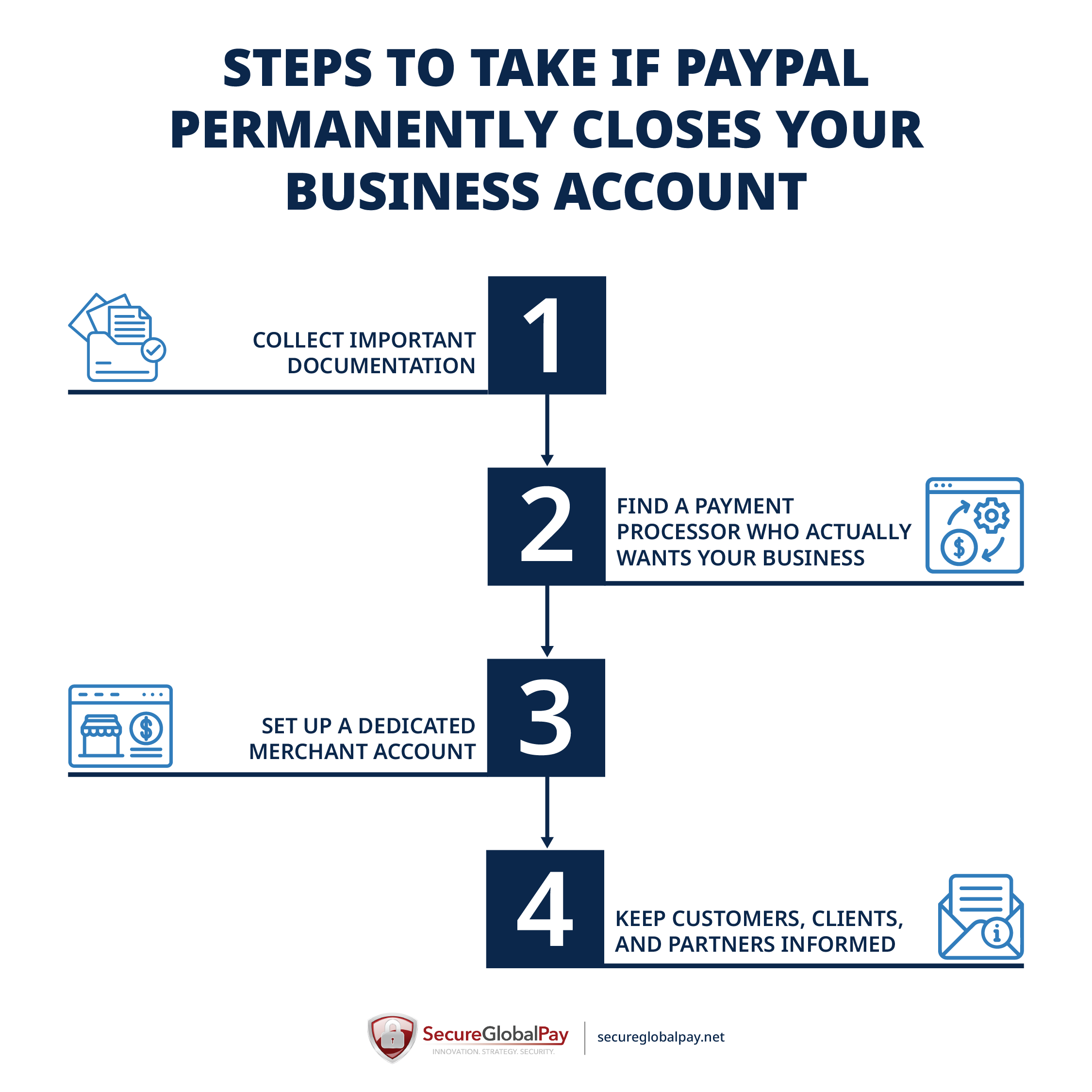
A permanent closure means PayPal’s decision is final. Your time is better spent finding a reliable high-risk processor than arguing your case. Don’t open a new PayPal account to get around it, since PayPal treats that as a violation. Instead, work through these four steps to get your business accepting payments again.
Step 1: Collect important documentation
Start by gathering everything that shows what happened and how your business operated on PayPal. You may need it for a new merchant account or a dispute over held funds later. Begin with the closure notice and any emails or Resolution Center messages from PayPal, then download your transaction history and account statements for as far back as you can.
Add the records that back up your side: invoices, shipping and delivery confirmations, customer communications, refund and dispute records, and supplier or fulfillment documentation. Prepare your business registration and identity documents too, since any new provider will ask for them.
If you can’t log in or download certain documents, contact PayPal support and ask how to get them. Do it early so missing paperwork doesn’t hold up your application.
Step 2: Find a payment processor who actually wants your business
Most merchants can’t afford to wait and see whether PayPal will restore their account (and the chances of that after a permanent closure are extremely low anyway). Every day without a way to take payments costs you revenue, so start your search right away.
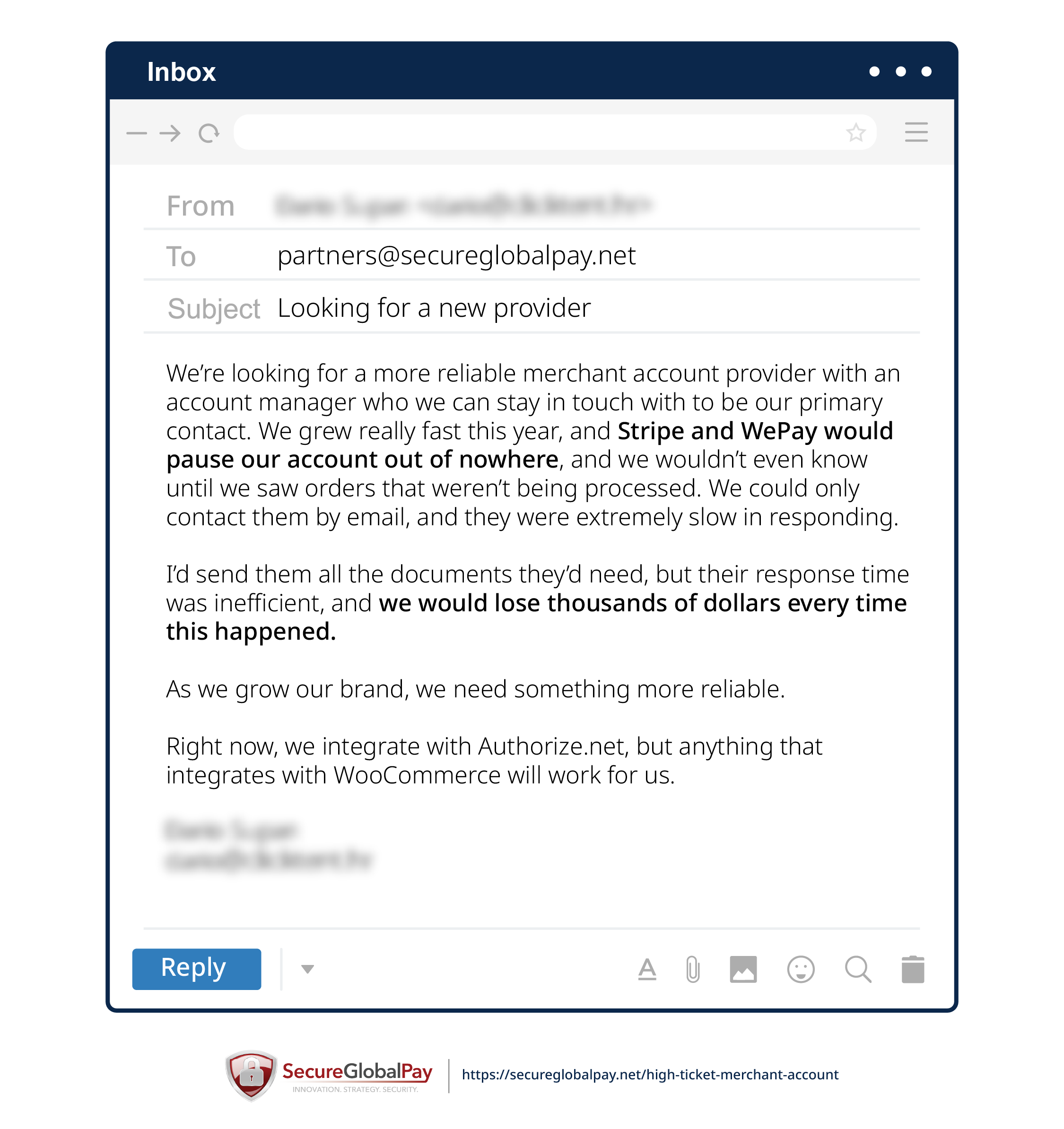
At SecureGlobalPay, we regularly onboard merchants whose accounts were closed by PayPal, Stripe, and similar platforms, as well as merchants who are simply sick of frozen funds and delayed payouts. These are often high-volume, high-ticket, and high-risk businesses. Here’s an example of an email we get almost every month:
When comparing providers, look for experience in your industry and dedicated U.S. customer support. Ideally, your merchant account provider will also offer a capable payment gateway that integrates with the invoicing tools, chargeback software, and e-commerce platforms you already use. Ask about fees, reserves, and contract terms upfront. A provider that’s vague about them is a red flag.
Step 3: Set up a dedicated merchant account
Most merchant services providers now let you apply for a merchant account through an online form. You’ll typically be asked for:
- Business registration or formation documents
- Your EIN or other tax ID
- Government-issued ID for the business owners
- Recent business bank statements, plus a voided check or bank letter
- Processing statements from your previous provider, including PayPal
- Your website URL, product or service details, and refund policy.
From our experience, approval + setup takes anywhere from 2 to 5 working days. Having the documents from Step 1 ready helps keep things moving.
Step 4: Keep customers, clients, and partners informed
While your new account is being approved and set up, keep the relevant parties informed. That includes your customers, clients you invoice, and any suppliers, contractors, or partners you pay through PayPal. Keep the message short and honest: payments are temporarily unavailable, we’re switching to a new processor, and here’s when we’ll be back online.
Base your estimate on the timeline above and update people if it changes. If you are accepting recurring payments, notify those customers or clients that they may need to re-enter their payment details once the new processor is live. Also remove PayPal from your checkout page and invoices so nobody tries to pay through a closed account.
What to do if PayPal closed your account with money in it
When PayPal closes an account, it’s required to notify you and make any unrestricted funds available for withdrawal. But if it considers some of your balance at risk, it can hold that money for up to 180 days to cover reversals, chargebacks, fees, and other liability.
The hold can last longer if a court order or other legal process requires it. You also stay responsible for any chargebacks or reversals that come in after the closure, and PayPal can deduct them from the funds it’s holding. So what you eventually get back depends partly on how many disputes are still open.
Here are the steps you can take to recover your funds:
- Check your email and Resolution Center for the closure notice, which should explain the reason and what’s being held.
- Withdraw any funds PayPal shows as available right away.
- Submit any documentation PayPal requests and reply quickly to follow-up questions.
- Contact PayPal support and ask about the reason for the hold, how much is being held, and the conditions for releasing it.
- Resolve any open disputes, chargebacks, or buyer claims so PayPal has less reason to keep holding funds.
- Note the closure date so you know when the 180-day window ends.
- If nothing moves, escalate through PayPal’s formal dispute process or look into legal options such as small claims court.
For detailed, step-by-step instructions, read our full guide on what to do if your PayPal freezes your funds.
Got shut down by PayPal? Get up and running quickly with SecureGlobalPay
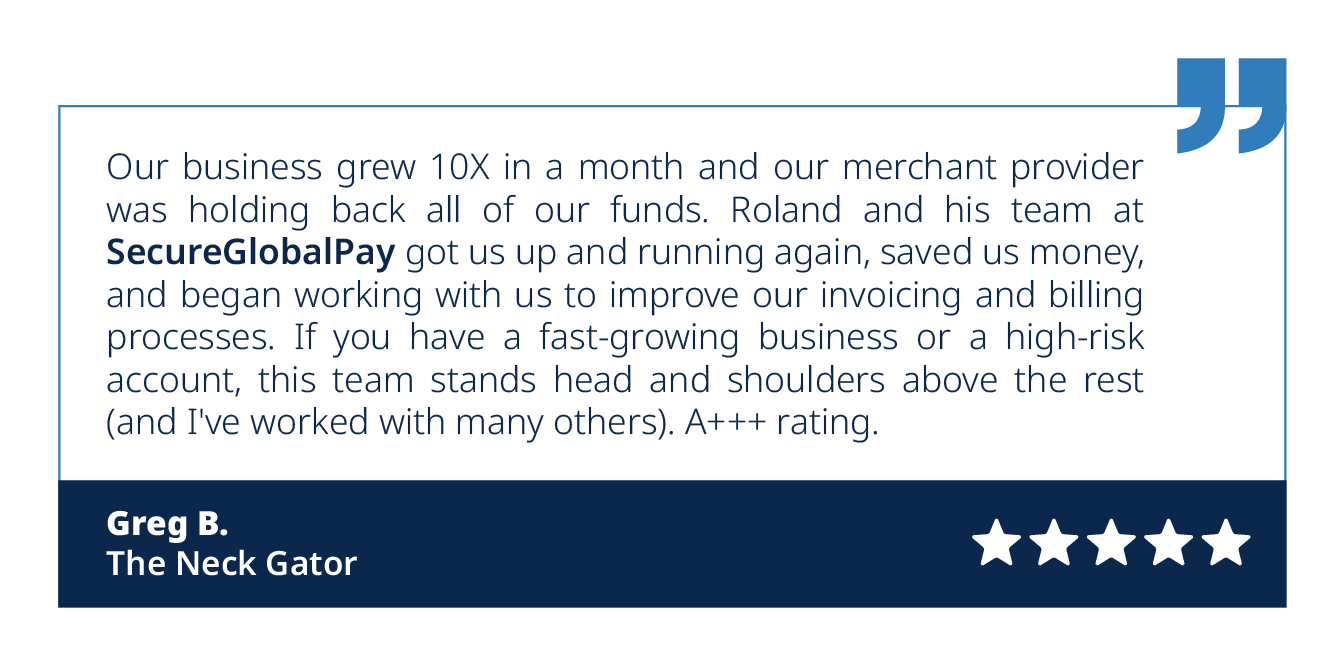
SecureGlobalPay is an all-in-one high-risk merchant services provider. We regularly work with former PayPal merchants that are looking for a more stable processing solution. Through our extensive acquiring relationships, we get them processing again quickly, regardless of their industry.
Here’s why merchants choose and stay with SecureGlobalPay:
- Support for domestic or offshore merchant accounts to fit your business.
- Experience with many high-risk industries, including onboarding merchants who were previously closed.
- A powerful payment gateway with multi-MID capabilities and hundreds of integrations.
- Advanced fraud, chargeback, and security controls to protect your revenue.
- Dedicated, experienced US support available by phone or email.
Don’t let payment aggregators like PayPal and Stripe keep you from growing your business. Fill out our simple online application and get a stable and scalable processing solution.
Written by Roland G. Szasz - Director of Business Development - 25+ years in payment processing.
Roland has spent nearly three decades helping businesses navigate the complexities of payment processing. He now works closely with high-risk merchants that have been declined or restricted by conventional providers - and shares his experience and best practices on this blog.
FAQs
Usually not. If PayPal permanently closed or limited your account, fixing the original issue normally won’t restore it. You can contact PayPal through the Resolution Center or support and ask for a review, but don’t count on it. It’s safer to set up another way to accept payments in the meantime.
Not to get around the closure. PayPal’s user agreement treats opening a new account to circumvent a restriction, suspension, or limitation as a restricted activity. PayPal can close the new account and refuse to provide its services to you in the future.
Common reasons include selling restricted items, high chargeback or dispute rates, suspected fraud, identity verification problems, an unpaid negative balance, and links to another restricted account. PayPal doesn’t always explain the exact reason, since its risk decisions can rest on confidential criteria. Check the closure notice and your Resolution Center messages for details.
PayPal should make any unrestricted funds available for withdrawal. If it considers some of your balance at risk, it can hold that money for up to 180 days, and longer if a court order or other legal process requires it. Chargebacks or reversals that come in after the closure will be deducted from the held funds.

Posted in - Merchant Accounts, Payment Aggregators
Tailored payment solutions for high-risk merchants
- Domestic and offshore accounts
- Competitive, interchange plus pricing
- No long-term contracts or hidden fees
- Built in fraud protection
- Dedicated account manager; 24/7
Sign up in 5 minutes

A+ Rating
as of 06/17/26