| February 13, 2026
A rolling reserve can show up under various names like merchant account reserve, merchant holdback, or fund hold. All of these terms point to the same basic idea: a portion of your card sales is temporarily withheld by your payment processor rather than paid out immediately.
Rolling reserves are far more common for high-risk merchants. Banks and processors use them to offset the increased risk of working with such businesses.
Today, we will explain how different types of merchant account reserves work. This will help you understand what’s happening to your money — and how to regain control of your cash flow.
QUICK TAKEAWAYS
A rolling reserve is a risk management tool used by payment processors and acquiring banks.
Instead of paying out 100% of your daily card sales, the processor withholds a small percentage — often between 5% and 10% — and holds it for a set period of time (commonly 90 to 180 days). After that holding period passes, the funds are released back to the merchant on a rolling basis.
The purpose is to protect the processor and bank from losses caused by chargebacks, refunds, fraud, or sudden business closure. Because disputes can occur weeks or months after a sale is processed, the reserve acts as a safety net.
For high-risk merchants, rolling reserves come with trade-offs.
Not all merchant account reserves work the same way. Processors use different reserve structures depending on your risk profile, processing history, and business model. The most common ones include rolling, fixed, capped, and up-front reserves.
You’ll often see processors use some of these terms interchangeably. That can be confusing, but here’s the key point: the name matters less than the release mechanics. What really affects your cash flow — and what you should pay attention to — is :
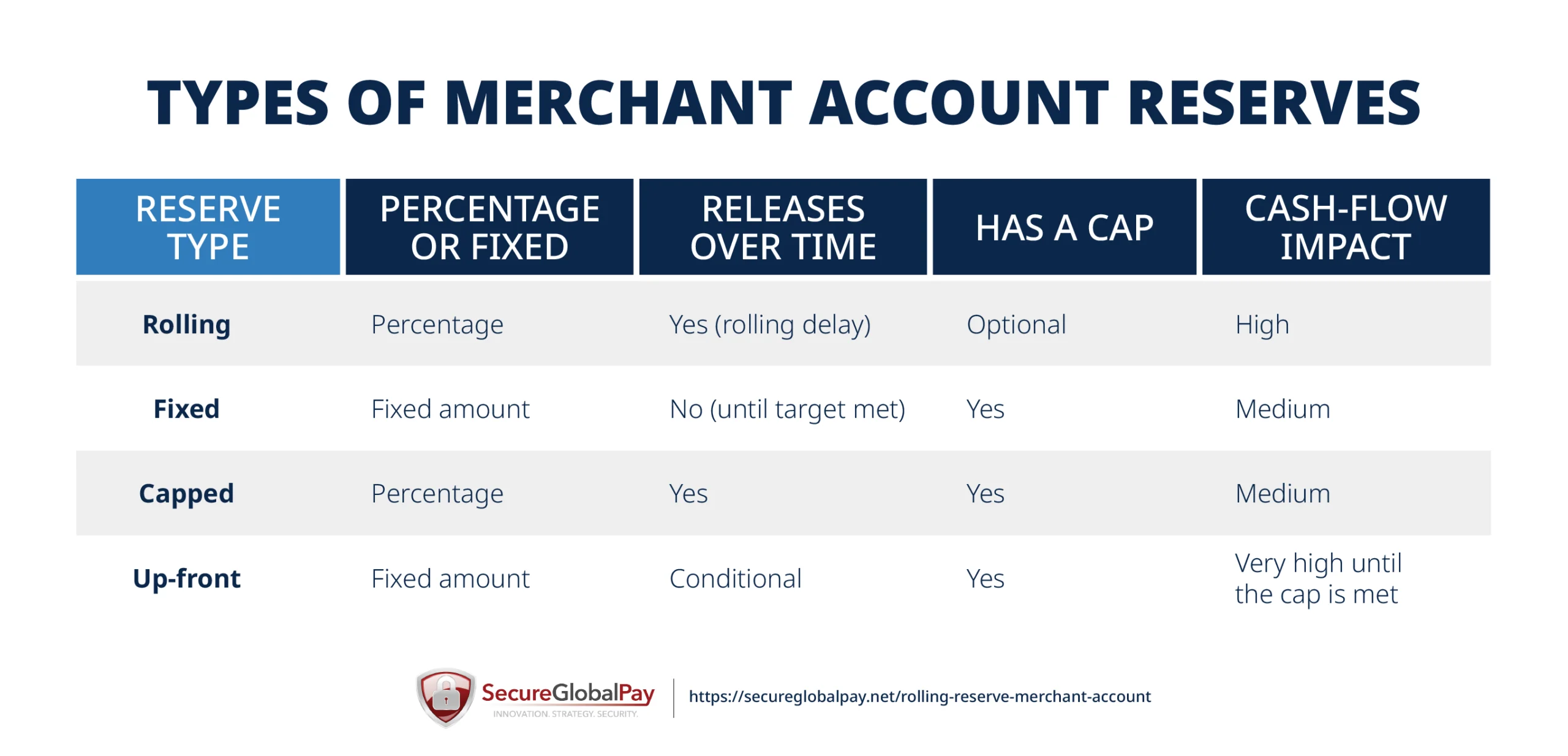
It’s also important to know that reserves can be combined. For example: a 10% rolling reserve capped at $25,000 plus a $5,000 up-front reserve. This is rare but can occur for extremely high-risk approvals.
A rolling reserve withholds a percentage of each day’s card sales and holds those funds for a fixed period of time — most often 90, 120, or 180 days. Each day, a new portion is withheld, and each day, the oldest portion (from the end of the holding period) is released. That’s why it’s called “rolling.”
Key traits of rolling reserves:
Example: A subscription-based nutraceutical company processes $100,000 per month with a 10% rolling reserve held for 180 days. Each month, $10,000 is set aside. In month seven, the $10,000 withheld in month one is released, while a new $10,000 is withheld. The reserve never stops — it just cycles.
Merchants often assume chargebacks are paid directly from the reserve. That’s not how it works. Chargebacks are typically debited from the merchant’s active account or settlement balance. The reserve exists primarily as a backstop and is generally only accessed if the merchant account is closed, terminated, or unable to cover its liabilities.
A fixed reserve requires the merchant to maintain a set dollar amount in reserve at all times. A portion of the funds is withheld until the agreed-upon reserve balance is fully funded. Once that amount is reached, no additional funds are withheld from daily processing — as long as the reserve balance remains intact.
Key traits of fixed reserves:
Example: A high-volume, high-risk online electronics retailer is required to maintain a $50,000 fixed reserve. During the first few months of processing, the processor withholds a larger portion of daily settlements until the full $50,000 is collected. After that point, the merchant receives normal payouts. If a spike in chargebacks later reduces the reserve to $42,000, the processor begins withholding again until the balance is restored to $50,000.
A capped reserve is essentially a rolling reserve with a maximum limit. The processor withholds a percentage of each transaction — just like a rolling reserve — but only until the reserve reaches a predetermined dollar amount. Once that cap is met, no additional funds are withheld, even though the reserve may still be subject to a holding period.
Key traits of capped reserves:
Example: A high-ticket coaching business processes $250,000 per month and is placed on a 5% rolling reserve capped at $25,000 with a 180-day hold. For the first six months, 5% of each month’s volume is withheld until the reserve balance reaches $25,000. At that point, withholdings stop. After the 180-day holding period passes, funds begin to release unless a new risk prompts the processor to reapply the reserve.
An up-front reserve is collected at the start of the merchant relationship rather than over time. The processor requires a set dollar amount to be funded immediately, often through an initial lump-sum deposit.
Unlike rolling or capped reserves, an up-front reserve does not reduce every future payout once it’s fully funded. The funds simply sit in reserve and are released after the agreed holding period, assuming the account remains in good standing.
Key traits of up-front reserves:
Example: A new international SaaS company with limited processing history is required to post a $25,000 up-front reserve held for 180 days. The company pays 15,000 upfront, and the processor withholds an additional $10,000 in settlements during the initial weeks of processing. After that, the merchant receives full payouts going forward. At the six-month mark, the reserve is released, provided chargebacks and refunds stay within acceptable limits.
Some payment platforms employ proprietary fund-holding mechanisms tailored to their operating models. Examples include reserve holds imposed by PayPal, rolling reserve programs used by Amazon, and platform-managed reserves implemented by Stripe. These may include automated triggers, standardized hold periods, or restrictions on fund access that differ from negotiated merchant account reserves. In this way, they represent a tailored — but often more rigid — approach to transaction risk management.
Rolling reserves aren’t random or punitive — they’re typically applied when a processor sees higher financial or chargeback risk. If your business falls into one or more of the categories below, a reserve is more likely to be required as a condition of approval:
SecureGlobalPay is an experienced high-risk merchant services provider that works with hard-to-place businesses. Our focus is on structuring reserves in a way that protects the bank without unnecessarily choking cash flow for merchants.
Here’s how SecureGlobalPay helps high-risk merchants manage reserves:
Sign up with SecureGlobalPay — and let us help you get approved, stay approved, and improve your processing terms!
Sign up in 5 minutes